Showing: 1 - 32 of 32 RESULTS

Kooie Kaka (Spiced Pumpkin Pancakes)

Fluffy and warmly spiced pancakes – a delightful breakfast option during the winter and a great way to use pumpkins up post Halloween.

What is Kooie Kaka?

These delicious pancakes are inspired by those commonly eaten in and originating from Gilan in the North of Iran.

In the Gilaki language these pancakes are called Kooie Kaka which means Pumpkin (Kooie) Pancake (Kaka). Despite our love for poetry and romanticising everything that is Persian, we Iranians cut straight to the chase with our food descriptions!

How to Make Kooie Kaka?

These pancakes are a also great way to make sure there is no waste from the pumpkins you carve for Halloween.

All you need to do is roast a chopped pumpkin with or without the skin (if you are using the remains of your carved pumpkin) in a medium-hot oven (180°C fan oven) for about 30 minutes or until soft. When cooked and cooled down, take the cooked pumpkin flesh and place into a bowl mash into a purée. The pumpkin purée can be used for the Kooie Kaka pancakes as per the recipe below and any leftovers can be frozen to be used at a later date. Alternatively, I am sure most of you will have a favourite soup or risotto recipe to use the remaining pumpkin for. A small / medium sized pumpkin usually yields about 400 grams of purée.

The pancake batter is a standard American fluffy pancake batter with the addition of the pumpkin and spices (cinnamon, cardamom and nutmeg). Traditionally the amount of pumpkin used in Kooie Kaka is more than I use in my recipe below – mine is kid friendly and mostly about ensuring there is no waste from the Halloween pumpkin decoration season. Also the pancake is firmer and keeps better if there are any leftovers. If you do want the pancakes to be more about the pumpkin, then reduce the flour measurement to 200 grams in the recipe below.

Please also feel free to substitute and experiment with your favourite pancake batter, particularly if you prefer gluten free or are vegan.

How to Serve the Pancakes

Serve with either maple syrup, honey or cherry syrup drizzled over and sprinkle with pomegranate arils, crushed pistachios and a dusting of icing sugar as pictured.

Other Breakfast Recipes


Kooie Kaka

Spiced Pumpkin Pancakes
Prep Time10 minutes
Cook Time20 minutes
Total Time30 minutes
Course: Breakfast, Brunch
Cuisine: Persian, Iranian
Keyword: vegetarian, fluffy pancakes
Servings: 4 (to 6 people)
Author: Mersedeh Prewer

Ingredients

  • 250 g pumpkin purée (roast pumpkin and mash flesh - see notes above)
  • 1 tsp cinnamon
  • 1/4 nutmeg (grated)
  • 1 cardamom pod (seeds removed and crushed)
  • 1 pinch sea salt
  • 300 g self-raising flour
  • 300 ml milk
  • 1 tsp baking powder
  • 2 tbsp caster sugar
  • 2 medium free range eggs
  • Vegetable Oil and butter (for cooking the pancakes)
  • Crushed pistachios, icing sugar, maple syrup / honey / cherry syrup (to serve)

Instructions

  • Place the flour, baking powder, spices, sugar and salt into a large bowl. Crack in the eggs and whisk until smooth. Add the milk while whisking.
  • Then add the pumpkin purée and whisk further.
  • Heat a splash of oil and a small knob of butter in a non-stick frying pan until sizzling. Add spoonfuls of batter to make pancakes the size you prefer (I make mini ones - approx 5 cm diameter). Cook until bubbles start to form on the surface, then flip and cook the other side. Eat straight away or keep warm in a low oven while you cook further batches.
  • Serve pancakes with pomegranate arils, drizzled with honey or syrup of your choice and garnish with a dusting of icing sugar and crushed pistachios.

Advieh Kabab (Grilled Beef Kebabs with Persian Spices)

With echoes of the Levantine shawarma, this recipe for beef kebabs made with Persian spices (nutmeg, rose petals, cardamom, cumin, black pepper, coriander, cinnamon) is a great addition to a summer BBQ.

Inspiration for this Recipe

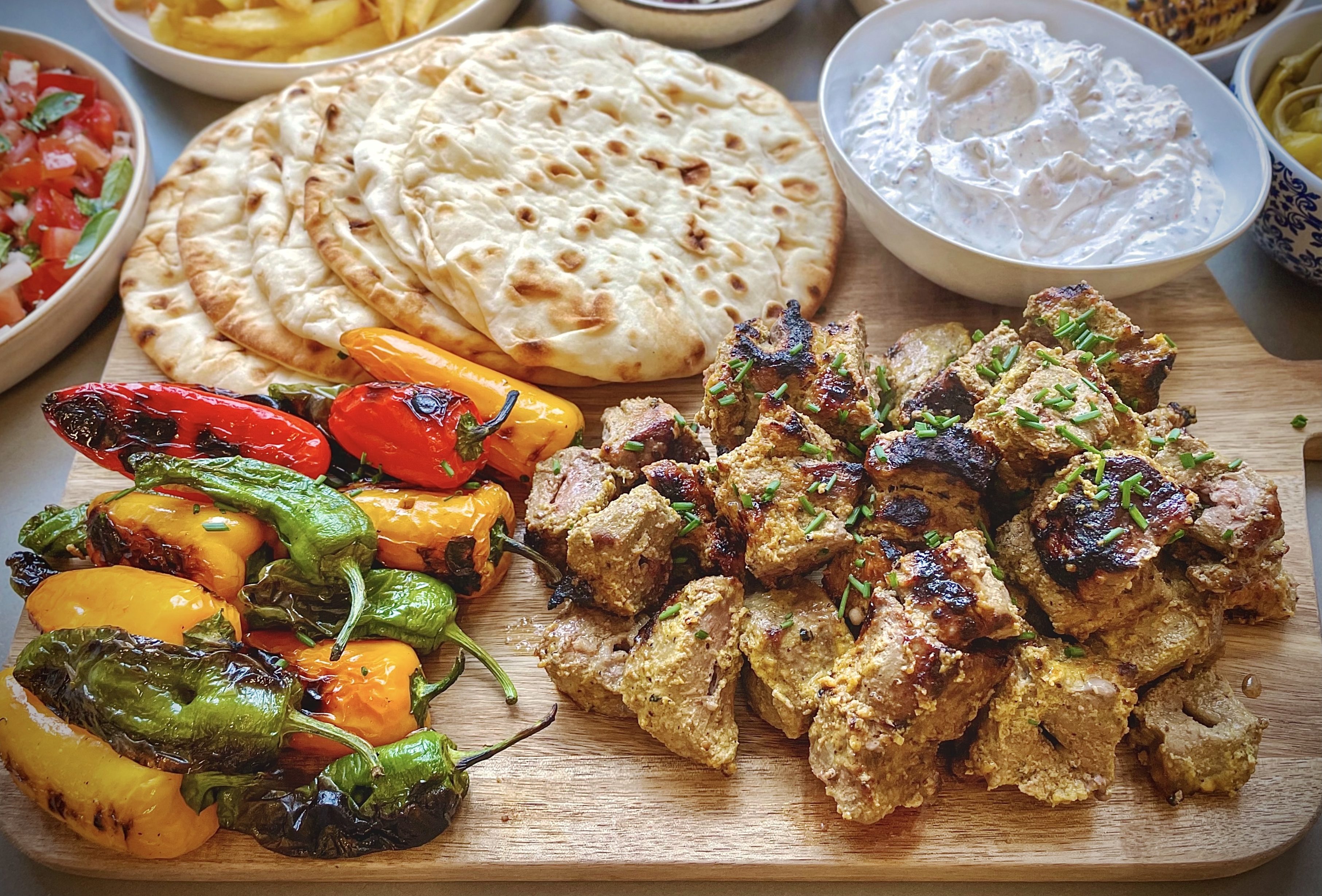
This is a recipe inspired by Persian flavours and one I developed by throwing various things together as a marinade for some cubed rump steak. With echoes of the Levantine shawarma, by using the Persian mixed spice advieh (a mix of nutmeg, rose petals, cardamom, cumin, black pepper, coriander, cinnamon), this kabab will not disappoint. You can use lamb or chicken as an alternative and you can cook it under your grill as opposed to on a BBQ.

How to Make this Recipe

The marinade combines yoghurt, garlic, olive oil, onion, lime juice, advieh, saffron, turmeric, sumac and chilli sauce. The meat is marinated for a minimum of 12 hrs to let the flavours fully intensify and be absorbed into the meat. You can get your hands on saffron from most supermarkets and advieh can be bought from most Middle-Eastern food shops – I buy mine online from Freshly Spiced on  Etsy.

How to Serve Advieh Kabab

Build yourself the perfect kebab wrap fakeaway by filling flatbreads with the meat, salad, fresh herbs, chopped onion with parsley, pickled chillies and a dollop of Greek yoghurt. Serve alongside with homemade fried chips and bbq corn-on-the-cob with a butter, chilli and chive drizzle.


Advieh Kabab

Grilled Beef Kebabs with Persian Spices
Prep Time15 minutes
Cook Time20 minutes
(Marinating Time)12 hours
Total Time12 hours 35 minutes
Course: Main Course
Cuisine: Persian, Iranian, Middle-Eastern
Keyword: kebabs, advieh, bbq
Servings: 4
Author: Mersedeh Prewer

Ingredients

  • 1 - 1.2 kg cubed lamb or beef (I've used beef rump steak)

Marinade

  • 1 large brown onion
  • 3 cloves garlic
  • 2 tbsp olive oil
  • Juice of 1 lime
  • 1 tbsp Greek yoghurt
  • 1/8 tsp ground saffron (bloomed in 50 ml of water)
  • 2 tbsp advieh
  • 1/2 tsp turmeric
  • 1 tbsp chilli sauce ( I use habanero)
  • Salt and Pepper (to taste)

To baste while cooking

  • 2 tbsp butter (melted)

Instructions

  • Place the beef (or any other cubed meat you fancy) into a large bowl or tupperware box.
  • Place all the ingredients for the marinade in a blender and blitz until all the onion and garlic is blended. Pour over the meat and rub in until evenly coated. Cover and place in the fridge to marinate for a minimum of 12 hrs.
  • Remove the meat from the fridge about 30 mins before cooking to bring to room temperature.
  • Divide the meat on to about 4 skewers and cook on your BBQ or under your grill (on the highest setting). Baste with the melted butter, turning the skewers until the meat is a little charred. It takes roughly 15 to 25 minutes on a bbq (depending on how hot your bbq is).
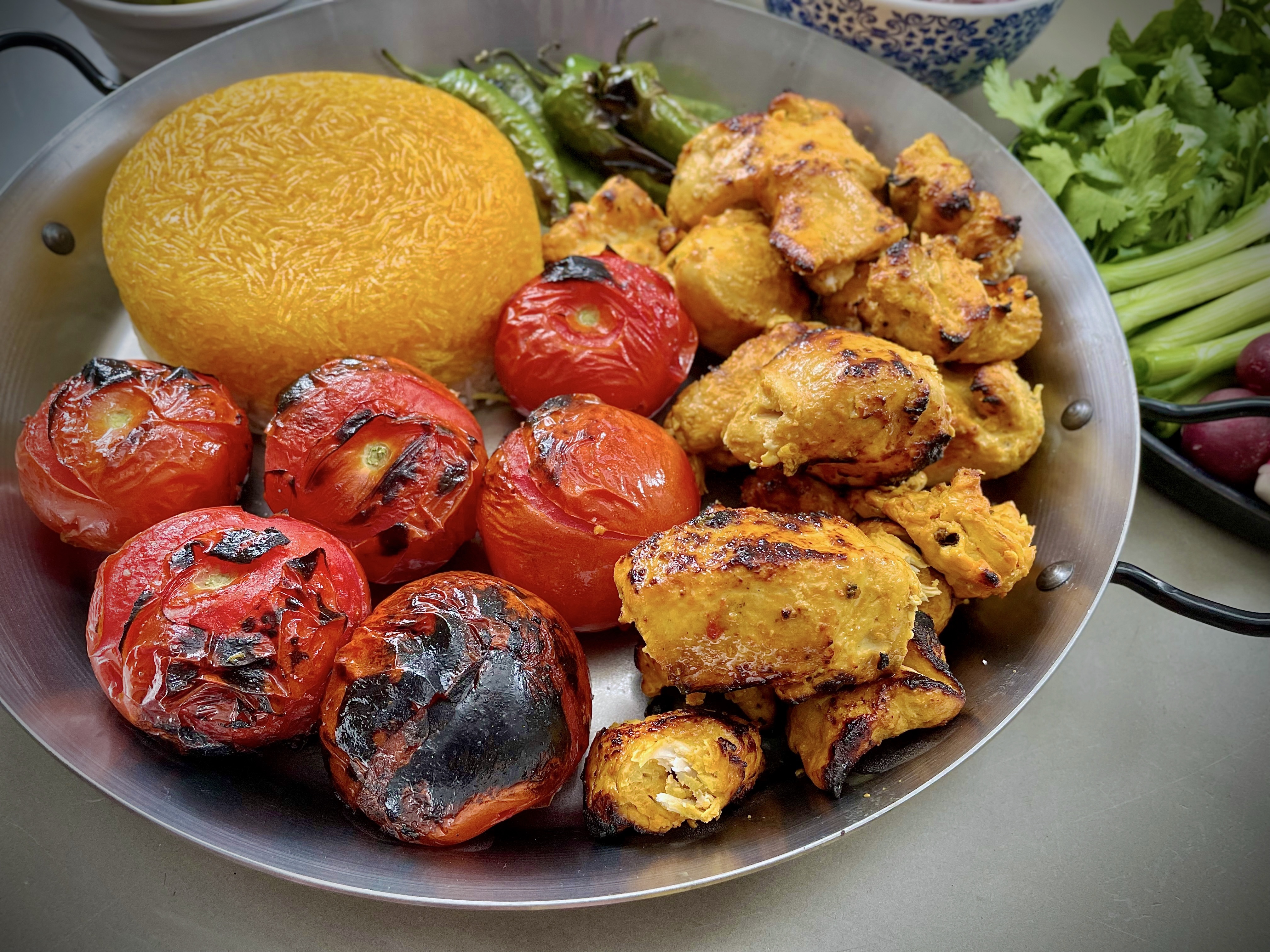
  • For serving inspiration either serve alongside rice and grilled tomatoes or with flatbreads; lettuce; chopped tomatoes with Thai basil; chopped onion and parsley; pickled chillies; bbq/grilled peppers; Greek yoghurt mixed with dried mint, Aleppo pepper, garlic and a little sea salt; chips; and bbq corn with a butter, chilli and chive drizzle.

Summer Kuku served with a Pea, Mint and Feta Dip

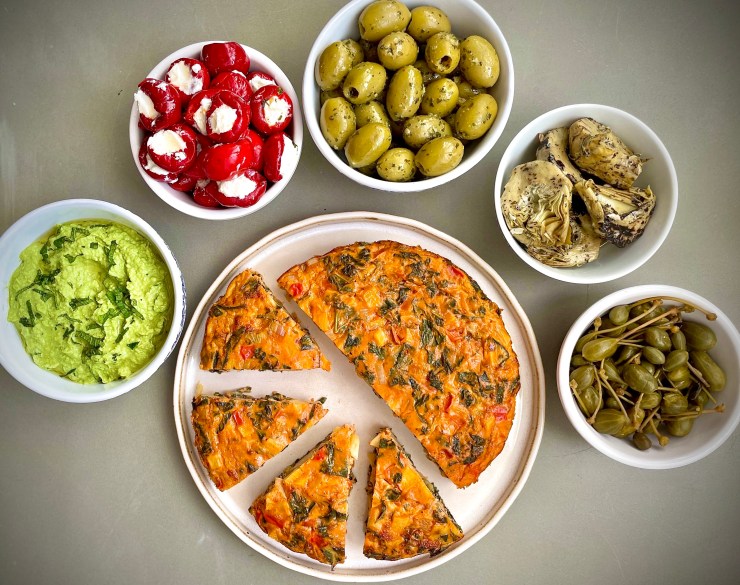
A Persian-style summer frittata made with cooked kale, red onions, potatoes and red pepper folded into eggs with aromatics and spices, then baked, sliced and served with a fresh pea, mint and feta dip.

This recipe is pure summer on a plate! A light and easy meal – I often cook it the night before we want to eat it and store it in the fridge. It can be eaten warm or cold and it is a great way to get a hit of goodness into you.

What is Kuku?

Kuku (also spelled ‘kookoo’) is an egg-based, vegetarian dish from Iran made with beaten eggs, folding in various ingredients. It is similar to the Italian frittata, the French quiche or an open-faced omelette, but it typically has more vegetables than its Western counterparts. It is served either hot or cold as a starter, side dish or a main course, and is accompanied with bread and either yogurt, salad and / or rice.

The two most well known kuku recipes are Kuku Sabzi (made with herbs and barberries and / or walnuts); and Kuku Sibzamini (made with potatoes). Ultimately, you can make kuku with any vegetables you like.

Variation on a Theme

This kuku recipe materialised after an Oddbox delivery. Oddbox is a wonderful company that rescues surplus or imperfect vegetables and fruit, which would otherwise not make it to the shopper, and offers it by way of a home delivery subscription services. It’s a fantastic initiative that helps me to eat more vegetables and fruit, while helping to save our planet. It is also been great for challenging my recipe ideas as sometimes I can fall into the routine of buying the same ingredients and cooking the same recipes.

One of my Oddbox deliveries had some kale and red peppers, which lead me down the path of experimenting with the medium of kuku. Kale has become very popular in the UK due to the health benefits. Our supermarkets are always well-stocked with kale and red peppers, potatoes and red onions – the vegetables used to cook this dish. I use garlic, smoked paprika and chillies for the aromatic notes, which results in a smoky and gently warming feel to eating this even when eaten cold.

Traditionally kuku is fried and flipped over to brown on the other side, but I prefer to oven bake mine so the recipe below is geared towards baking but feel free to fry it if you prefer, either omelette-style or like fritters.

Serving this Dish

The beauty of kuku is that you can make a batch one evening and have it as a quick lunch on your working days. It is also a well-loved addition to a mezze-style meal or served with bowls filled with lots of antipasti.

I have paired this kuku recipe with a pea, mint and feta dip, making the overall experience fresh, light and summery.

Other Kuku Recipes:


Summer Kuku served with a Pea and Mint Dip

Prep Time20 minutes
Cook Time1 hour
Total Time1 hour 20 minutes
Course: Main Course, lunch
Cuisine: Persian, Iranian, Fusion
Keyword: light lunch, mezze, frittata, kookoo
Servings: 2 (to 4 people)
Author: Mersedeh Prewer

Ingredients

Kuku

  • 2 tbsp olive oil (and a little to grease your tin)
  • 200 g potatoes (diced into 1 cm cubes)
  • 1 medium / large red onion (finely diced)
  • 1 red pepper (medium diced)
  • 75 g kale (removed from stalks, washed and roughly chopped)
  • 2 cloves garlic (crushed)
  • 1 tbsp tomatoe purée (dissolved in 100ml of water)
  • 1 tsp smoked paprika
  • 1 small red chilli (minced)
  • 6 large free range eggs (cracked and beaten in a bowl)
  • Salt and pepper (to taste)

Pea and mint dip

  • 2 cups peas (frozen is fine - blanch them in boiling water before blending into the dip)
  • 1 clove garlic
  • 40 g feta
  • 2 tbsp olive oil (plus extra to drizzle on top)
  • 10 leaves fresh mint (plus extra to chop and garnish the dip with)
  • Salt and Pepper (to taste)

Instructions

  • Pre-heat the oven to 160°C (fan) / 180°C (conventional) / Gas Mark 4.
  • Take a cake tin (20 cm diameter) (preferably one without a loose base as the egg is likely to seep out unless you properly cover the gaps with baking paper). Grease and line the tin with baking paper. Place the tin in the oven to heat up.
  • Take a frying pan, place on a medium / high heat and add 2 tbsp of oil.
  • Add the potatoes and cook until the potatoes start to turn golden and little crispy.
  • Add the peppers and onions and cook until they soften.
  • Add the garlic, smoked paprika, chilli and stir until evenly distributed.
  • Add the tomato purée and water to the mixture.
  • Then add the kale and cook until wilted and the mixture has little or no liquid. then turn off the heat and let cool for 10 mins.
  • Take the beaten egg mixture and add the vegetable mixture and stir. Season with salt and pepper.
  • Remove the tin from the oven and pour the mixture in. Then place in the oven to cook for about 30 to 40 mins (or until a knife poked into the middle of the kuku comes out clean)
  • To make the dip, blend all the dip ingredients in a food processor and pour into a serving bowl. Feel free to adjust seasoning and lemon juice to taste. Scatter a little finely chopped mint on top and drizzle with a little olive oil.
  • Serve the kuku warm or cold with the dip, flatbreads and other antipasti type dishes or as part of a mezze-style meal.

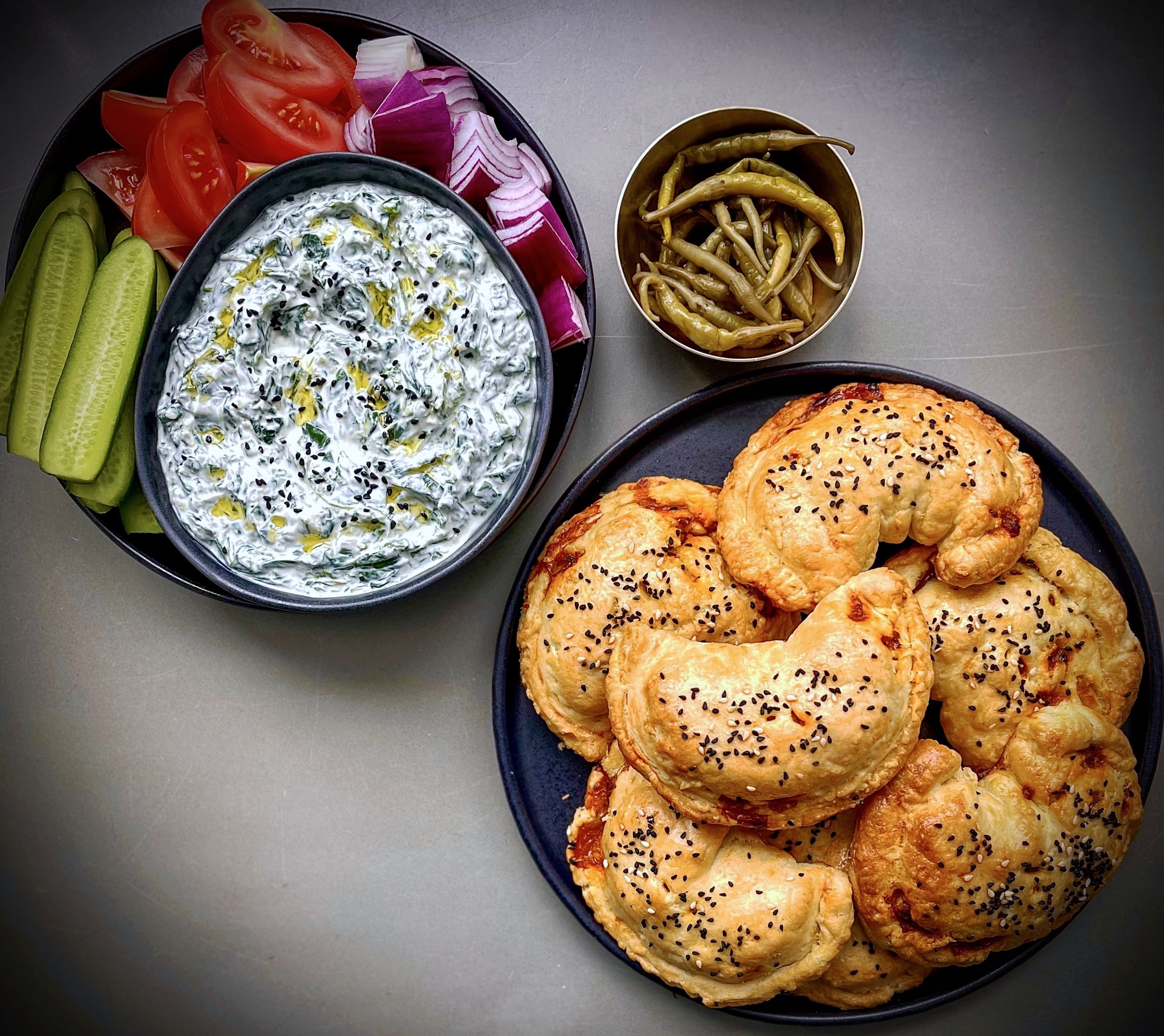
Spicy Halloumi Pasties with Borani Esfenaj

Spicy halloumi and vegetable handmade shortcrust pastry pies served alongside a cooling and creamy Persian spinach and yoghurt dip. 

A Middle Eastern Pie

A pasty is a British baked pastry associated with Cornwall, South West England, but has spread all over the British Isles. It is typically made by placing an uncooked filling, usually meat and vegetables, in the middle of a flat shortcrust pastry circle, bringing the edges together in the middle, and crimping over the top to form a seal before baking. The humble pasty has been made with so many different fillings including chicken tikka or steak and blue cheese. The variations are endless and always welcomed!

The recipe below calls for pre-made and rolled shortcrust pastry making it very easy to make. You can buy this type of pastry from most leadking UK supermarkets. The pastry is filled with a cooked mixture of halloumi, potatoes, onions, pepper and fresh herbs cooked in a spicy tomato based and red pepper sauce. The pies are then baked to golden perfection.

The feel of this meal is very much Mediterranean-inspired and we happily eat this in the warmer seasons for either lunch or dinner. The pasties fare well eaten cold and we often eat the leftovers for our packed lunches on ensuing work days.

For the purposes of my recipe offering to you, I have paired the borani with some spicy halloumi pasties.

What is Borani Esfenaj?

Borani Esfenaj is a delicious Persian dip made simply with yoghurt and spinach and flavoured with garlic, a little lemon or lime juice and some salt and pepper.

I have fond memories of this dip as my khaleh (maternal aunt) would make it regularly when I was a child. This dish and Nargessi (a Persian breakfast / brunch dish made with garlicky spinach and eggs) are the reasons I love spinach so much. Spinach cooked with lots of garlic is a perfect combination and, with the addition of thick creamy yoghurt, makes this dip a lovely addition to a table full of appetisers for your guests to dip in and out of or a mezze-style offering.

Borani Esfenaj can either be made with frozen or fresh spinach. If you are making it with frozen spinach use 500g for the recipe below. Using frozen spinach creates a creamier dip and is perfect if you are serving it alongside crisps or other crudites for people to dip in and out of.  If you are serving it as part of a meal, as in this recipe, then the chunkier dip with fresh spinach works well both in texture and aesthetics.

I like to make the borani the day before so the flavours can intensify.

Serving Suggestions

In addition to serveing alongside the Borani, I love serving these two dishes with pickles, olives or salad-type ingredients to pick at too. If you want some extra carbs with this dish, then roasted sweet potato wedges work really well and can be dipped into the borani as well.

Storage

Both the pies and the Borani will keep in an air tight container in the refrigerator up to 5 days. 

The pies can be frozen and kept up to 3 months. Make sure the pies have fully cooled before freezing or palcing in the fridge. Make sure th epies a re fully defrosted before baking them if frozen.

Re-heat the pasties in a medium oven circa 160°C in a fan oven.


Spicy Halloumi Pasties

Prep Time15 minutes
Cook Time1 hour 15 minutes
Cooling time for pasty filling1 hour
Total Time2 hours 30 minutes
Course: Main Course
Cuisine: Mediterranean, Cross-cultural
Keyword: vegetarian, pasties, halloumi
Servings: 8 medium sized pasties
Author: Mersedeh Prewer

Ingredients

Spicy Halloumi Pasties

  • 2 tbsp olive oil
  • 2 medium potatoes (about 250 g - peeled and medium diced)
  • 2 large cloves garlic (crushed or minced)
  • 1 medium red onion (finely diced)
  • 1 green pepper (medium diced)
  • 1 tsp turmeric
  • 1 tsp dried orgeano
  • 2 tbsp biber salçası (Turkish tomato and red pepper paste)
  • 200 ml water
  • 1 tbsp balsamic vinegar
  • 40 g fresh coriander (chopped finely including stalks)
  • 250 g halloumi (chopped into 1 cm chunks)
  • Salt and Pepper (to taste)
  • 2 packs pre-rolled shortcrust pastry (2 x 320g sheets)
  • 1 egg (beaten)
  • A mix of nigella and sesame seeds to sprinkle on top of the pasties

Instructions

  • Take a large frying pan, add the olive oil and place on a medium heat. Add the chopped potatoes and cook until they start to crisp, stirring occasionally.
  • Add the garlic and stir until the aroma is released. Then add the onions and green pepper and cook until softened. Stir in the turmeric and oregano.
  • Then add the biber salçası, water and balsamic vinegar and stir. Then add the chopped coriander and stir until the water has been absorbed into the mixture. Turn off the heat and leave to cool. Once cooled, add the chopped halloumi and season to taste with salt and pepper.
  • While your pasty mixture is cooling, take your pre-rolled pastry out of the fridge and leave (as per packet instructions) at room temperature for approximately 45 mins.
  • Preheat the oven to 200°C (180°C in a fan oven)/ Gas mark 6. Unroll your pastry and using a small side plate or pastry cutter 5 inches in diameter cut 8 discs. You may need to take remaining pastry and roll to make further discs.
  • Place 1/8th of the filling on one side of one of the circles. Brush the edge of half the circle with beaten egg, then fold over the other half to make a D shape. Crimp the edge using a fork or the back of a knife. Then gently push the tips towards each other to create more of a crescent shape. Make a hole in the top to allow some air to escape and place on a lined baking tray. Repeat with the other 7 circles. Brush with the beaten egg, sprinkle with nigella and sesame seeds and bake on a baking tray for 30 to 40 minutes or until they are golden.
  • Leave to stand for 10 minutes before eating. Serve with the Borani Esfenaj and other mezze-style dishes.

Borani Esfenaj

Persian spinach and yoghurt dip
Prep Time10 minutes
Cook Time10 minutes
Total Time20 minutes
Course: Appetiser
Cuisine: Persian, Iranian
Keyword: dip
Servings: 4 (to 8)
Author: Mersedeh Prewer

Ingredients

  • 1 tbsp olive oil
  • 4 large cloves garlic (crushed or minced)
  • 400 g baby spinach (roughly chopped)
  • 500 g Greek Yoghurt
  • Juice of half a lime
  • Salt and Pepper (to taste)
  • Drizzle of olive oil and nigella seeds for topping / garnish

Instructions

  • Take a large frying pan, add the olive oil and place on a medium heat. After a minute add the garlic and stir untill the aromas are released. Then add the spinach and stir until wilted and it is coated in the garlic infused olive oil. Remove from the heat and place the spinach in a colander over a bowl to drain excess liquid and to cool. Allow all the excess water to run out, pressing it with the back of a spoon or underside of a ladle will help force excess water out of the spinach through the colander.
  • Place the spinach in a serving bowl, add the Greek yoghurt and mix. Add the juice of half a lime and season with salt and pepper.
  • Drizzle a little olive oil on top of the borani and sprinkle some nigella seeds as a garnish. Serve with the spicy halloumi pasties or as an appetiser or as part of a mezze-style spread with flat-breads (or anything else you want to dip into it).

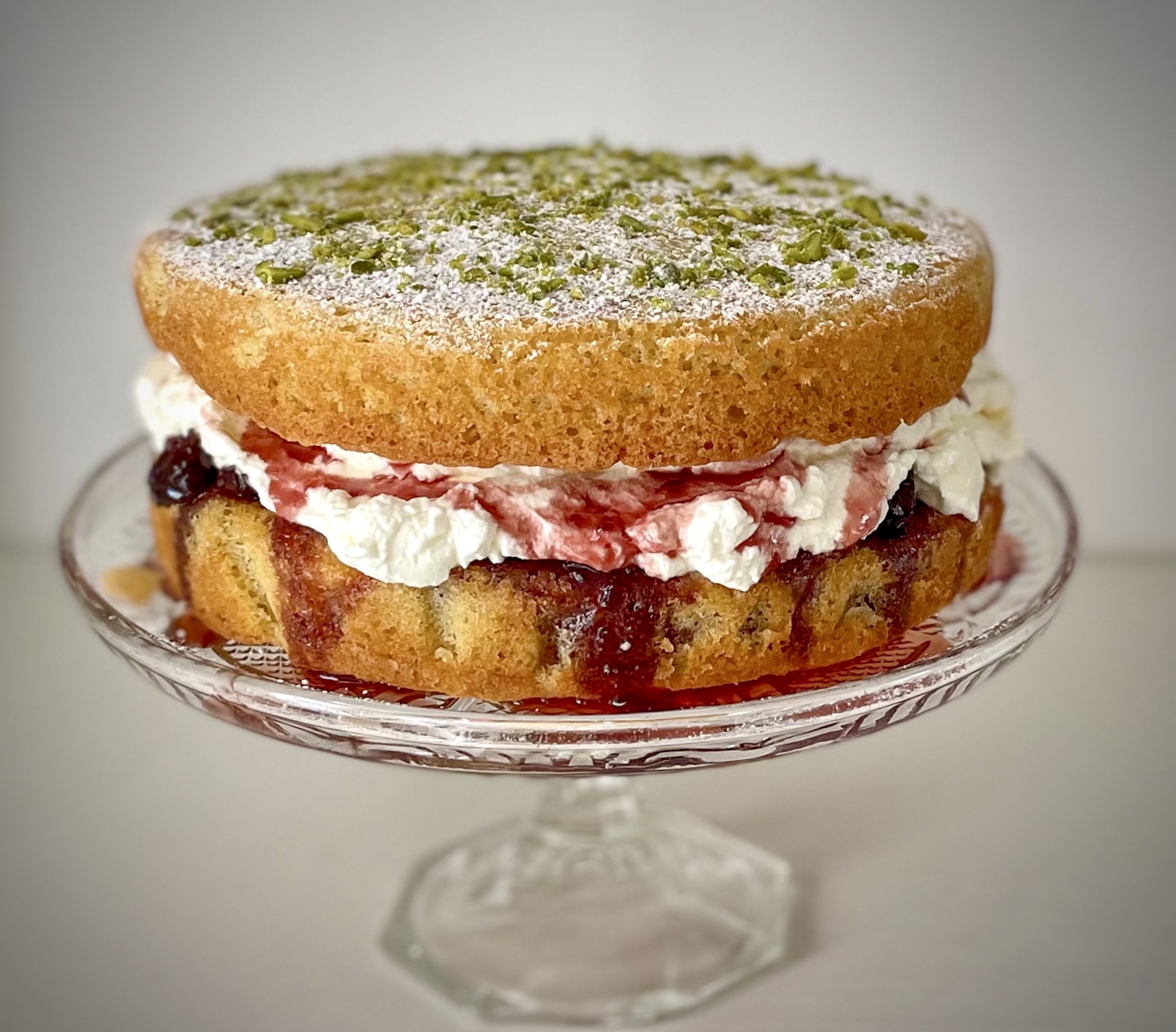
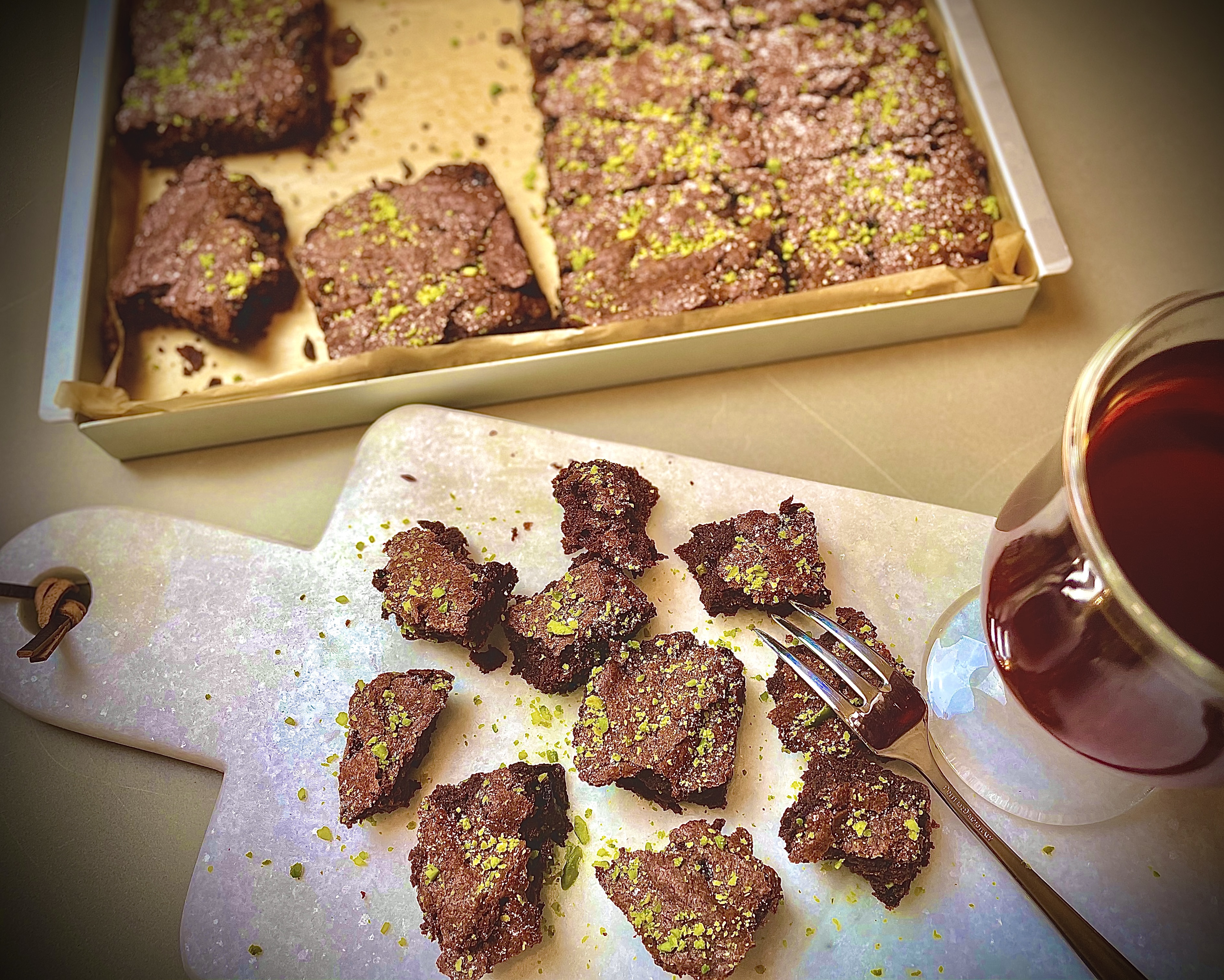
A Persian Homage to the Victoria Sandwich

A British classic bake adapted to add Persian flavours with a lime and vanilla sponge layered with rose flavoured whipped cream and sour cherry jam.

Recipe Inspiration

Once in a while I channel Mary Berry and produce a home-baked goody. One such moment resulted in this delight. I really fancied a Victoria Sandwich, mostly because it brings so much joy with very little baking effort. The only problem was I only had Persian sour cherry jam in my cupboard as opposed to strawberry or raspberry.

I briefly contemplated heading out to the nearest shop for jam but it was a Sunday, my pyjamas felt snug and frankly I couldn’t be bothered. I rummaged around my kitchen cupboards for flavour inspiration to match with the sour cherry jam. I landed on lime and vanilla for the sponge, rose water flavoured whipped cream and ground pistachios for the decoration. The experiment was a success and my Persian version of the British classic Victoria Sandwich is a firm favourite in my household.

Ingredients

The cake batter is the standard cake sponge recipe of:

  • 225 grams of  butter;
  • 225 grams of sugar;
  • 225 grams of self-raising flour: plus
  • 4 eggs.

A little baking powder is added to help the rise. Vanilla paste and lime zest flvour the sponge. The filling is made using sour cherry jam and whipping cream flavoured with rosewater.

It’s a great cake batter and one where even the novice baker will yield the perfect crumb. I also use this for my Persian Delight Cupcakes.

Specialist Ingredients

You can get your hands on sour cherry jam, rose water and pistachios from most Middle-Eastern food shops or online. The brand of sour cherry jam I use is ‘1&1‘ but ‘Anjoman‘ is also an excellent alternative. If all else fails just use a good quality cherry jam from your local supermarket which will also have rose water and pistachios.

How to Serve

Slice and serve with a nice cup of chai or coffee.  It makes a wonderful addition to an afternoon tea-style offering.

Other Sweet Delights


A Persian Homage to the Victoria Sandwich

A lime and vanilla sponge layered with rose flavoured whipped cream and sour cherry jam
Prep Time30 minutes
Cook Time25 minutes
Total Time55 minutes
Course: Dessert
Cuisine: Persian, British, Cross-cultural
Keyword: cake, victoria sandwich
Servings: 12
Author: Mersedeh Prewer

Ingredients

  • 225 g golden caster sugar
  • 225 g unsalted butter (plus a little extra to grease tins - at room temperature)
  • 4 free range eggs
  • 1 tsp vanilla paste
  • zest of 1 lime
  • 2 tsp baking powder
  • 225 g self-raising flour
  • 1 jar sour cherry jam (290g)
  • 300 ml whipping cream
  • 1 tbsp rose water
  • 1 to 2 tbsp icing sugar (to dust)
  • 2 tbsp ground pistachios

Instructions

  • Preheat the oven to 180°C conventional / 160°C Fan / Gas mark 4. Grease and line the bottom of two 20cm/8in sandwich tins with a circle of baking paper.
  • In a mixing bowl, beat the butter and sugar until light in colour and fluffy. Crack the eggs one by one and beat each one in before adding the next.
  • Add the vanilla extract and lime zest. Then sift the flour and baking powder into the bowl and gently fold into the mixture.
  • Divide the mixture evenly between the tins, using a spatula to remove all of the mixture from the bowl. Gently smooth the surface of the cakes. Place the tins on the middle shelf of the oven and bake for 25 minutes. Don’t open the door while they’re cooking.
  • While the cakes are cooking, add the whipping cream and rose water to a mixing bowl and whip until it forms stiff peaks.
  • The cakes are done when they’re golden brown and coming away from the edge of the tins. Remove them from the oven and set aside to cool in the tins for 5 minutes. You can use a thin skewer or the tip of a sharp knife to check the cakes by gently poking the centre to the bottom. It should come out clean of cake batter. Run a palette knife around the inside edge of the tin and carefully turn the cakes out onto a cooling rack. Set aside to cool completely.
  • To assemble, choose the sponge with the best top, then put the other cake top-down on to a serving plate. Spread with the sour cherry jam (I use the whole jar - reserve some of the jam liquid to drizzle on top of the whipped cream), then spread the whipped cream on top of the jam and drizzle the remaining jam liquid over the cream. Place the other sponge on top and dust with icing sugar and the ground pistachios.

Soupe Jo (Persian Cream of Barley & Chicken Soup)

The Persian version of the medicinal chicken soup. Our version is made with vegetables cooked with shredded chicken and pearl barley to create a creamy and comforting soup.

Soup for the Soul

Many Iranians are more familiar with our turnip soup for illnesses (Ash-e Shalgham) but for me it will always be our version of the classic concept of chicken soup that I turn to when in need.

Creamy, hearty and comforting – essential components for a medicinal chicken soup.

Ingredients

In Persian (Farsi) ‘Jo’ (pronounced ‘joh’) means barley – so we have simply named this soup ‘barley soup,’ despite the additional ingredients required to make this divine soup. This soup is easy to cook and as you can see below, the ingredients can be easily sourced from most local supermarkets.

  • Olive oil: Use extra virgin olive oil to cook the vegetables.
  • Onion or medium leek; garlic; celery sticks: The base vegetables which provide the aromatic flavours for this soup.
  • Carrot: Coarsely grated carrot is added to the soup giving flecks of orange in each spoonful and a lovely slightly sweet flavour profile to the soup.
  • Pearl barley: The easier and quicker type of barley to cook.  If using hulled barley you will need to soak it overnight and cook the soup for longer to ensure it is tender.
  • Bay leaves: A soup essential, imparting a nuanced peppery and tea like aroma and flavour.
  • Chicken stock: Use good quality chicken stock (low salt preferably), either shop bought or home-made, for the liquid base of the soup.
  • Chicken: Chicken breast is cooked by poaching in the soup, then removed, shredded and added back in.
  • Single cream: A little is added to enhance the creaminess of the soup. Not necessary if you prefer a dairy free version or are making a vegetarian version of the soup.  Alternatively use a plant based cream like soy cream.
  • Fresh coriander: Finely chopped fresh coriander is added to the soup to add a fresh taste to the soup.
  • Fresh lemon juice, salt & pepper: Used to season and flavour the soup.

Traditionally this soup is thickened with a roux, which I feel is unnecessary and makes the soup too thick and gloopy. With the availability of the handy stick-blender you don’t need to use a bechamel and can thicken the soup by blending a little bit of it. Also cream makes for a luxurious addition to the soup so my variations to the traditional recipe actually results in a velvety and lighter soup.

Variations

If you are not a fan of coriander, then replace with parsley, which is the herb more commonly used in this recipe.

You can convert this into a vegetarian recipe by using vegetable stock and using mushrooms as an alternative to the chicken. I recommend frying the mushrooms in a little butter and garlic and then adding them to the soup for the last 10 mins of simmering and before serving. 

Serving Soupe Jo

It is such a  hearty soup you don’t need to have bread with it but do feel free to have a buttered crusty roll or whatever you fancy to dip into the soup.

Other Soup Recipes


Soupe Jo

Persian cream of barley soup with shredded chicken
Prep Time20 minutes
Cook Time1 hour
Total Time1 hour 20 minutes
Course: Soup, Main Course, lunch
Cuisine: Persian, Iranian
Keyword: chicken soup
Servings: 6 (to 8 people)
Author: Mersedeh Prewer

Ingredients

  • 2 tbsp olive oil
  • 1 onion or medium leek (finely diced)
  • 3 cloves garlic (crushed or minced)
  • 2 celery sticks (finely diced)
  • 1 large carrot (or 2 medium carrots grated)
  • 200 g pearl barley (washed and then soaked in cold water for a minimum of 1 hr)
  • 2 Bay leaves
  • 1.8 litres chicken stock
  • 2 chicken breasts
  • Juice of 1 lemon
  • 3 tbsp single cream
  • Small bunch of fresh coriander (finely chopped)
  • Salt and pepper (to taste)

Instructions

  • Take a large stock pot or saucepan and place on medium / high heat. Add olive oil and follow with onion and cook until it turns golden.
  • Add garlic, celery and 1/2 grated carrot to the pan and stir. Cook for 5 mins, stirring occasionally to ensure it doesn't stick to the pan.
  • Drain pearl barley and add to pan with bay leaves and stock. Bring to the boil and then lower heat to allow the soup to simmer.
  • Add chicken breast to the soup and place a lid on the pan. Poach for approximately 15 mins, or until the juices run clear in the thickest part of the breast. Remove chicken breasts from the soup and set aside to cool. Once cooled, shred the chicken and put to one side.
  • Add juice of a lemon to the soup and leave to simmer for a further 30 mins or until pearl barley has cooked with the lid of the pan partially off. Check and stir the soup on occasion.
  • Remove bay leaves and take a stick-blender and blend a little of the soup on one side of the pan to thicken. Add cream, shredded chicken breast, remaining grated carrot, chopped fresh coriander and season to taste. Simmer for a few minutes to ensure the shredded chicken is warmed through.
  • Ladle into bowls and drizzle with a little more cream, chopped fresh coriander and olive oil to serve.

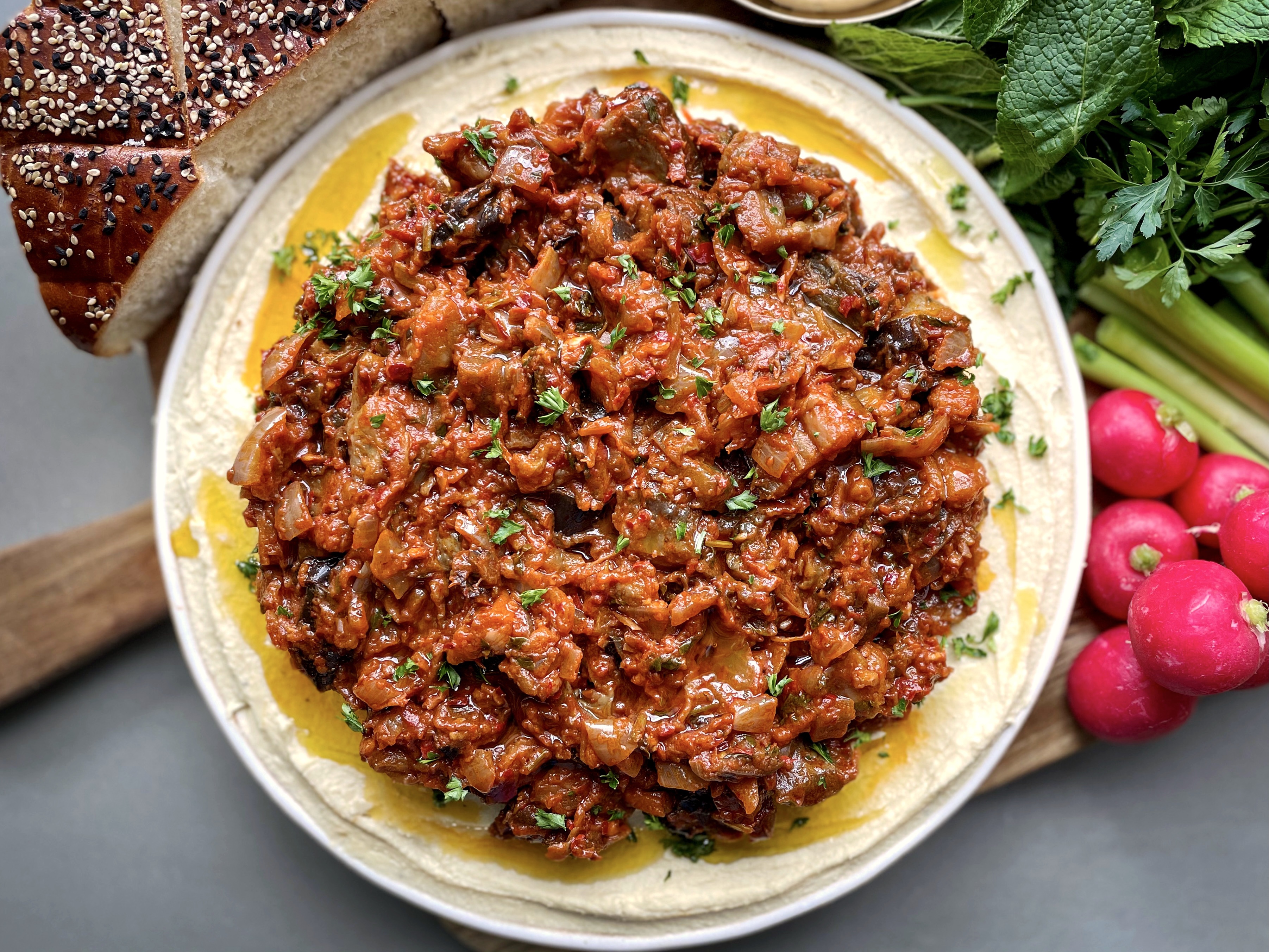
Rose Harissa Aubergines & Hummus

A divine dip of silky smooth hummus topped with aubergines cooked in a tomato and harissa sauce. A great addition to a mezze served alongside flatbread to scoop up this delicious and decadent dip.

The Humble Hummus

Most people are familiar with this incredible and versatile dip. For those who are new to velvety dip, hummus is a savoury Middle-Eastern dip made from cooked, chickpeas blended with olive oil, tahini (sesame paste), lemon juice, and garlic. It is difficult to pinpoint the exact origins of hummus as multiple different theories and claims of origins exist in various parts of the Middle-East but apparently the earliest known written recipes for a dish resembling it are recorded in Egyptian cookbooks written in the 13th century.

It can either be made with a chunky or smooth texture and comes in a variety of different flavours and different toppers. From plain hummus with a drizzle of olive oil and sprinkling of za’atar to Beetroot Hummus with Feta and Anything-Green Topper, the variations to the offering of hummus are endless.

Harissa

For those of you who may not know, harissa originates from North Africa, while every region has its own variation and take on the paste, it’s particularly associated with Tunisia. It is a hot chilli pepper paste, the main ingredients of which are roasted red peppers, Baklouti peppers, spices and herbs such as garlic paste, caraway seeds, coriander seeds, cumin and olive oil.

Rose harissa contains dried rose petals, and, usually, rosewater too. This softens the heat and adds a subtle floral note to the dishes it is added to. I use Belazu rose harissa. They also do an apricot version which can be used as a substitute in the recipe below as can the standard harissa paste.

A Simple Recipe

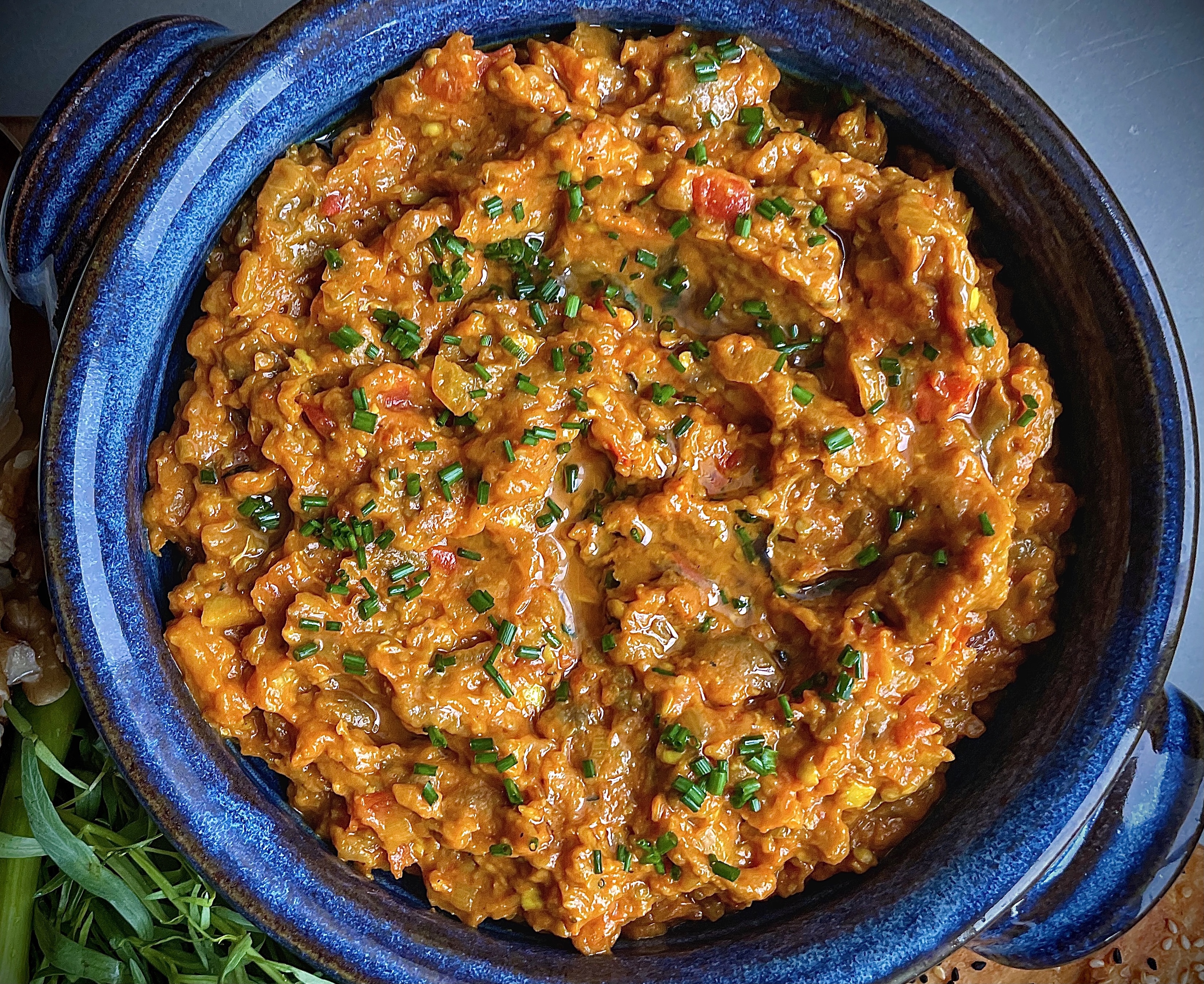
The topper to this hummus dish is simply sautéed aubergines and onion with the addition of rose harissa, garlic, tomato purée, balsamic vinegar and fresh coriander to create an aromatic dish with a little heat.

The aubergine mixture, which you can either have cold or warm, is then layered on hummus and served with some bread to dip into it. You can buy your favourite brand of hummus as opposed to making it from scratch but the recipe for hummus below is so easy, resulting in a beautifully creamy and smooth hummus, I can’t recommend it enough.

Serving Ideas

It is a really easy dish to prepare and one that can easily be cooked up after work. It is vegan so a great option for a ‘Meat Free Monday’ meal. Served with other mezze-style offerings such as bread, olives or, as pictured, a fresh herb and feta cheese platter, this dish can generously feed 4 people.

If there are any leftovers, place in an airtight container and store in the fridge up to 3 days. Makes a great sandwich or wrap filler.


Rose-Harissa Aubergines & Hummus

Prep Time20 minutes
Cook Time30 minutes
Total Time50 minutes
Course: Main Course, Appetiser
Cuisine: Middle-Eastern, Cross-cultural
Keyword: vegetarian, vegan
Servings: 4 (as part of a mezze-style meal or appetiser)
Author: Mersedeh Prewer

Ingredients

For the Rose Harissa Aubergines

  • 3 tbsp vegetable oil
  • 2 large aubergines (chopped into 2 inch chunks. If you have time salt them and leave them for 30 mins to extract water - this will reduce the amount of oil needed to cook them)
  • 1 large onion (finely diced)
  • 2 cloves garlic (crushed or minced)
  • 2 tbsp rose harissa paste
  • 2 tbsp tomato purée
  • 250 ml water
  • 20 g fresh coriander (finely chopped including stems)
  • 1 tbsp balsamic vinegar
  • Salt and Pepper (to taste)
  • Olive oil (to drizzle on top before serving)
  • Finely chopped fresh herbs (to garnish - you can use any herb you like including coriander or parsley)

For the Hummus

  • 720 g large chick peas in a jar (drained weight approx. 400g)
  • 2 cloves garlic
  • Juice of 1 lemon
  • 4 tbsp tahini
  • 40 ml olive oil
  • 40 ml ice cold water
  • Salt and Pepper (to taste)

Instructions

For the Rose Harissa Aubergines

  • Place a large frying pan on a medium / high heat and add 2 tbsp of oil. Add the aubergines and cook until soft all the way through. After 5 minutes of cooking the aubergine, add the remaining 1 tbsp of oil. Stir occasionally to ensure all sides of the aubergine cook through.
  • Add the onions to the pan. The pan may be dry as aubergine has a tendency to absorb oil. Do not be tempted to add more oil as the rose harissa paste contains oil. Stir and cook the mixture until the onions are translucent. Add the garlic and stir until evenly distributed.
  • Add the rose harissa and stir into the mixture. Then add the tomato purée and stir in. Follow with the water, then the fresh coriander and finally the balsamic vinegar. Cook and stir until the liquid reduces and you have a lovely sticky mixture - some of the aubergine chunks will be mashed into the mixture and that is absolutely fine. Reduce the heat to the lowest setting and season to taste. You can turn the heat off and leave in the pan until ready to serve the dish. Alternatively you can leave it on a low flame but make sure the mixture does not dry out / burn - add more water if necessary.

For the Hummus

  • Add all the hummus ingredients, except the water, salt and pepper to a food processor / nutribullet. Blend until it is smooth. Then add the water and blend further until you have creamy texture. Season to taste.
  • Spoon the hummus onto a serving dish and top with the rose harissa aubergine mixture. Drizzle with olive oil and a sprinkle of fresh herbs. Serve as part of a mezze-platter with bread.

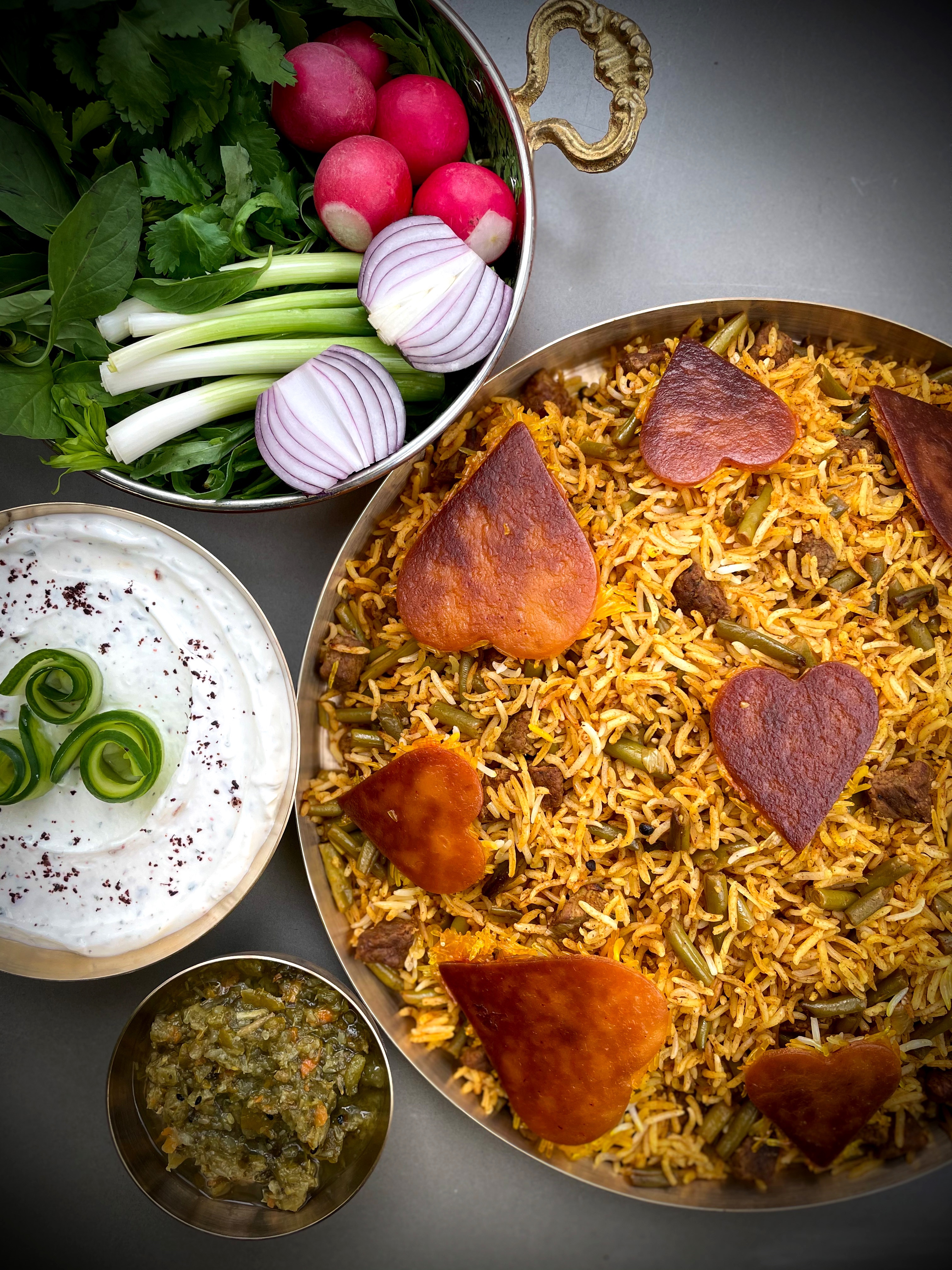
Loobia Polo (Rice with Green Beans & Beef)

A favourite amongst Iranians with its warming cinnamon notes in a deeply savoury and satisfying dish of rice layered with a green beans and chunks of beef cooked in a rich tomato sauce.

What is Loobia Polo?

Loobia polo is an Iranian dish made with rice, green beans, and beef or lamb. Loobia means beans in Persian (Farsi) and ‘polo’ indicates it is a rice-dish layered with meat and / or vegetables.

Think of that dish that represents the ultimate comfort food for you, Loobia Polo is the equivalent to that to most (if not all) Iranians. Even the fussiest of kids will love this dish and that stays with them through to adulthood. Everyone squeals with delight when Loobia Polo is served with its warming cinnamon notes, tomato flavour, chunks of meat and green beans. 

Cooking Tips

The rice I use for Loobia Polo is Kamran Basmati Sella Rice as opposed to Tilda Basmati rice. Kamran rice is very forgiving as it is a thicker kernel and holds its integrity against the bean and tomato mixture, which releases liquid into the rice. For this reason, if you are using the more delicate Tilda grain you have to remove it from the parboiling stage a little earlier than you would with the normal Chelow recipe. Alternatively buy yourself a packet of Kamran rice and be less exact and turn out a perfect Loobia Polo each time you cook it.

Variations

You can use lamb, chicken, turkey or mushrooms (if you are veggie) as an alternative to beef in this dish.

The recipe below includes the steps to make flatbread tahdig (using a tortilla wrap) but you can make tahdig with rice or potato,should you prefer. Just prepare a layer of saffron rice at the bottom of the pan at step 3 under the heading ‘For the rice’  below for rice tahdig; or layer your potato slices for potato tahdig.


Loobia Polo

Rice with green beans and beef
Prep Time20 minutes
Cook Time1 hour 30 minutes
Total Time1 hour 50 minutes
Course: Main Course
Cuisine: Persian, Iranian
Keyword: Green beans, rice, comfort food, basmati rice, tahdig, Lubia Polo
Servings: 4
Author: Mersedeh Prewer

Ingredients

For the loobia mixture

  • 3 tbsp vegetable oil
  • 500 g stewing steak (diced into 1 inch chunks)
  • 1 large onion (diced finely)
  • 1 large clove garlic (minced or crushed)
  • 1 tsp turmeric
  • 1 tsp cinnamon
  • 2 tbsp tomato purée (heaped tablespoons)
  • 500 g frozen runner beans (defrosted and sliced into 1 inch pieces)
  • 1/8 tsp ground saffron (bloomed in 200 ml of water)
  • Salt and Pepper (to taste)

For the rice

  • 500 g white basmati rice (rinsed until the water runs clear and soaked overnight in water plus 2 tbsp of salt - ensure the water covers the rice by a minimum of 2 inches)
  • 1 white tortilla wraps cut into heart shapes using a cookie-cutter or any other shape you prefer
  • 1 tbsp salt
  • Water (as directed below)
  • 2 tbsp vegetable oil (plus extra if you are making flatbread tahdig as pictured)
  • 1/4 tsp ground saffron (bloomed in 2 tbsp of water)
  • 2 tbsp melted butter or ghee

Instructions

For the loobia mixture

  • Place a large frying pan or equivalent on a medium / high heat and add 1 tbsp of vegetable oil. Seal the beef and them remove from the pan and set aside for now.
  • Add the remaining 2 tbsp of vegetable oil to the pan and add the onions. Cook until they turn golden. Then add the garlic, turmeric and cinnamon and stir until evenly distributed.
  • Add the beef back into the pan and the tomato purée and stir in. Add the green beans and bloomed saffron water and stir until everything is evenly distributed. Lower the heat and cook until most of the liquid has evaporated and the mixture has a stickier texture. Season with salt and pepper to taste and then turn the heat off and leave the mixture for when you are ready to mix with your rice.

For the rice

  • Fill a large non-stick saucepan with water and 1 tbsp of salt. Bring the water to a boil.
  • Drain the rice and then add to the saucepan. Gently stir the rice to make sure it does not stick to the pan. Every minute give the rice a gentle stir and take a grain of rice and check the texture – either between your fingers or using your teeth. What you want is the rice to be soft on the outer layer but still firm in the centre. It can take any time from 3 to 7 minutes with the quantity of rice in this recipe. Once the parboiled rice reaches the correct texture, turn your heat off and drain the rice in a colander or sieve. Sprinkle a little cold water on the rice to halt the cooking process. Taste the rice – if it is very salty then rinse the rice further with a little water.
  • Place the empty saucepan on the stove. Add 2 tbsp of oil and your bloomed saffron to the pan and give it a mix. Then arrange your oiled tortilla wrap shapes on the bottom of the pan making sure they do not overlap. Spoon about a 1-inch layer of rice into the saucepan.
  • Then layer your rice and loobia mixture and mix gently. Build up the layers into a pyramid shape away from the sides of the pot. Make 5 holes in the rice with the bottom of a spoon. Pour 2 tbsp of water and the melted butter / ghee over the rice. Cover the pot with a lid and cook on a high heat until the rice starts steaming. Then lower the heat to the minimum flame, wrap the lid of the pan with a tea towel and place on the pan and steam for another 45 minutes.
  • Once the rice is cooked, turn the heat off. Gently fluff the rice a bit to combine the loobia mixture and rice and spoon out onto a serving dish. Place the heart-shaped tahdig and and rice tahdig around the rice or on a separate dish. Pairs well with Salad Shirazi, fresh herbs and / or yoghurt or Torshi.

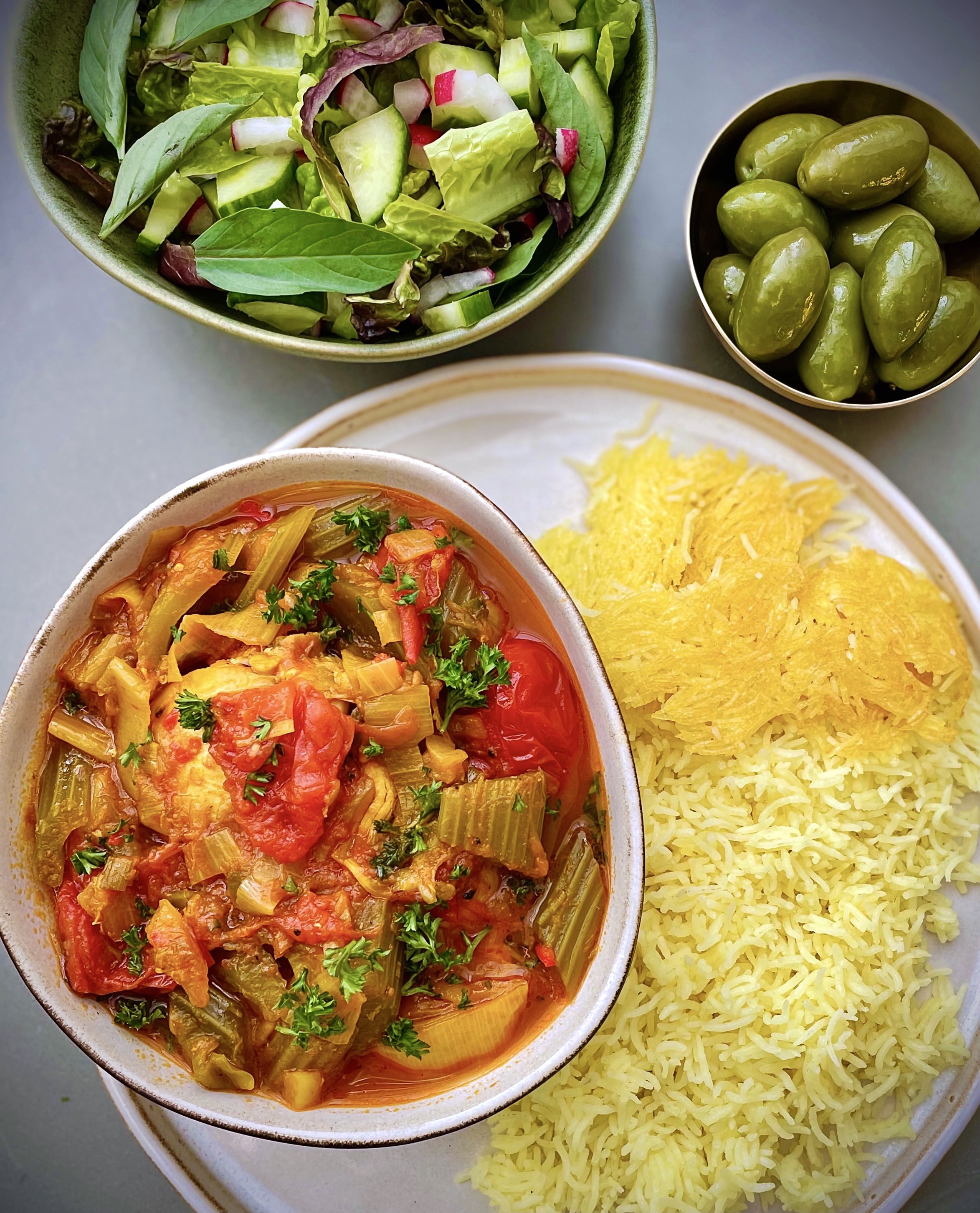
Khoresh Karafs – Ghermez (Chicken, Celery & Tomato Stew)

A Persian stew made with chicken thighs slow-cooked with celery in a tomato sauce. Wonderfully simple to prepare but with maximum flavour from the combination of garlic, turmeric and saffron with the tomato sauce.

A Familiar Stew

This stew is the lesser-known of the Persian celery stews. The famous one being Khoresh Karafs made with lamb, mint, parsley and celery. This version can be made with chicken, lamb or beef with the stew being tomato-based.

In my family, we distinguish between the two by referring to the colour: ‘Sabz,’ which translated means green in Farsi, for the herby version; and ‘Ghermez,’ which means red, for the tomato-based version. In fact, this version is probably the most popular among my mother’s side of the family, who primarily come from Mashhad in the Khorasan Province of Iran.

With tomatoes apparently only being introduced to Iran in the late 19th century, this stew is inevitably fairly young in the longstanding history of Iran and the Persian Empire. Some Iranians have never heard of this stew!

How to Serve Khoresh Karafs – Germez?

Serve with this stew with Kateh (Persian rice cooked the easy way). A simple salad with a citrus dressing, or fresh herbs, or pickle / olives also make complementary side dishes.

I cannot recommend this recipe enough with it being so easy to prepare and cook, using only a handful of ingredients but maximising on flavour. It is a comforting yet light stew so I love eating this in the earlier part of Spring as we make the gentle transition away from eating the heartier dishes and move towards salads, BBQ’s and a Mediterranean feel to our dishes.

Other Chicken Recipes


Khoresh-Karafs (Ghermez)

Chicken stew with celery and tomatoes
Prep Time10 minutes
Cook Time1 hour 30 minutes
Total Time1 hour 40 minutes
Course: Main Course
Cuisine: Persian, Iranian
Keyword: easy recipe, stew, slow cooked, comfort food
Servings: 4 (to 6)
Author: Mersedeh Prewer

Ingredients

  • 3 tbsp vegetable oil
  • 8 skinless chicken thighs on the bone
  • 1 medium onion (finely diced)
  • 3 cloves garlic (crushed or minced)
  • 1 red chilli (minced - optional)
  • 1 medium leek (medium sliced)
  • 1 tsp turmeric
  • 3 tbsp tomato purée
  • 650 ml water
  • 1 bay leaf
  • Juice of 1 lemon or lime
  • 1/8 tsp ground saffron (bloomed in 2 tbsp of water)
  • 1 head celery (chopped in 2 inch chunks)
  • 5 small / medium tomatoes (halved)
  • Salt and pepper (to taste)
  • Chopped fresh parsley (to garnish)

Instructions

  • Place a shallow casserole pan or equivalent on a medium-high heat. Add 1 tbsp oil. Seal the chicken thighs on both sides, remove from the pan and leave to one side until ready to use.
  • Add 2 tbsp oil to the pan and add onions. Cook until the onion turns golden. Then add garlic and chilli and stir in until evenly distributed.
  • Add leek to the pan and and cook until softened. Add turmeric and stir. Follow with tomato purée and stir in until evenly distributed. Then add water, bay leaf, lemon juice, saffron water and stir.
  • Add chopped celery. Then evenly arrange the chicken thighs in the pan so that they are just submerged in the liquid of the stew. Place the tomato halves evenly in the stew.
  • Bring stew to a boil and then lower the heat to allow to simmer with a lid on the pan for about an hour or until the chicken is practically falling off the bone. If the stew is too watery, allow to simmer further without the lid on to thicken the sauce.
  • Season with salt and pepper to taste and sprinkle with fresh chopped parsley before serving. Serve with saffron Kateh.

Sholeh Zard Overnight Oats

This healthy overnight oats recipe, inspired by a Persian dessert, is made with chia seeds, almonds, pistachios, strawberries and is flavoured with cinnamon, saffron and rose water.

Inspiration for this Recipe

Sholeh Zard is a Persian rice pudding dessert flavoured with saffron, rose water, sugar and decorated with almonds, pistachio and cinnamon. It is a delicious and comforting dessert and loved by Iranians.

After a light bulb moment, I decided to experiment with the flavours of Sholeh Zard with the concept of overnight oats. Overnight oats have become very popular over the last decade. A quick, healthy and delicious way of preparing rolled oats. With no cooking required, it is prepared by mixing rolled oats, liquids and other ingredients and leaving them in the fridge overnight.

How to Make this Breakfast Delight?

The process is simple. Soak oats and chia seeds in milk, Greek yogurt, saffron, rose water and honey. Leave in the fridge overnight. Add flaked almonds and some strawberries the next day and give it a good stir. Serve it in a bowl topped with more strawberries, crushed pistachios and a sprinkle of cinnamon. The resulting breakfast dish is fresh, light and delicious. My family love it and it is one of our regular breakfast options. It’s so low maintenance to knock up and washing up is easier than the mess cooked porridge creates!

I have included chia seeds in the recipe due to the nutritional benefits including adding fibre and protein. Feel free to leave them out if you are not a fan. You can also make this with non-dairy milk and yogurt and replace the honey with maple syrup if you are vegan. If you would prefer to substitute the honey / maple syrup with a wholesome way to sweeten the oats, then grate pear or apple into the oat mixture prior to leaving in the fridge overnight.

Other Breakfast Recipes


Sholeh Zard Overnight Oats

Overnight oats flavoured with saffron and rose water
Prep Time10 minutes
Total Time10 minutes
Course: Breakfast
Cuisine: Persian, Iranian, Cross-cultural
Servings: 1
Author: Mersedeh Prewer

Ingredients

  • 50 g rolled oats
  • 1 tsp chia seeds
  • 200 ml milk or non-dairy alternative
  • 1 tbsp Greek yoghurt or non-dairy alternative
  • 2 tbsp rose water (use only 1 tbsp if you want it less floral)
  • 1/8 tsp ground saffron
  • 2 tbsp honey or maple syrup
  • 2 tsp flaked almonds
  • Strawberries (to mix through and garnish when ready to serve)
  • Small pinch of cinnamon (to garnish)
  • 1 tsp ground pistachios (to garnish)

Instructions

  • Mix oats, chia seeds, milk, yoghurt, rose water, saffron and honey in a bowl. Cover and leave in fridge overnight to soak.
  • Prior to serving, add and stir through flaked almonds and some chopped strawberries. Spoon into your bowl and top with more chopped strawberries, a sprinkle of cinnamon and ground pistachios.

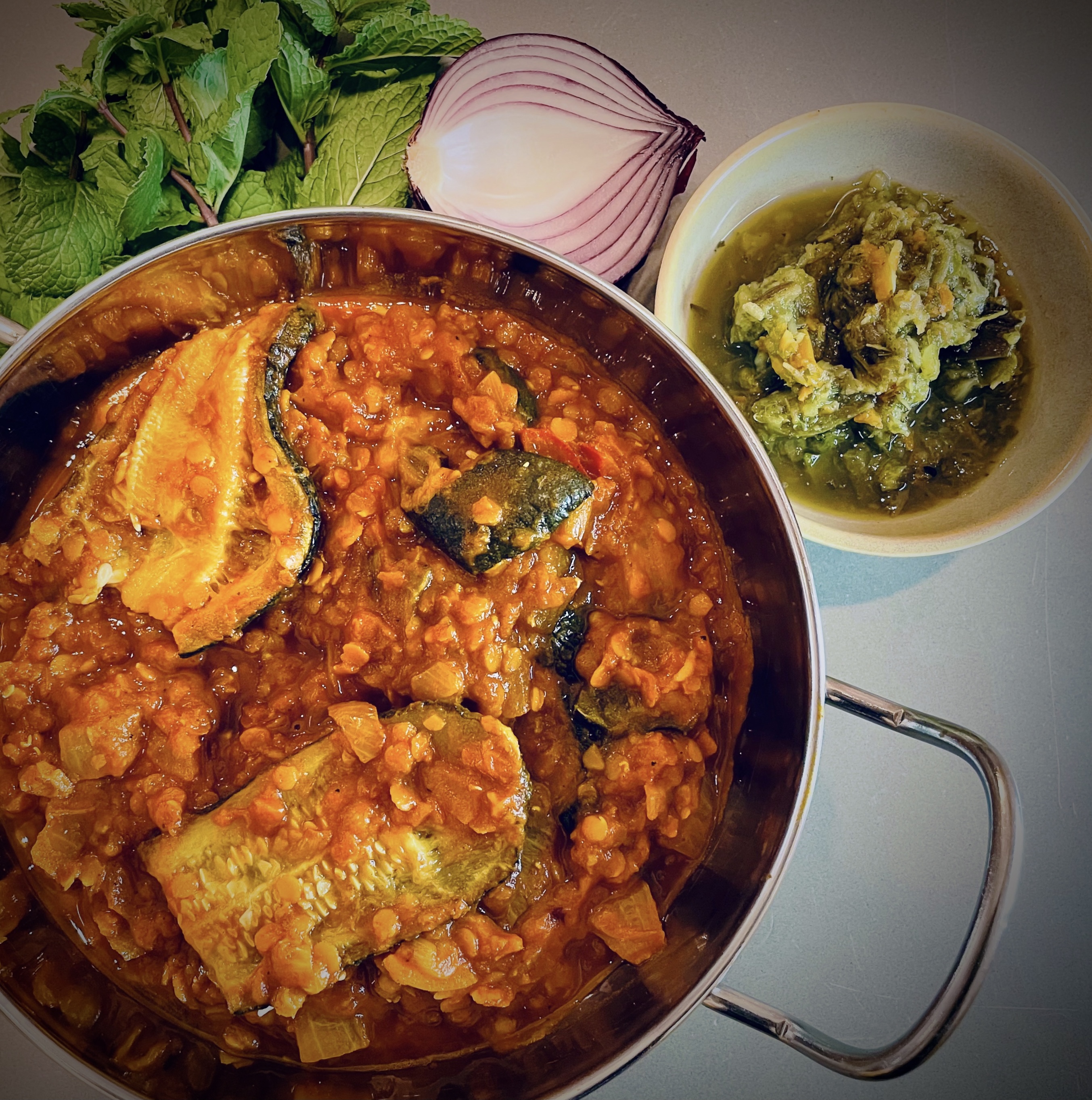
Persian-Style Dal with Persian Mixed Spice & Dried Limes

A deeply comforting dal cooked in a rich tomato sauce with warming spices. The combination of the dried limes and Persian mixed spice creates an incredible savoury dish. A great vegetarian dish to eat with rice and or flatbread.

I discovered a love for dal over the last ten years. My husband introduced me to the world of dal during one of our early dates. He is a big fan of Indian cuisine and always orders a dal dish to accompany his meal. I was reluctant at first but, after a spoonful, I fell in love with the creamy texture and the aromatics of the dish. I wanted to make a dal dish with a Persian twist so I started experimenting!

Ingredients in this Dish

This dish is made with yellow split peas (Channa Dal) using the holy trinity of Persian cooking – onion, turmeric and saffron. I also added other familiar flavours from our cuisine during the recipe development including limoo amani (dried lime), advieh (Persian mixed spice) and nigella seeds. The resulting dish is deliciously savoury, packing an umami punch and satisfying even the die-hard carnivore.

Limoo amani can be bought online or from most Middle-Eastern food shops. It adds a musky and citrusy flavour to the dish. Be careful when piercing a hole into the dried lime as you do not want the seeds to fall out while it is cooking as it can make the dish bitter – just a gentle shallow poke into the lime with the end of a sharp knife.

Advieh can also be bought from most Middle-Eastern food shops – I buy mine online from Freshly Spiced on  Etsy. The combination fo spices are nutmeg, rose petals, cardamom, cumin, black pepper, goriander, and cinnamon.

I like a little heat in my food so I add red chilli to my dal, but feel free to leave it out.

How to Serve This Dish

Serve it with roti or naan, rice if you want a hearty meal with fresh herbs, torshi or a yoghurt dip on the side such as Maast o’Moosir (yoghurt and Persian shallot dip) or Maast O’Khiar (Persian yoghurt and cucumber dip).

Leftovers

This dal dish will last in the fridge up to 5 says if kept in an airtight container. Always cool dishes completely before refridgerating.


Persian-Style Dal with Persian Mixed Spice & Dried Limes

Prep Time15 minutes
Cook Time1 hour
Total Time1 hour 15 minutes
Course: Main Course
Cuisine: Persian, Iranian, Fusion
Keyword: dahl, daal, vegetarian, vegan option, dhal
Servings: 4
Author: Mersedeh Prewer

Ingredients

For the dal

  • 250 g chana dal (split yellow lentils) (rinsed with water until it runs clear and left in a bowl of water to soak overnight)
  • 2 tbsp vegetable oil
  • 1 onion
  • 3 cloves garlic
  • 1 whole red chilli (finely chopped - please feel free leave out / reduce amount or deseed if you would prefer it less spicy)
  • 1 tsp coriander seeds
  • 1 tsp turmeric
  • 900 mls vegetable stock
  • 1 bay leaf
  • 1 to 2 limoo amani (dried lime)
  • 200 g fresh tomatoes (chopped)
  • 1/8 tsp ground saffron (bloomed in 2 tbsp of water)
  • Juice from half a fresh lime
  • Salt and pepper (to taste)

For the temper and garnish

  • 2 tbsp ghee (non dairy alternative, if vegan)
  • 1 tsp black mustard seeds
  • 1/4 tsp advieh (Persian mixed spice)
  • 1 tsp nigella seeds (to garnish)

Instructions

  • Blend onion and garlic into a paste in a food processor or equivalent.
  • Take a large saucepan and add 2 tbsp oil and place on medium-high heat. Add chilli and coriander seeds. Toast lightly for 30 seconds to release flavours. Be careful not to burn otherwise it will be bitter. Add onion and garlic paste to the pan and cook for 5 minutes. Add turmeric and cook for a couple of minutes.
  • Drain channa dal and rinse. Then add to the pan with stock, chopped tomatoes, bay leaf and bloomed saffron.
  • Pierce imoo amani 3 to 4 times around the lime gently with the tip of a sharp knife and add to the pan - only a shallow piercing is required. Bring to a boil, then turn the heat down, add a lid and let it simmer for 45 minutes.
  • When the channa dal has cooked, remove from heat and remove the bay leaf and limoo amani. Stir to break down. Squeeze some fresh lime juice and season to taste. Leave the mixture to thicken.
  • To make the temper, place a small frying pan on high heat. Add ghee and fry mustard seeds for 30 seconds. Turn heat off, add advieh and mix and then pour into the dal mixture and stir. Sprinkle nigella seeds to garnish.
  • Serve with chapatis or roti and/or rice with yoghurt or torshi.

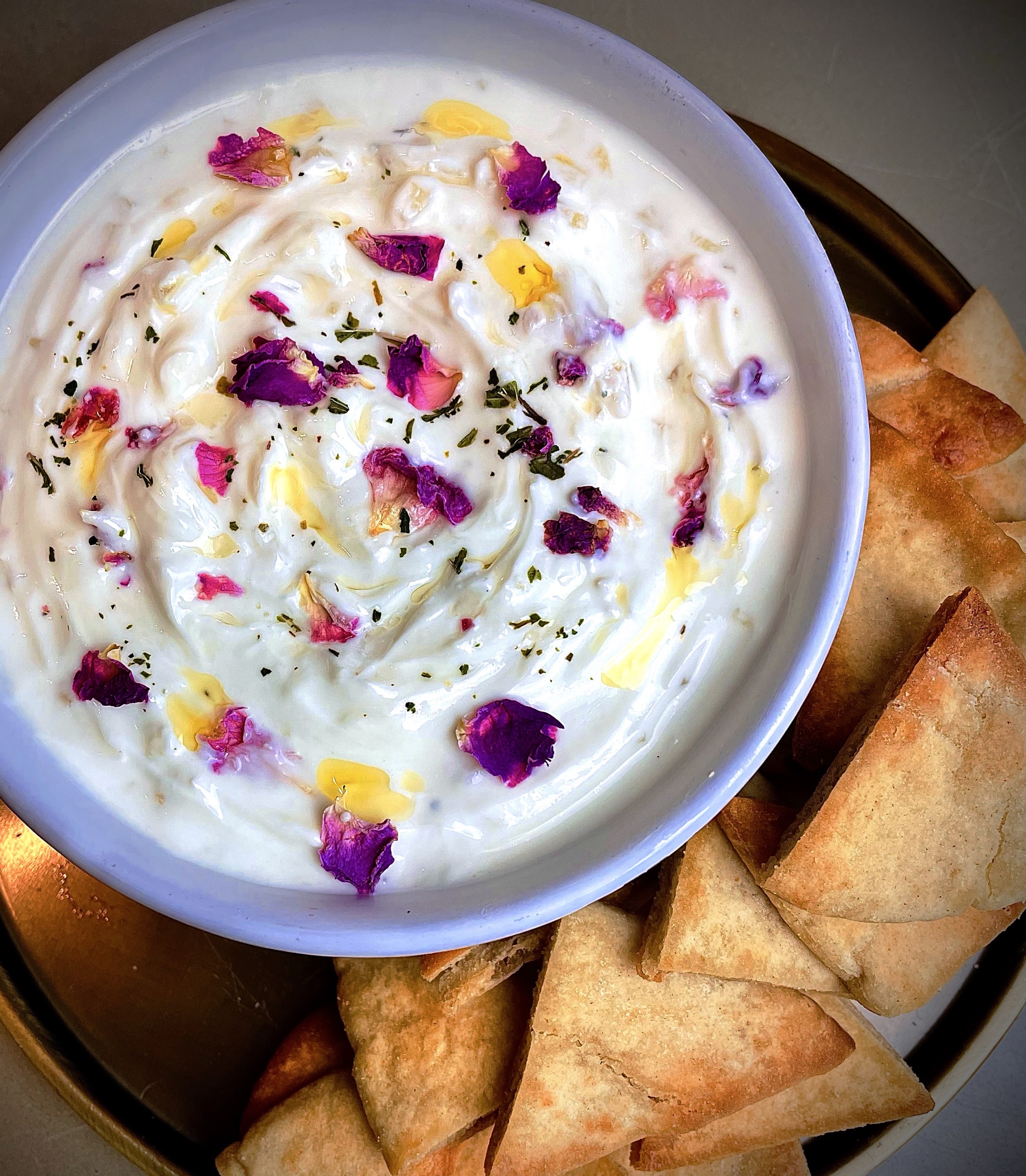
Maast O’Moosir (Yoghurt & Persian Shallot Dip)

A relative of the garlic but milder and a little sweeter, moosir makes for an extraordinary and delicious dip. Perfect for dipping flatbread, crackers or crisps.

What is Maast O’ Moosir?

Maast O’Moosir is a yoghurt dip commonly served as an appetizer or accompaniment in Persian cuisine. You may have eaten this dip at a Persian restaurant as it is usually offered as part of our mezze-style appetiser platters.

Moosir is described in English as a Persian shallot and similar to a Solo or Elephant garlic. It has a flavour profile similar to garlic but slightly sweeter and softer in its spiciness. They grow wild in the foothills of the Zagros Mountains. Moosir have to be found and dug out of the earth – a similar process to truffles. It adds an amazingly distinctive flavour to dishes. You can buy moosir from most Middle-Eastern food shops or online. It is available in its dried form and needs to be rehydrated by soaking in water overnight.

How to Serve this Dip?

Serve this dip alongside Persian main meals. It goes particularly well with kababs (Persian or other cuisines). Alternatively serve it as a dip with crudités, or crisps, or flatbread. I have served the one in the picture above with pitta chips (cooked by drizzling olive oil and toasting in a hot oven). We Iranians often just sit with a bowl of this dip and crisps, happily dunking away and it is loved by the young and the wise in our families.

If you are going to make this dip, remember that you will need to soak the moosir over night and also to leave the dip, once made, for no less than an hour for the flavours to fully infuse and intensify.

Storing Maast O’Moosir

Store this dip in an airtight container and in the fridge up to 5 days.

Other Great Dip Recipes


Maast O'Moosir

Yoghurt dip with Persian shallot
Prep Time10 minutes
Resting time1 hour
Total Time1 hour 10 minutes
Course: Appetiser, Accompaniment
Cuisine: Persian, Iranian
Keyword: dip, musir
Servings: 4
Author: Mersedeh Prewer

Ingredients

  • 8 heaped tbsp Greek yoghurt (preferably 5% fat)
  • 8 discs dried moosir (rehydrated in water overnight)
  • Salt and pepper (to taste) (pepper is optional)
  • Drizzle of olive oil, dried rose petals and dried mint (to garnish - optional)

Instructions

  • Drain the rehydrated moosir discs and rinse. Mince finely with a sharp knife, discarding any tough parts.
  • Take a bowl, add yoghurt and the moosir. Stir, add salt and pepper (pepper is optional) to taste. Cover the bowl and leave in the fridge for the flavour of the moosir to permeate through the yoghurt (no less than 1 hour).
  • When you are ready to serve the Maast O'Moosir, decorate with dried rose petals, a sprinkle of dried mint and a drizzle of olive oil. Serve with pitta chips as pictured, crisps, vegetables or part of a mezze-style spread.

Sabzi Polo ba Mahi (Persian Herbed Rice with Salmon)

Last Updated on 24/02/2024 by Saffron & Herbs

Commonly served during Norooz, rice is layered and steamed with fresh herbs, saffron and garlic butter to create a delightfully aromatic dish. Grilled salmon, marinated in saffron, lemon, garlic and honey, is served alongside the Sabzi Polo to create the ultimate Persian meal.

A Special Dish

This dish is synonymous with Norooz – Persian New Year. Rice is steamed with saffron, garlic and chopped herbs. It is usually served with fish and Kuku Sabzi (a herb and egg frittata).

In Persian, Sabzirefers to herbs or vegetables; ‘Polorefers to the fact that the rice is cooked with another element mixed in, in this case the fresh herbs. The herbs used in Sabzi Polo vary, but typically include dill, coriander, parsley, Persian chives or the green ends of spring onions and in some cases fenugreek.

Iranians traditionally eat Sabzi Polo with a fried or smoked ‘mahi sefid’ (‘white fish’, the Caspian kutum or Caspian white fish which inhabits the Caspian Sea). It’s usually served with pickled garlic, other traditional pickles, Salad Shirazi and ‘Naranj’ – a tart and slightly bitter orange, which we squeeze over the fish and rice like a lemon adding a citrus note to the dish. You can buy Naranj from your local Middle-Eastern supermarket. Sainsbury’s also stock Naranj (bitter Seville marmalade oranges) during the season. Kuku Sabzi is also served alongside the rice on the day, a great alternative should fish not be your thing.

What are the Ingredients?

Below is my family recipe for Sabzi Polo. We tend to use a greater amount of fresh herbs compared to others. The herbs use in this recipe are fresh coriander, parsley and dill. In Iran chives are also used but the chives available in the UK are not as spicy so we replace these with the green ends of spring onions. The herbs and greens are mixed in while the rice is parboiling. After draining the rice, it is steamed with garlic butter drizzled over with a little saffron to add further aromatics to this dish.

The accompanying fish is grilled salmon marinated in a simple saffron, honey, garlic, lemon juice, olive oil infusion and smoked sea salt. You can make the Sabzi Polo with any fish you want, including smoked fish like many in Iran will eat on the day. You can pan fry, BBQ, grill, oven bake, poach or steam your fish if you prefer.

Your Choice of Tahdig

Due to the herbs, the tahdig (crispy rice formed at the bottom of the pot) will come out a dark green-brown as you can see in the first picture so do not panic when you flip the crispy stuff out – it’s meant to be that dark!

However, should you prefer you can prepare the dish with a saffron layer of Tahdig as you can see in the pictures above and below. All you need to do is parboil the rice without adding the herbs, drain it and then take 2 cups of rice and add to a little saffron water (1/4 teaspoon ground saffron bloomed in 3 tablespoons water). Mix the rice until fully coated and then line the bottom of the pan, following the addition of the oil/butter, as set out at the step entitled ‘Prepare the Tahdig Layer’ below. Then pat it down and layer the cooked rice with the fresh herbs and the garlic butter layer by layer on top.

You can also have potato or bread tahdig as an alternative. Just replace the rice layer with slices of potato or flatbread.

Serving and Storing Sabzi Polo Ba Mahi

Serve this dish alongside all or one of the following.

  • Salad Shirazi (Persian chopped tomato, cucumber and red onion salad dressed with lime, olive oil and mint).
  • Borani Laboo (Persian beetroot and yoghurt dip).
  • Maast O’Moosir (yoghurt and Persian shallot dip).
Storing Leftovers

Store in an airtight container, once cooled down, and in the fridge. The rice will last up to 5 days. The salmon will last up to 3 days. you can reheat the rice and salmon in a microwave. Or you can reheat the rice in a saucepan. Remember to add a tablespoon or so of water to rehydrate the rice if reheating. The salmon can also be reheated in a medium oven.

Norooz – Persian New Year and the First Day of Spring (Northern Hemisphere)

Norooz is the day of the vernal equinox and marks the beginning of spring in the Northern Hemisphere. It marks the first day of the first month of the Iranian calendar (Farvardin). The moment the Sun crosses the celestial equator and equalises night and day is calculated exactly every year. Families gather together to observe the rituals. Due to this calculation, the day Persian New Year falls upon can vary but generally it is either on the 20th or 21st March. The Persian name translated means ‘New Day.’

The festivities and rituals we observe are focussed on letting go of the winter and all the negativity that may be associated with it. We look forward to new life, prosperity and have great optimism which is brought by spring and then the summer months.

In the lead up to the the New Year celebrations, many Iranians will undertake a ritual familiar to many – the ‘Spring Clean.’ I always do a major spring clean and this year was no exception. By day 3 into my efforts my house was messier than when I started, but by the end of the process I felt physically and mentally lighter from the purge of the clutter and the deep clean of the house.

The evening of the last Tuesday before Norooz is the night we celebrate Chaharshanbeh Soori – a festival of fire where we gather together and jump over bonfires. The tradition of jumping over the bonfire originates from people believing that the fire would take their problems, sickness and winter pallor and be replaced by energy and warmth, contributing towards their success for the upcoming year. As we jump, we chant the following words: ‘Zardiye man az toh (my pallor to you); Sorkhiye toh az man (your redness to me).’ See my post about Chaharshanbeh Soori and the dish we eat on that day here.

Haft-Seen

On the day of New Year we will go to one family member’s house and gather together for the turn of the New Year. We gather around the Sofreh Haft-Seen, a table or other surface, which is set with the symbols of Persian New Year and await the exact moment of the March equinox to celebrate the New Year (even if it happens at 3 am in the morning for some Persian families).

Traditionally, the Haft-Seen (seven things beginning with the letter ‘س‘ pronounced ‘seen’) are:

  1. Sabzeh (wheat, barley, mung bean, or lentil sprouts grown in a dish) – symbolising rebirth and growth.
  2. Samanu (sweet pudding made from wheat germ) – symbolising strength and power.
  3. Senjed (Persian Olive / oleaster) symbolising love.
  4. Serkeh (vinegar) symbolising patience.
  5. Sib (apple) – symbolising beauty.
  6. Seer (garlic) – symbolising health and medicine.
  7. Somagh (sumac) – symbolising sunrise.

The Haft-Seen may also include a mirror (self-reflection), candles (enlightenment), eggs (fertility),  goldfish (progress), coins (wealth), hyacinth (spring’s arrival), and traditional confectioneries. A “book of wisdom” such as the Quran (religious text of Islam), or the Book of Kings – the Shanameh of Ferdowsi (an epic and long poem on the Persian Empire), or the Divān of Hafez (an anthology of the famous Iranian poet Hafez’s poems) may also be included.

Music will play and we will eat Sabzi Polo ba Mahi and Kuku Sabzi. Many of us continue the celebrations by having a separate organised event for the wider family and friends at a hotel or restaurant where we dress up and dance the night away.

During the Norooz holidays, we make short visits to the homes of family and friends. Typically, young people will visit their elders first. Visitors are offered tea and pastries, cookies, fresh and dried fruits and mixed nuts or other snacks. Gifts are given from the elders to the younger members of the family.

On the 13th day of the Norooz celebrations we celebrate Sizdah Bedar. Iranians spend the day outdoors. Many will go out for a family picnic in a local park. Come rain or shine we will gather outdoors and celebrate this day – throwing our sabzeh into a nearby river or stream marking the end the Persian New Year celebrations.


Sabzi Polo ba Mahi

Herbed rice served with grilled salmon
Prep Time20 minutes
Cook Time1 hour
Course: Main Course, Rice Dish, Fish Dish
Cuisine: Persian, Iranian
Keyword: coriander, parsley, dill, salmon
Servings: 4 (to 6)
Author: Mersedeh Prewer

Ingredients

For the Sabzi Polo (herbed rice)

  • 1/4 tsp ground saffron (bloomed in 100mls of water)
  • 400 g white long grain basmati rice
  • 2 tbsp salt
  • 80 g fresh coriander
  • 80 g fresh dill
  • 80 g fresh parsley
  • The green ends of 5 spring onions
  • 2 tbsp vegetable oil
  • 2 tbsp melted butter mixed with 3 crushed or minced cloves of garlic

For the mahi (salmon)

  • 4 salmon fillets (or 1 side of salmon circa 600g to 800g)
  • Juice of 1 lemon
  • 1 tbsp honey
  • 2 tbsp olive oil
  • 1/8 Small pinch of ground saffron (bloomed in 2 tbsp of water)
  • 2 cloves garlic (minced or crushed)
  • Smoked Sea Salt and Pepper (to taste - you can use normal salt)

Instructions

Marinade the Salmon

  • Mix olive oil, lemon juice, bloomed saffron, honey, smoked sea salt, pepper and garlic and pour it over fish. Massage the marinade into the fish. then pleace fish flesh side down into marinade. Cover and place in fridge for a minimum of 12 hrs. I find the best results are to marinade the salmon for 2 nights.

Wash and Soak the Rice

  • Wash the rice in cold water until the water runs clear. Then place with 1 tbsp of salt in a bowl and pour in cold water to cover with 2 inches clear above the rice. Soak overnight.

Prepare the Herbs & Greens

  • Wash all the herbs and spring onions. Remove tough woody stems from the herbs and cut the spring onions to remove the green ends. In batches, pulse the herbs and spring onion ends in a food processor until they are finely chopped. Place in a bowl until ready to use.

Make the Garlic butter

  • Melt butter mixed with 3 crushed or minced cloves of garlic over medium heat in small pan. Put to one side until ready to use.

Parboil the Rice

  • Fill a large non-stick saucepan with approximately 1.5 litres of water and 1 tbsp of salt. Bring the water to boil. Drain rice and add to the saucepan. Gently stir the rice to make sure it does not stick to the pan. cook rice until al-dente.
  • Stir in herbs and greens, turn heat off and immediately drain rice in a colander or sieve. Sprinkle a little cold water on the rice to halt the cooking process. Taste the rice - if it is very salty then rinse the rice further with a little water.

Prepare Tahdig Layer

  • Place the empty saucepan on stove. Add 2 tbsp of oil. Add 1 tbsp of the bloomed saffron to the saucepan and mix with the oil to distribute evenly. To make rice tahdig spoon about a 1-inch layer of rice into the saucepan and gently stir to mix with the saffron oil to ensure colour is distributed evenly. Pat down flat with spoon.

Layer and Steam the Rice

  • Reserve 5 tbsp of rice and layer rest into a gentle sloping pyramid shape in the saucepan, drizzling garlic butter on each layer of rice spooned in. Mix reserved rice with remaining saffron water and then spread on top of the rice. Pour any remaining saffron water over the rice. Poke 5 holes, evenly distributed, into the rice to the bottom of the pan with the end of a spoon.
  • Place glass lid on saucepan over high heat. Once steam rises from rice lower heat to the minimum flame or equivalent. Cover the lid with a tea towel (making sure it is not a fire risk) and place on saucepan. Allow to steam for a minimum of 45 mins to get a crunchy and thick layer of tahdig.

Cook the Salmon

  • Remove salmon from fridge to come to room temperature prior to cooking.
  • Heat grill to high. Place the fish in a shallow baking dish, then grill for 5 to 7 mins until cooked through, but still a little pink in the centre, cover and set aside.

Serve the Sabzi Polo Ba Mahi

  • When the rice is cooked, spoon the saffron coloured rice separately in a bowl and reserve for the garnish. Spoon the rest of the Sabzi Polo on to your chosen dish and plate up your tahdig separately. Garnish with the saffron-coloured rice and serve with the grilled salmon, fresh naranj (or lemons or limes) to squeeze over the fish and rice, Salad Shirazi and torshi.


Ash Reshteh (Persian Noodle Soup with Herbs & Beans)

A hearty soup made with legumes, fresh herbs and noodles. This beloved Persian soup is one of the dishes eaten during Persian New Year celebrations (Norooz) and is basically a hug in a bowl!

What is Ash Reshteh?

Although we have translated this dish to be described as a soup, Persian ash (pronounced ‘aash’) recipes tend to be a hearty bowl of goodness. Ash Reshteh is no exception to the rule. A wholesome bowl packed full of Persian noodles (‘reshteh’), kidney beans, chickpeas, green lentils, cooked with fresh herbs and greens and flavoured with kashk (a fermented / preserved food made with the whey left over from cheese-making). The texture of this ash is less soup and more like a chilli.

My version of this recipe differs to my maman’s recipe. I don’t use flour to thicken my ash. I also use slightly more herbs than her. The resulting ash feels fresher and lighter than the traditional recipe / method. If you cannot get your hands on Persian noodles, the closest alternative are udon noodles. You can also use spaghetti or linguine. If you are vegan, leave the kashk out and add some freshly squeezed lemon or lime juice to taste. You can also use a dairy-free yoghurt  in addition to the fresh citrus.

This dish is served during the winter time and at special Iranian events like Chaharshanbeh Soori; and Sizdah Bedar. The noodles in the ash are supposed to symbolize good fortune for the new year.

See my next post which is about Norooz and the dish Sabzi Polo ba Mahi (rice layered with herbs and served with fish) which we Persians eat on the day. This post focusses on Chaharshanbeh Soori and Sizdah Bedar, when my family come together to celebrate and eat Ash Reshteh.

Chaharshanbeh Soori

The first event in our Norooz festivities takes place on the evening of the last Tuesday before Persian New Year. It is a Festival of Fire. People in all parts of Iran and those of us who live outside of Iran celebrate this festival by setting up bonfires in almost all the public places in Iran – in our gardens or at organised events for the diaspora community.

We eat Ash Reshteh and other Persian delights and jump over the bonfires. The tradition of jumping over a bonfire originates from people believing that the fire would take their problems, sickness and winter pallor and be replaced by energy and warmth, contributing towards their success for the upcoming year. Therefore, jumping over fire on Chaharshanbeh Soori night is like a purification rite or a phrase familiar to the West  ‘out with old, in with the new.’

As we jump, we chant the following words: ‘Zardiye man az toh (my pallor to you); Sorkhiye toh az man (your redness to me).’

Another tradition is to bang on pots and pans with spoons that are named as ‘Ghashogh Zani,’ with the objective of beating out the last Wednesday of the year.

It is a celebration of good health and light – the end of winter and the beginning of Spring. It is believed that the ritual guarantees the dissipation of the misfortunes and evils and the materialization of hopes and desires for the next year.

Sizdah Bedar

Sizdah Bedar is considered the final day of the Persian new year celebration. It is celebrated on the thirteenth day of Norooz. The festival’s name translated means ‘getting rid of the thirteenth.’ As with many cultures, the number 13 was considered bad luck by Iranians and so they believed that by being outside with nature the bad luck would dissipate. Therefore, on Sizdah Bedar, Iranians spend the day outdoors. Many will go out for a family picnic in a local park. One family member will be entrusted with bringing a pot of Ash Reshteh and the rest of us the sandwiches and other Persian treats!

Come rain or shine we will gather outdoors and celebrate this day – throwing our sabzeh (sprouted lentils or wheat and one of the symbols of Norooz representing rejuvenation and new life) into a nearby river or stream. Other than eating, another ritual for the day is knotting greens. Usually, the young unmarried people knot the green of the sabzeh to find their soulmate prior to throwing it into the water.


See my how to Instagram Reel below:


https://www.instagram.com/reel/Ch75lI9ImZ0/?utm_source=ig_web_copy_link


Ash Reshteh

Persian noodle soup
Prep Time20 minutes
Cook Time2 hours 30 minutes
Total Time2 hours 50 minutes
Course: Soup, Main Course
Cuisine: Persian, Iranian
Keyword: spinach, coriander, parsley, dill, ashe reshteh, legumes
Servings: 6 (to 8)
Author: Mersedeh Prewer

Ingredients

For the ash

  • 125 g chickpeas (soaked overnight in a bowl with the other beans and lentils plus tsp of salt)*
  • 125 g red kidney beans (soaked overnight in a bowl with the other beans and lentils plus tsp of salt)*
  • 125 g green lentils (soaked overnight in a bowl with the other beans and lentils plus tsp of salt)*
  • 1 large bunch fresh coriander (between 100 and 150 g)
  • 1 large bunch fresh parsley (between 100 and 150 g)
  • 1 large bunch fresh dill (between 100 and 150 g)
  • 1 bunch spring onions (green ends only)
  • 200 g fresh spinach
  • 3 tbsp vegetable oil
  • 1 large onion (finely diced)
  • 3 cloves garlic (crushed or minced)
  • 1/2 tsp turmeric
  • 2 litres vegetable stock (you can use water which is traditionally used but I like the extra depth of flavour stock brings to the dish)
  • 150 g Persian noodles - reshteh (you can use udon noodles, spaghetti or linguine as an alternative)
  • 3 tbsp kashk (mine are heaped tablespoons - add 1 tbsp at a time and mix and taste each time to see what amount suits your tastes)
  • Salt and pepper (to taste)

For the garnish

  • 100 ml vegetable oil
  • 1 to 2 large onions (finely sliced)
  • 2 tsp dried mint
  • 1 tbsp kashk (diluted with some water to make it runny for drizzling on the ash)

Instructions

For the Ash

  • Soak your beans, lentils and chickpeas in a bowl of salted water overnight. The morning after, cook the beans and lentils in water by bringing to the boil and then simmering for 30 mins (this aids with making them digestible). Drain and leave to one side until you are ready to cook the Ash Reshteh.
  • Wash all the herbs, spinach and spring onions. Remove all the tough woody stems from the herbs and spinach. Cut the spring onions to remove the green ends for the Ash.
  • In batches, pulse the herbs, spinach and spring onion ends in a food processor until they are finely chopped. Place the greens in a bowl until you are ready to add to the Ash.
  • Take a large stockpot or equivalent and place on a medium / high heat. Add 3 tbsp of vegetable oil. After a minute or so add the finely diced onion and fry until it is tender and turning golden brown.
  • Add the garlic and turmeric and stir until evenly distributed and you can smell the aroma.
  • Drain the bean and lentil mixture and add to the stockpot. Cook for about a minute, stirring gently to coat with the onions, oil and spice.
  • Add the stock and bring to a boil. Reduce the heat to allow the beans to simmer. Place the lid on the pot and cook for approximately 30 mins to 1 hr. Skim off any foam which may rise to the top and stir now and again. To check if the bean mixture is cooked test a chickpea, as they take the longest to cook. The chickpea should be tender with no grainy or chalky texture to it.
  • Once the bean mixture is cooked, add the chopped greens and allow the Ash to simmer for about 30 mins for the greens to wilt. If the Ash is too thick after the greens have wilted, add some water. The texture of the Ash should be thicker than soup like a chilli but not so thick it feels like there is no liquid in it.
  • Then add the noodles - you can snap these to the length you desire. I like mine fairly long so I snap mine in half, if at all. Allow the Ash to cook with the noodles for about 20 to 30 mins. Test a noodle to see if cooked to you preferred texture - we tend to have ours very soft.
  • Then add the kashk 1 spoonful at a time and mix it fully into the Ash. Taste as you go along. Some put less kashk into their Ash and add more to their liking by way of a garnish.
  • As kashk is salty, add any extra salt to your taste and a generous amount of pepper. Then give the Ash a gentle stir and simmer on a low heat until it is evenly heated through.

For the Garnish

  • You can prepare the mint oil and fried onions in advance of / or during the cooking of the Ash.
  • For the mint oil - place a frying pan on a low heat and add 2 tbsp of oil and 2 tsp of dried mint and let the mixture heat through for only 1 minute. Then pour it out into a bowl and set aside for when you are ready to garnish the Ash.
  • For the fried onions - wipe the frying pan used to make the mint oil and place it on a medium heat. Add the remaining oil and let it heat through for about 1 minute. Then add the finely sliced onion and a pinch of salt. Cook, stirring regularly until it turns golden brown and caramelized - about 20 mins. Place the onions on a paper towel to absorb the oil and set aside for when you are ready to garnish the Ash.
  • When you are ready to serve, ladle into bowls, drizzle with some of the diluted kashk, the mint oil and a sprinkling of onions.

Notes

*You can use pre cooked tinned beans and lentils. Use 1 x 400 gram tin of each.

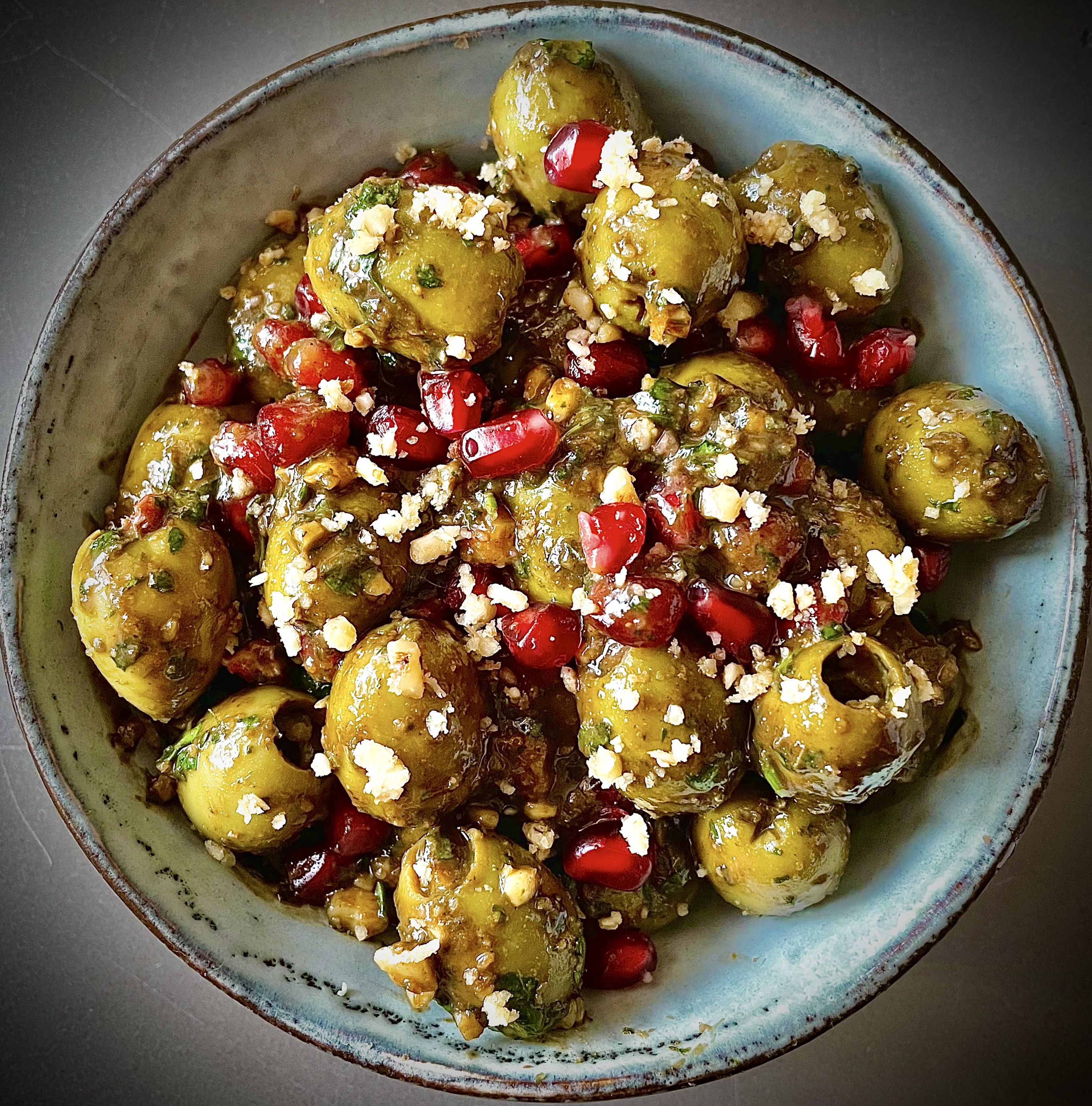
Zeytoon Parvardeh (Persian Marinated Olives)

Green olives are marinated in a herb, garlic, walnut and pomegranate paste to create an incredible and deliciously tangy appetiser.

Origins of Zeytoon Parvardeh

This delightful appetiser heralds from Gilan Province in the North of Iran, a region I visited in my mid twenties and one my family has become more familiar with over the last 20 years. Gilan Province lies along the Caspian Sea bordering Russia. The Province is lush and green with many delicious dishes, particularly vegetarian, originating from the Province, including Mirza Ghasemi (smoked aubergines and eggs) and Baghali Ghatogh (eggs with broad beans and dill).

What are the Ingredients?

The North of Iran loves walnuts and pomegranates and a number of their dishes use this combination including Zeytoon Parvardeh.

The ingredients are olives; pomegranate juice, molasses and arils; walnuts; garlic; and a herb called chuchagh. Chuchagh is a rare herb and is found in certain areas In Iran. In order to emulate its flavour for this dish we replace it with mint in the UK. I have also added a bit of coriander and parsley to my recipe.

I use large pitted green olives like gordal  or karyatis olives. By using pitted olives, it allows for the marinade to seep into the olives and also makes it easier to eat them.T he flavour profile of this dish is sweet and sour and incredibly moreish.

How to Serve Zeytoon Parvardeh

It is an easy and quick dish to prepare and ideally made the night before so that the flavours blend and intensify. I often make a small bowl of this appetiser and slowly work my way through it with cheese and crackers – I hasten to add that eating it as an accompaniment with cheese is not authentically Iranian but it works!

Zeytoon Parvardeh can be eaten with pre-dinner drinks (wine, cocktails or hard liquor – whatever you fancy), as part of a mezze-style platter or array of dishes, or with cheese and crackers which is my favourite way to eat it.


Zeytoon Parvardeh

Prep Time15 minutes
Course: Appetiser
Cuisine: Persian, Iranian
Keyword: vegetarian, vegan
Servings: 4
Author: Mersedeh Prewer

Ingredients

  • 7 whole walnuts (or 14 halves)
  • 2 cloves garlic
  • 10 g fresh mint
  • 10 g fresh coriander
  • 10 g fresh parsley
  • 2 tbsp pomegranate molasses
  • 1 tbsp olive oil (extra virgin preferably)
  • 2 tbsp pomegranate juice (squeeze this out of the pomegranate or use 2 tbsp of the arils)
  • 350 g large pitted green olives (drained weight approx 160g)
  • 1 to 2 tbsp pomegranate arils (to stir through and garnish)
  • Ground walnuts (to sprinkle as a garnish)

Instructions

  • Add walnuts and garlic to a food processor and blitz until walnuts are finely ground.
  • Remove mint leaves from the stems. Remove the tougher parts of the stems from coriander and parsley. Then add herbs to walnut and garlic and pulse in the food processor until finely chopped.
  • Add pomegranate molasses, olive oil and the pomegranate juice. Pulse in the food processor until it is a coarse paste.
  • Mix the paste with the olives in a bowl. Stir through some pomegranate arils, reserving some for a garnish. Cover and leave in the fridge to marinate (preferably overnight).
  • Serve with ground walnuts and pomegranate arils sprinkled on top.

Kashke Bademjan (Persian Aubergine Dip with Kashk)

Deliciously moreish, you only need a few ingredients to make this traditional garlicky Persian aubergine dip. A great addition to a mezze or as an appetiser.

What is Kashke Bedemjan?

This dish literally translates as ‘kashk and aubergine.’ It is a dip make with aubergine, which is cooked and flavoured with turmeric, onion and lots of garlic. Kashk is mixed through to give a slightly tart and creamy flavour. The dip is then topped with mint oil, kashk, crushed walnuts and cispy onions. It is a unique tasting dip with its rich and earthy tones.

What is Kashk?

Kashk is a range of fermented dairy products used in Iranian, Turkish, Balkan and Arab cuisines. Kashk has been a staple in the Persian diet for thousands of years.

Persian “kashk” is a fermented / preserved food that comes in liquid or dried form. It is traditionally made with the whey left over from cheese-making. It is used in dishes like Ash Reshteh (a herb, lentil, bean and noodle soup) and Kaleh Joosh (a soup made with walnuts, onions and mint). In its dried form it needs to be soaked and softened before it can be used in cooking.

The taste of kashk is distinctive and almost indescribable. It is well worth purchasing and not substituting with an alternative, such as yoghurt. Kashk provides a sour, salty, creamy and slightly cheesy flavour to the dishes it is added to.

When I was growing up, my maman used dried balls of kashk which she would soak in a bowl before adding it to a recipe. Apparently before she knew she was pregnant with my sister, a relative surmised she was as she saw her sucking on kashk like they were sweets! Nowadays, you can buy kashk in liquid form in jars from Middle-Eastern food shops or online. I use Kambiz Kashk and buy it online here or by popping into a local Middle-Eastern supermarket.

Variation to the Recipe Below

I fry the aubergines, as do most Iranians when they cook this dish. But you can oven roast the aubergine, if you prefer. Brush them with a little oil and roast for 30 – 40 minutes or until they are cooked through and soft (oven temp – 180°C (fan) / 200°C (conventional) / Gas Mark 6). If you roast your aubergine, you will need to add a little oil to your frying pan to cook the garlic step 5 and 6 below).

How to Serve this Dish

In our family we tend to serve it as a starter with flatbread at our larger family gatherings. At home, as a family of 3, we eat it as a main course with a hearty salad like tabbouleh, Nan-e Barbari (Persian Flatbread) and some fruit for afters as pictured.

Other Delicious Dips

Check out these other great dip recipes.


Kashke Bademjan

Aubergine dip with kashk
Prep Time30 minutes
Cook Time1 hour
Total Time1 hour 30 minutes
Course: Main Course, Appetiser
Cuisine: Persian, Iranian
Keyword: kashk-e bademjoon, kashke bademjan
Servings: 4
Author: Mersedeh Prewer

Ingredients

  • 1 cup Vegetable oil (plus more if required)
  • 3 large aubergines
  • 2 large onions (sliced very finely)
  • 5 cloves garlic (crushed or minced)
  • 1 tsp turmeric
  • 250 ml water
  • 2 tbsp kashk (plus a little more diluted in a little water for the garnish / topping design)
  • 1 tsp dried mint
  • 1 tbsp ground walnuts (for garnish)
  • 1/8 tsp ground saffron (bloomed in 2 tsp of water - for decorating the dish - optional)
  • Salt and pepper (to taste)

Instructions

Prepare the Aubergines

  • Peel the aubergines and cut them lengthwise (approximately 1 inch thick slices). Salt them and leave them in a colander for 30 minutes to remove some of the water content.

Make the Mint Oil & Crispy Onions

  • In the meantime, take 2 tsp vegetable oil and heat in a small pan on low heat with 1/2 tsp dried mint. Let it infuse on low heat for 10 seconds and then remove and leave until ready to garnish the dish. Be careful not to burn the mint.
  • Place a large frying pan on medium-low heat. Add 2 to 3 tbsp oil and add onions with a pinch of salt. Fry them gently until they caramelise and start to turn a little crispy. Be careful not to burn them otherwise they will be bitter. Once cooked, remove them and place them on an absorbent paper towel for use later.

Cook the Aubergines

  • Add half of the remaining oil to the frying pan and fry aubergines in batches until they are golden brown. Top up the oil in the pan, if required. Using the back of a fork press down on the aubergine while it is frying to aid the process. When cooked, remove the aubergines from the pan and place them on an absorbent paper towel on a plate for use later.
  • You can re-use the pan you fried the aubergines in for cooking the next stages but if you do, make sure you give it a wash. Place pan on medium-low heat. Some oil will have formed on the top of your aubergine, drip this into the pan - just enough to sauté the garlic.
  • Add the garlic and let it sauté for only 10 seconds. Then add aubergines and stir until it has mixed with all the garlic. Add turmeric and 125 ml of water and stir. Then mash the aubergines using a fork or potato masher. Add the rest of the water (125ml) and mash and stir further until it has a stringy texture.
  • Add 1/2 tsp dried mint, half of the onions (reserve some of the fried onions for the topping / garnish) and 2 tbsp kashk. Mix until everything is fully incorporated. Taste the mixture and then season further with salt (if required) and pepper. Let mixture gently heat through and stir occasionally. The dish only needs to be warm for serving.

Garnish & Serve the Dish

  • Turn heat off and spoon aubergine mixture into a serving dish. Spoon off any extra oil which may have formed on top before garnishing. Garnish with fried onions, diluted kashk, saffron water (you can mix some of the kashk with the saffron water to make a yellow kashk as I have in the picture above), mint oil and ground walnuts in any design you like. Serve with flatbreads and salad.

Kateh-e Estamboli (Persian Easy Cook Tomato Rice)

A simple and comforting vegetarian dish made by steaming rice layered with an aromatic tomato, onion and potato mixture. A great mid-week meal option when served with fried eggs and yoghurt.

What is Kateh-e Estamboli?

This recipe is an adaptation of the dish ‘Estamboli Polo.’ A rice dish that comes in many different iterations. Some do a vegetarian version. Others include meat. Some include green beans. Some don’t use potatoes. My version is a vegetarian version with onions, potatoes and tomatoes layered through the rice. In addition, as found in most Persian cooking, turmeric and saffron provide the rich flavour to this rice dish. I have added some extras to my version including garlic, parsley and coriander for extra flavour.

I wanted a quick version of this dish for my family. Instead of using the traditional method of cooking Estamboli Polo by draining the rice after par-boiling, I used the kateh method. Simply boiling and steaming the rice without draining the water. The resulting rice is delicious, quick and involves less washing up. Also it still creates tahdig – the crispy rice at the bottom of the pot.

How to Serve this Dish

Perfect when accompanied with a salad like Salad Shirazi, or Maast O’Khiar (Persian yoghurt, mint and cucumber dip), or torshi and/or fried eggs.

How to Store Leftovers

Make sure the rice has completely cooled down, then store in an airtight container in the fridge up to 5 days.


Kateh-e Estamboli

An easy-cook vegetarian rice with potatoes, tomatoes, onions
Prep Time15 minutes
Cook Time1 hour 15 minutes
Total Time1 hour 30 minutes
Course: Side Dish, Rice Dish, Accompaniment
Cuisine: Persian, Iranian
Keyword: vegetarian, vegan option
Servings: 4
Author: Mersedeh Prewer

Ingredients

  • 2 tbsp vegetable oil
  • 200 g potatoes (peeled and diced into small cubes)
  • 1 medium onion (finely diced)
  • 2 cloves garlic (crushed) (optional)
  • 1 tsp turmeric
  • 1 tbsp tomato purée
  • 350 g fresh tomatoes (chopped)
  • 1/8 tsp ground saffron (bloomed in 2 tbsp of water)
  • 15 g each of fresh chopped parsley and coriander (optional)
  • Salt and pepper (to season potato and tomato mixture)
  • 2 cups white long grain basmati rice (approximately 400g of rice)
  • 650 ml vegetable stock
  • 1 tsp salt (for the rice)
  • 1 tbsp butter / ghee / vegetable oil

Instructions

  • Gently wash rice in cold water until water runs clear. Place in a bowl and fill with cold water to 2 inches above the rice. Let the rice soak for a minimum of 30 mins (preferably overnight).
  • Take a saucepan and add 2 tbsp vegetable oil and place on a medium / high heat. Add diced potatoes and fry until they turn golden and a little crispy. Then add onions and fry until they soften and turn translucent.
  • Then add the garlic, turmeric and tomato purée and stir until evenly distributed in the mixture. Add chopped fresh tomatoes, the bloomed saffron, fresh herbs and seasoning. Stir and cook for a few minutes. Turn heat off and leave mixture until you are ready to add to rice.
  • Drain and put rice in a saucepan and add vegetable stock and 1 tsp salt (I use a standard UK 20 cm saucepan with a glass lid, 2.5 litre capacity).
  • Put the saucepan on high heat until water starts to boil. Once water comes up to the boil, turn heat to medium and add butter /ghee / oil and stir gently to mix. 
  • Once you start to see holes forming in the rice (as the water is evaporating), take the temperature down to the lowest setting. Take potato and tomato mixture and pour into the rice. Gently stir into the rice mix whilst trying to avoid breaking the rice grains.
  • Take a clean tea towel and wrap the lid of the saucepan, making sure it is not a fire hazard. Place the lid on the saucepan. The tea towel will help the steaming process and soak up the water, preventing it from falling back into the rice and making it mushy. Leave the rice cooking for 45 mins or more. The longer you leave it, the better the crispy layer that forms at the bottom of the pot (tahdig).
  • Once you have come to the end of the cooking time (45 mins or more with the lid on), turn off heat and dish up the rice on to your plates or serving dish. Plate up your tahdig as well. Serve with salad or yoghurt, and / or eggs.

Cherry and Pistachio Brownies

Indulgent and fudgey brownies made with luxardo cherries and pistachios. A lovely accompaniment to a cup of Persian chai (tea).

Cherry and Pistachio Brownies

This brownie recipe is one I created to add to the selection of tea-accompanying sweet treats for the chocolate lovers in my family. I have adapted a standard brownie recipe and added Luxardo Maraschino Cherries and fresh pistachios to add a little Persian touch to a familiar friend.

For those of you who have not come across Luxardo Maraschino Cherries, these are candied cherries soaked in Luxardo marasca cherry syrup. Often used by mixologists for their cocktails, replacing those bright red cocktail cherries, with a deep purple, slightly sour cherry. They are incredible in cocktails, but also an amazing addition to baking recipes or just being poured (with the syrup) over a vanilla ice cream. Using them in a brownie recipe adds to the gooey texture and balances the sweetness with a subtle sour note.

These brownies can be eaten as a dessert with cream or custard, should you fancy. I break mine down into little bites and enjoy them with a glass of hot Persian tea.

The Art of Making Tea

We Iranians love our tea (chai).  As far back as I can remember my maman has always had a samovar in her kitchen. Samovars are traditionally used to make tea. Originating in Russia, the samovar has spread through Russian culture to other parts of Europe and the Middle-East, including Iran. Samovars are typically crafted out of metal such as plain iron, copperp or polished brass. It usually consists of a body, base and chimney, steam vent and teapot. The body shape is usually like a barrel and the water is boiled in this section.

Many samovars have a ring-shaped attachment around the chimney to hold and heat a teapot filled with tea concentrate (tea leaves with water). The tea pot is placed on the chimney and is steamed by the boiling water in the body of the samovar. The tea is then poured into a glass and then hot water is poured in to dilute the tea to your liking i.e. the right colour. No milk is added to our tea. Modern samovars now look like giant kettles and are made using plastic.

Most Iranian households will have a special blend of tea leaves that they mix themselves from varieties such as Early Grey, Darjeeling and Assam. I remember my maman pouring all her chosen tea leaves into a large bowl and mixing them by hand with the aroma of the leaves filling the kitchen. That aroma is amplified into another level of joy while it steams in the little tea pot on the samovar. Then when the fragrance hits your nose before you take your first sip.

What Iranians Serve with Tea

Part of tea drinking ritual is having sugar cubes or sweet nibbles served alongside our tea. The veteran tea drinker will place a sugar cube in their mouth and sip their tea, with the cube breaking down and sweetening each intake of the beverage. Some of us like our tea with the well-known Middle-Eastern sweet treat, Baklava. With a table full of Persian treats ranging from biscuits to nougat, we are often spoiled for choice.

Despite the array of these Persian delights my heart always belongs to chocolate! Being born and brought up in the UK, chocolate was introduced to me at a young age and if it is on offer I always choose it first over other sweet treats. Whether it is the posh stuff that a Swiss-based relative has brought over as soghati (a gift from their travels) or the cheap stuff we gorged on as kids – I am not picky!

Other Sweet Delights

Check out some other sugary treats!


Cherry and Pistachio Brownies

Prep Time10 minutes
Cook Time35 minutes
Total Time45 minutes
Course: Dessert, Sweet Treats
Cuisine: Cross-cultural
Servings: 12 portions
Author: Mersedeh Prewer

Ingredients

  • 175 g unsalted butter (cut into cubes)
  • 200 g dark chocolate (good quality - 70%+ cocoa)
  • 325 g caster sugar
  • 130 g plain flour
  • 1/2 tsp sea salt
  • 3 free-range eggs
  • 125 g Luxardo Cherries (chopped) (plus 2 tbsp of the syrup)
  • 2 tbsp ground fresh pistachios (the pistachios do not need to be finely ground as you want some texture in the brownie mix) (plus extra to decorate)
  • 1 tsp icing sugar (to decorate)

Instructions

  • Preheat oven to 160°C (fan) / 180°C (conventional) / Gas mark 4. 
  • Line a baking tray (33cm x 23cm x 5cm) with baking paper / grease-proof paper.
  • Put chocolate and butter in a heatproof bowl over a saucepan of simmering water. Do not let the base of the bowl touch the water. Leave mixture to melt. Stir to ensure there are no lumps and the butter and chocolate are fully incorporated.
  • Remove from heat. Add sugar and stir until incorporated. Add flour and salt and stir until well incorporated. Stir in eggs and mix until smooth. The mixture will have a thick consistency.
  • Add chopped cherries, cherry syrup, ground pistachios and mix in. Spoon the mixture into the prepared baking tray.
  • Place tray in oven for about 30 to 35 mins. The brownies are done when they are flaky on top but still gooey in the middle. Be careful not to over-cook as the edges will become crunchy and hard.
  • Once baked, leave to cool before dusting with the icing sugar and sprinkling with ground pistachios.

Borani Laboo (Beetroot, Yoghurt and Feta Dip)

A delicious and vibrant pink Persian dip made with cooked beetroot, grated into yoghurt with crumbled feta and flavoured with garlic. Serve with flatbread as part of a Mezze offering or as a side to a Persian feast.

What is Borani?

Borani is an Iranian appetiser, which is a dip made with yoghurt. The most well-know of these dips are Borani Esfenaj (spinach, garlic and yoghurt dip) and Borani Laboo. But you can make borani with any vegetable you want including roasted aubergines and courgettes.

Borani Laboo Ingredients

This dip is made using cooked beetroot, Greek yoghurt, garlic, nigella seeds, dried mint, feta, toasted argan oil and red wine vinegar. My go-to Greek Yoghurt is Total by Fage – 5%. It is thick and creamy which is perfect for Persian dips.

Beetroot is of exceptional nutritional value with it being an excellent source of folic acid and a very good source of fibre, manganese and potassium. But it can taste too earthy to some or as my husband puts it – ‘It’s like eating soil.’ In fact, beetroot isn’t the most loved vegetable in my family unless I make it into this dip. Then it gets devoured at a rate of knots with me barely getting a look in! The combination of ingredients brings out the best in beetroot.

I recommend buying raw beetroot and boiling them yourself. But if you do want to use pre-boiled ones then avoid the ones cooked in vinegar. Otherwise your borani will be too tart. You can make a vegan version by substituting the yoghurt and feta below with a plant-based alternative.

How to Serve Borani Laboo

The recipe for Borani Laboo below is an add-on recipe to my Kuku Sabzi post (seen pictured around the borani dip bowl). You can, of course, make and eat this dip without Kuku Sabzi. It is delicious with crisps or flatbread and makes a great addition to a mezze-style meal. The colour of the borani is stunning and has an eye-catching presence on your table of appetisers or other Persian delights.

Storing Leftovers

Keep leftovers in an airtight container in the fridge and this dip can last up to 5 days.


Borani Laboo

Betroot Borani
Prep Time10 minutes
Cook Time40 minutes
Total Time50 minutes
Course: Dip, Appetiser
Cuisine: Persian, Iranian
Keyword: vegetarian, beetroot, yoghurt, vegan option
Servings: 4
Author: Mersedeh Prewer

Ingredients

  • 4 small raw beetroot
  • 5 tbsp Greek yoghurt (heaped tablespoon)
  • 1 clove garlic (crushed)
  • 50 g feta crumbled
  • 1 tsp dried mint
  • 1 tbsp red wine vinegar
  • 1 tbsp toasted argan oil or olive oil (plus extra for drizzling)
  • 1 tbsp nigella seeds (plus extra for sprinkling on top)
  • Salt and pepper (to taste)

Instructions

  • Wash beetroot, put in a pan (unpeeled), cover with water and bring to the boil. Cook until tender (approx. 40 mins), topping up water, if necessary. The beetroot is ready when a sharp knife goes through easily.
  • Drain and leave to cool. Peel beetroot and grate using the coarse side of a grater.
  • Transfer to a bowl, add yoghurt, garlic, oil, mint, vinegar, feta, nigella seeds, salt and pepper and mix well.
  • Top with a sprinkling of nigella seeds and a drizzle of oil. Serve with Flatbread.

Kuku Sabzi (Persian Herb Frittata )

A traditional Persian frittata dish, densely packed with fresh herbs with a crunch provided from walnuts and a little tartness from barberries in each mouthful. This delightful dish is commonly eaten during Persian New Year celebrations (Norooz).

What is Kuku Sabzi?

Kuku Sabzi is a frittata-style dish traditionally made with eggs, turmeric, coriander, parsley, dill, chives, barberries and crushed walnuts. It is usually fried and then sliced into triangles. You can serve it either hot or cold as a starter, side dish or a main course. It can be accompanied with bread or rice and either yogurt or salad.

The key difference between a kuku and a frittata is the egg to vegetable ratio, with the kuku favouring the latter.

Kuku Sabzi and Norooz

Kuku Sabzi is eaten during the celebrations for Persian New Year (‘Norooz’). Norooz is the day of the vernal equinox, and marks the beginning of spring in the Northern Hemisphere. It usually falls on 21 March each year. This festival dates back over 3000 years and is rooted in the ancient Persian religion of Zoroastrianism.

It is estimated that Norooz is celebrated by over 300 million people including communities in Afghanistan, the Kurdish regions of Iraq and Turkey, Parsis in India, and their related diaspora around the world.

The herbs in Kuku Sabzi symbolise rebirth, and the eggs symbolise fertility. We serve it alongside Sabzi Polo ba Mahi (Persian herbed rice and fish).

How this Recipe Differs

  • This version of Kuku Sabzi is baked, which makes for a healthier dish.
  • British chives are not as spicy as Iranian chives so replace these with the green ends of spring onions.
  • The addition of baby spinach leaves results in a bright green kuku.

As with the traditional recipe, dried barberries are added to the kuku mixture. This gives a tart burst of flavour from the berries with each bite. You can buy barberries from most Middle-Eastern food shops or, alternatively, buy them online. I also add coarsely ground walnuts to the mixture to give a little crunch to the kuku.

Some Tips for cooking Kuku Sabzi

To prepare the herbs, wash them and remove the toughest parts of the stems. There is no need to remove all the leaves from all the stems if you have a food-processor to chop the herbs finely for you. Dill and parsley will require a bit more time removing the tough stems unlike coriander which you can usually chuck in and blitz.

Silicon baking moulds are excellent for baking kuku but if you don’t have any, use a standard muffin tin but make sure you grease and line it properly.

How to serve Kuku Sabzi

Serve alongside vibrant Beetroot Borani (yoghurt and beetroot dip) as pictured. You can find the recipe for this delicious dip here.


Kuku Sabzi Instagram Reel


https://www.instagram.com/reel/CbRvGrjI-84/?utm_source=ig_web_copy_link


Kuku Sabzi

Persian herb frittata
Prep Time10 minutes
Cook Time25 minutes
Total Time35 minutes
Course: Main Course, Appetiser
Cuisine: Persian, Iranian
Keyword: vegetarian, egg recipes
Servings: 12 (mini kuku)
Author: Mersedeh Prewer

Ingredients

  • 100 g fresh parsley (washed and tough stems removed)
  • 100 g fresh coriander (washed and tough stems removed)
  • 100 g fresh dill (washed and tough stems removed)
  • 5 spring onions (green ends only)
  • 1 handful baby spinach leaves
  • 3 tbsp olive oil (1 tbsp for greasing your muffin tin, 2 tbsp for the kuku mixture)
  • 1/2 tsp turmeric
  • 2 cloves garlic
  • Zest of 1 lime
  • 6 large free range eggs
  • Salt and pepper (to taste)
  • 1 tbsp self-raising flour (heaped tbsp)
  • 1 tbsp dried barberries (optional)
  • 1 tbsp ground walnuts (to garnish - optional)

Instructions

  • Pre-heat oven to 160°C (fan) / 180°C (conventional) / Gas Mark 4.
  • Take a 12-hole muffin tin, grease (using 1 tbsp olive oil) and line holes with baking paper. Brush a little olive oil into each recess after lining and leave to one side until ready to use.
  • Put herbs, spinach and spring onion ends into food processor and pulse until the herbs are finely chopped. Then add eggs, turmeric, garlic, lime zest, olive oil, self-raising flour, salt and pepper and pulse food processor until fully incorporated.
  • Add barberries and coarsely chopped walnuts (if using) to the mixture and stir.
  • Take muffin tin and spoon the mixture evenly between the 12 holes.
  • Place in oven for 25 mins. To check if  the kuku are done, use a thin skewer / tip of a knife to check one by gently poking to the bottom. It should come out clean.
  • Serve warm or cold, sprinkled with ground walnuts and barberries alongside a salad, dips and bread as part of a mezze-style meal.


Kuku Sibzamini ba Laboo (Potato & Beetroot Mini Frittatas)

These Persian mini frittatas made with potatoes, beetroot and feta are full of flavour and incredibly easy to make. Serve either warm or cold with flatbread and yoghurt as part of a mezze platter.

What is Kuku?

Kuku is a Persian frittata-style dish. Usually vegetarian, it is made with beaten eggs, herbs or vegetables folded in. The main difference between kuku and its western counterparts is the ratio of egg to vegetables, with kuku favouring the latter.

Types of Kuku

The two most well known kuku recipes are Kuku Sabzi (made with herbs, barberries and walnuts); and Kuku Sibzamini (made with potatoes). We also have Kuku Kadoo (made with courgettes). There are no hard and fast rules about what you should put in your kuku. I have made ones with curried mushrooms; kale and red pepper; cheese and tomatoes; and the list goes on.

What is in Kuku Sibzamini ba Laboo?

The traditional Kuku Sibzamini recipe is made using mashed potatoes, grated onion, turmeric, saffron, dried mint and egg. The mixture is then made into patties and fried.

This recipe is my variation to Kuku Sibzamini. I have added beetroot, garlic and feta to the recipe. The resulting kuku has a vibrant colour and delicious depth to the flavour. I also bake the kuku instead of frying.

Always use fresh and good quality ingredients. Make sure the feta you use is block feta in brine and not crumbled. My favourite brand is Aytac.

How to Serve Kuku Sibzamini ba Laboo

It is a great addition to a mezze platter or a sandwich filler. You can serve it either hot or cold; as a starter, side dish or a main course. Serve kuku with flatbread, yoghurt and/or salad. The picture below is one of our kuku platters.


Kuku Sibzamini ba Laboo

Potato & Beetroot Mini Frittatas
Prep Time15 minutes
Cook Time45 minutes
Total Time1 hour
Course: Main Course, Appetiser
Cuisine: Persian, Iranian
Keyword: vegetarian, egg recipes
Servings: 12 (mini kuku)
Author: Mersedeh Prewer

Ingredients

  • 3 tbsp olive oil (1 tbsp for greasing the muffin tin and 2 tbsp for the kuku mixture)
  • 500 to 600 g potatoes (peeled, boiled and mashed - use potatoes suitable for mashing such as Desiree or Maris Piper)
  • 1 medium / large beetroot (boiled, peeled and grated with excess water squeezed out)
  • 80 g feta or equivalent (crumbled or cut into small chunks)
  • 1 small / medium onion (grated with excess liquid squeezed out)
  • 2 cloves garlic (minced)
  • 1 to 2 tsp dried mint
  • 1 tsp turmeric
  • 4 large free-range eggs
  • Salt and pepper (to taste)

Instructions

  • Pre-heat oven to 160°C (fan) / 180°C (conventional) / Gas Mark 4.
  • Take a 12-hole muffin tin, grease (using 1 tbsp of olive oil) and line holes with baking paper. Brush a little olive oil into each recess after lining and leave to one side until you are ready to use.
  • Mix all ingredients for the kuku (mashed potato, grated beetroot, grated onion, crumbled feta, garlic, mint, turmeric, eggs, remaining 2 tbsp olive oil, salt and pepper) in a mixing bowl.
  • Take muffin tin and spoon mixture evenly between the 12 holes.
  • Place in oven for 25 mins. To check if kuku are done, use a thin skewer / tip of a knife to check one by gently poking to the bottom. It should come out clean.
  • Serve warm or cold with salad, dips and flatbread as part of a mezze platter / meal.

Khoresh Beh ba Aloo (Persian Chicken & Quince Stew)

A seasonal stew made with slow cooked chicken, quince, sour plums and apricots. Deliciously sweet and sour and warming from the saffron and cinnamon aromatics.

What is Khoresh Beh ba Aloo?

Chicken is slow-cooked in a saffron and turmeric-infused sauce with apricots, sour plums and quince to give an amazing sweet and sour flavour.

This khoresh (stew) is not as well-known as other stews from Iran such as Ghormeh Sabzi (lamb stew with herbs and dried limes) or Fesenjoon (chicken stew with pomegranate molasses and walnuts). This is probably due to the hero ingredient of the stew – quince. Quince is in season between October and January in the UK and during these months I suspect most Iranian households (like my family) will try to cook this dish a few times before the season ends.

What is Quince?

Quince is the fruit from a deciduous tree. It has a similar appearance to a pear but the fruit is generally not eaten raw but processed. Many of you may be familiar with quince being used to flavour gin, eaten as a paste with cheese or made into jam.

For those of you new to quince, let me tell you about this lovely fruit. It is a member of the apple and pear family. It has a yellow, lumpy hard flesh with a bitter flavour when raw. Due to the unpalatable flavour when raw, quince is generally consumed after cooking. When cooked, quince becomes soft and dense and develops a sweet, slightly tart flavour with hints of apple, pear, and citrus. Quince can last up to several weeks if stored in a fridge.

Origins of this Dish

The best quince is grown in Esfahan in Iran and unsurprisingly the dish originates from this beautiful city. There are a few variations of this khoresh  with some cooking it with lamb; using tomato purée; adding lentils. The recipe I have shared below results in a sweet and sour stunning golden stew, an unusual colour by comparison to the other stews we Iranians cook.

Ingredients in Khoresh Beh ba Aloo

This dish is delightfully easy to cook with minimal preparation. The final dish is comforting and loved by adults and children alike, so it is a great family recipe.

  • Butter / Ghee and Vegetable Oil: to cook various elements of the stew such as the quince and onions.
  • Quince: available at most South Asian or Middle Eastern supermarkets when in season.
  • Chicken Thighs: skinless chicken thighs on the bone are the best cut for stews.
  • Onion: used as the basis of most stews including meat.
  • Turmeric, Saffron and Cinnamon: provides a warming and earthy flavour profile to the stew. The turmeric and saffron also provide the golden hue to the dish.
  • Water: the cooking liquid. Vegetable or chicken stock can also be used.
  • Corn flour: to thicken the stew.
  • Honey: to sweeten and balance the tartness of the quince and sour plums.
  • Dried Apricots: available in local supermarkets. Soak them before adding them to the stew.
  • Dried Bukhara Sour Plums: deliciously tart and will need to be soaked overnight before adding to the stew. You can buy them online or from most South Asian or Middle Eastern supermarkets.
  • Salt and Pepper: to season the dish.

How to Serve Khoresh Beh ba Aloo

Serve this khoresh with Chelow (Persian steamed rice) and Salad Shirazi. Alternatively, serve it with a parsley mash and steamed green vegetables or just eat it with crusty bread.


Khoresh Beh ba Aloo

Chicken stew with quince, sour plums and apricots
Prep Time10 minutes
Cook Time1 hour 20 minutes
Total Time1 hour 30 minutes
Course: Main Course
Cuisine: Persian, Iranian
Keyword: sour plums, chicken, quince, apricots
Servings: 4
Author: Mersedeh Prewer

Ingredients

  • 1 tbsp butter or ghee
  • 2 medium quince (halved, sliced 1.5 inch thick and with core taken out)
  • 3 tbsp vegetable oil
  • 8 chicken thighs or a whole large chicken (approx. 2 kg - quartered) (on the bone, skin removed)
  • 1 onion (finely diced)
  • 1/4 tsp turmeric
  • 1/4 tsp ground saffron (bloomed in 2 tbsp of water)
  • 1 cinnamon stick
  • 500 ml water
  • 1 heaped tsp corn flour (dissolved in 1 tsp of cold water)
  • 3 tbsp honey
  • 15 small dried apricots (soaked in hot water overnight)
  • 20 dried bukhara sour plums (soaked in hot water overnight)
  • Salt and pepper (to taste)

Instructions

  • Take a frying pan, add butter and place on medium-high heat. Once the butter has melted, fry quince until caramelised on each side. Place them on a plate and put to one side.
  • Season chicken. Add 1 tbsp oil to the same frying pan and seal the chicken. Then place on a plate and put to one side.
  • Take a large casserole dish with a lid (minimum 3.5 litre capacity). Add 2 tbsp of oil and place on a medium / high heat. Then add diced onions and fry until translucent.
  • Add turmeric and stir until evenly distributed. Add chicken thighs, then add water and bloomed saffron. Add the corn flour paste. Season sauce to taste. Add cinnamon stick.
  • Drain apricots and sour plums from the water they have soaked in and add to pan with honey. Stir gently and distribute the fruit evenly across pan.
  • Arrange quince in the saucepan. Quince cooks very quickly and can be quite mushy so arrange the quince so it partially rests on the thighs. Once the liquid starts to bubble, turn the heat down to low and place the lid on the pan. Let the stew simmer for 40 mins to 1 hr or until chicken is tender and falling off the bone. Prior to serving, taste the stew and season further if required.
  • Serve with chelow and Salad Shirazi; or mashed potatoes and some steamed green vegetables; or crusty bread.


Zereshk Polo ba Morgh (Barberry Rice & Saffron Chicken)

Steamed rice with a layer of sweetened barberries served with a saffron roasted chicken. This dish is a real Persian classic and one that most Iranians cherish!

It definitely tops my list of Persian comfort foods, reminding me of my childhood and the big family gatherings my mother would host.

What is Zereshk Polo ba Morgh?

Zereshk polo is Persian steamed rice, layered and/or topped with barberries. It is a sweet and sour dish. The barberries are gently sautéed on a low heat with sugar and bloomed saffron water before being added to the rice.

Where rice dishes are referred to as ‘polo’ (pronounced ‘pawlaw’) it usually indicates that the rice has been mixed with some other ingredient. Our plain white rice, served with our kebabs and khoresh (stews) is referred to as ‘chelow.‘ In the case of this dish, barberries are the additional ingredient. 

Barberries are edible red berries which grow in the wild in Europe and West Asia. They are rich in vitamin C and tart in flavour. They are called ‘zereshk’ in Persian and are bought and used in their dried form. You can buy zereshk from most Middle-Eastern food shops or online.

‘Morgh’ means ‘chicken’ in Persian and refers to the accompanying protein served with the rice. It is commonly served with poached saffron chicken or chicken stewed in a saffron sauce and either layered through the rice or on the side. Some Persian restaurants serve it with Jujeh Kabab (grilled chunks of chicken, marinated in onion, lemon juice and saffron). Either way, you must be getting a sense that some kind of saffron flavoured chicken complements this sweet and sour rice dish! 

My Version of Zereshk Polo ba Morgh

My mother and other members of our family would always poach chicken breast and layer it in the zereshk polo. I appreciate now that, when cooked for too long, this cut of meat can be quite dry. My recipe below uses chicken breast but the cooking method ensures it remains juicy. I generally source chicken from a butcher (online or the old-fashioned method of dropping into a local establishment).

For this recipe I bought chicken breasts with the skin left on and a partial wing (the drumette) in tact. I marinate the chicken overnight, pan fry them and then finish it off in the oven as per the recipe instructions below.

You can also eat this rice with saffron stewed chicken (see picture below). I will post a recipe for this in due course, but for now the recipe below is a homage to the dish I grew up with. The recipe below will also result in the delicious crispy rice formed at the bottom of the pot (tahdig). Tahdig adds a lovely crunchy texture to the dish.

How to Serve Zereshk Polo ba Morgh

Because of the layer of barberries and saffron rice, the key to serving this dish is to spoon the rice out on to a platter (as seen in the pics). The tahdig is usually served separately as a side dish.

Serve this dish with:
  • A mix of fresh herbs (coriander, parsley, mint, chives, tarragon and Thai basil).
  • Torshi (Persian pickles).
  • Maast O’Khiar (Persian yoghurt and cucumber dip).
  • Salad Shirazi (Persian chopped cucumber, tomato and onion salad).


Zereshk Polo ba Morgh

Barberry Rice and Saffron Chicken
Prep Time15 minutes
Cook Time1 hour 15 minutes
Total Time1 hour 30 minutes
Course: Main Course, Rice Dish
Cuisine: Persian, Iranian
Keyword: family recipes, chicken, saffron
Servings: 4
Author: Mersedeh Prewer

Ingredients

For the Saffron Chicken

  • 4 Chicken Breasts (with skin and drumette - see note above about cut)
  • 1 medium Onion (finely sliced)
  • 1 tbsp tomato purée
  • 1 tbsp Greek yoghurt
  • 2 tbsp olive oil (for the marinade)
  • 1/2 tsp turmeric
  • 1/8 tsp ground saffron (bloomed in 2 tbsp of water)
  • 1/2 lemon (juice squeezed)
  • Salt and Pepper (to season)
  • 25 g butter (to cook the chicken)
  • 2 tbsp olive oil (to cook the chicken)

For the Rice

  • 2 cups white long grain Basmati rice (approx. 400g)
  • 2 tbsp salt
  • 2 tbsp vegetable oil
  • 2 tbsp ghee or butter
  • 1/8 tsp ground saffron (bloomed in 2 tbsp of water for the tahdig - crispy rice formed at the bottom of the pot)
  • 1/4 tsp ground saffron (bloomed in 2 tsp of rose water and 2 tbsp of water for the saffron rice garnish)

For the Barberries

  • 5 tbsp barberries (washed)
  • 2 tbsp caster sugar (feel free to add more if you want it sweeter)
  • 1/8 tsp ground saffron (bloomed saffron in 2 tbsp of water)
  • 2 tbsp caster sugar

Instructions

Preparation

  • Chicken – take chicken breasts and place in large bowl. Add onion, tomato purée, yoghurt, olive oil, turmeric, saffron and fresh lemon juice. Mix until evenly coated. Cover and leave in fridge to marinate for minimum 8 hrs (preferably overnight).
  • Rice – gently wash rice in cold water until water runs clear. Then place rice with 1 tbsp salt in a bowl and pour in cold water to cover up to 2 inches above. Leave to soak for minimum 30 mins (preferably overnight).
  • Barberries – take a small saucepan, place it on low heat and add 1 tbsp butter. Once melted, add barberries, sugar and bloomed saffron water and stir for 30 secs. Turn heat off and set aside for later.

Cooking the Rice

  • No less than 1 hour before you want to serve this dish, fill a large non-stick saucepan (minimum capacity 2.5 litres) with approximately 1.5 litres water and 1 tbsp salt. Bring water to boil.
  • Drain rice and then add to saucepan. Gently stir rice to make sure it does not stick to the pan. Every minute give it a gentle stir and take a grain of rice and check the texture – either between your fingers or using your teeth. What you want is a soft outer layer but still firm in the centre i.e. al dente. It can take any time from 3 to 7 minutes with the quantity of rice in this recipe.
  • Once parboiled rice reaches the correct texture, turn heat off and drain in a colander or sieve. Sprinkle a little cold water to halt the cooking process. Taste the rice – if it is very salty then rinse further with a little water.
  • Place empty saucepan on stove. Add 2 tbsp oil to pan. Add bloomed saffron (1/8 tsp bloomed saffron in 2 tbsp water) to saucepan and mix with oil to distribute evenly (this will give a lovely golden colour to your tahdig).
  • To make tahdig, spoon 1-inch layer of rice into saucepan and gently stir to mix with saffron oil to ensure colour is distributed evenly. Then pat down flat with spoon. Then layer the rest of the rice, reserving 5 tbsp in a separate bowl, into a gentle sloping pyramid shape and poke a few holes in it. 
  • Take bloomed saffron (1/4 tsp of saffron bloomed in 2 tsp rose water and 2 tbsp water) and add to the bowl with the reserved rice. Mix gently to create a golden coloured rice. Then spoon the golden rice into the saucepan to one side of the white rice.  Do not mix it. This saffron coloured rice will be your garnish.
  • Pour 2 tbsp cold water evenly over and drizzle 2 tbsp melted ghee or butter over rice. Place glass lid on saucepan and turn heat to highest setting. Once steam starts to rise, lower heat to lowest setting. Cover the lid with a tea towel (making sure it is not a fire risk) and replace on saucepan.
  • Allow to steam for a minimum of 45 mins to get a crunchy layer of tahdig – the longer you steam the rice the thicker the tahdig.

Cooking the Chicken

  • Approximately an hour before you want to serve this dish and just before you launch into cooking your rice, remove chicken from fridge and bring up to room temperature.
  • Preheat the oven to 180˚C (fan) / 200˚C (conventional) / Gas mark 6.
  • Approximately 30 mins before the rice has completed the cooking process, take chicken and generously season both sides with salt and pepper. Discard the rest of the marinade including the onion.
  • Place a non-stick pan over high heat. Once smoking add a drizzle of olive oil and place chicken breasts skin down in pan. Cook on this side for 5 minutes or until the chicken skin is golden and crisp.
  • Flip over and add 25 grams of butter split into small knobs. Once melted, baste the chicken with the foaming butter for 1 min. Then flip so they are skin side up again.
  • Place in oven and cook for 15–20 mins. The flesh should be firm and white (not pink) and the juices should run clear. A temperature probe should read 75˚C when it is safe to eat. Rest for 5 minutes before serving.

Serving the Dish

  • Once rice has completed its cooking time, turn off heat and remove lid from saucepan. Spoon the saffron-coloured rice out first into a separate bowl and reserve until you are ready to garnish. Spoon the rest of the rice onto a serving dish and plate up your tahdig separately. Then sprinkle the saffron rice over the white rice.
  • Reheat your barberries for 30 seconds on low heat, remove from and turn off the heat, and then spoon over the rice.
  • Serve the rice with the chicken, tahdig, a side of fresh herbs and / or Salad Shirazi and / or Maast O'Khiar and/or torshi.


Garni Yarikh (Stuffed Aubergines in a Tomato Sauce)

A vegan version of a dish cooked by both the Turkish and Iranians. Aubergines stuffed with lentils cooked in a tomato and saffron sauce.

Origins of this Dish

Garni Yarikh comes from the Azerbaijani province of Iran (northwestern Iran bordering Iraq, Turkey, Armenia, and the Republic of Azerbaijan). The region is mostly populated by Azerbaijanis also known as Iranian Azeris, who tend to speak Azerbaijani (a Turkic language) as their first language.

Garni Yarikh translated is ‘torn belly’ with the Persian equivalent being ‘Shekam Pareh’. Traditionally the aubergine is stuffed with a mixture of mince meat and then simmered in a rich and tangy tomato-based sauce. The Turkish version, and where it originates from, is called ‘Karnıyarık.’

A Vegan Version

The recipe below is a vegan version, as Iranian food can be quite heavy on the meat. Where an opportunity presents itself, I like to adapt a recipe to be plant-based. To make the recipe vegan, I have replaced the mince meat with lentils and added vegetables to the stuffing mixture. You can use any lentils you want. I buy pre-cooked lentils as it reduces the preparation and cooking time.

My go-to lentils for this dish are Merchant Gourmet Beluga Lentils. They absorb the sauce brilliantly and have a lovely texture.

If you have time, I recommend salting and leaving the aubergines for 30 minutes to draw out some of the water. Aubergines can afford to lose a little water pre-cooking but it isn’t an issue if you just want to launch into the recipe as per the steps below.

What to Serve with this Dish

Eat Garni Yarikh with a salad like tabbouleh and hummus on the side. This dish can also be served with rice (kateh or chelow). Also flatbread is a great accompaniment. 


Garni Yarikh

Stuffed aubergines in a tomato sauce
Prep Time10 minutes
Cook Time1 hour 20 minutes
Total Time1 hour 30 minutes
Course: Main Course
Cuisine: Iranian
Keyword: tomatoes, vegetarian, vegan, aubergines
Servings: 4
Author: Mersedeh Prewer

Ingredients

  • 4 tbsp olive oil
  • 2 large aubergines
  • 1 onion (finely diced)
  • 1 carrot (grated)
  • 1 celery stick (finely sliced)
  • 4 garlic cloves (crushed)
  • 1 tsp turmeric
  • 1 tsp smoked paprika
  • 1/2 tsp dried red chilli flakes
  • 2 tbsp tomato purée
  • 1 pack Merchant Gourmet Beluga Lentils (250 grams cooked weight)
  • 250 ml water
  • 1 tbsp maple syrup
  • 150 g cherry tomatoes (halved)
  • 400 g tin of chopped tomatoes or passata
  • 1/8 tsp ground saffron bloomed in 2 tbsp of water (optional)
  • A few sprigs of fresh coriander (for garnish)
  • Salt and pepper to season

Instructions

Prepare and Roast the Aubergines

  • Pre-heat oven to 180°C (fan) / 200°C (conventional) / Gas Mark 6.
  • Slice aubergines lengthways. Then take a knife and criss-cross the flesh. Brush aubergines with olive oil and some of the crushed garlic and season well. Place on baking tray and roast in oven for 30 mins or until flesh is soft and cooked through.

Make the Lentil Stuffing Mixture

  • In the interim, take a frying pan, add 2 tbsp olive oil and place over medium-high heat.
  • Add onions and fry until they turn golden. Then add carrot, celery and garlic (reserve a little garlic for the tomato sauce) and cook until vegetables have softened.
  • Add turmeric, smoked paprika and chilli flakes. Follow with tomato purée and stir until evenly distributed in the mixture for a few minutes.
  • Add lentils, cherry tomatoes, water and maple syrup. Reduce the heat to low and let it cook for about 5 to 10 minutes until water has been absorbed and the cherry tomatoes have softened.
  • Remove aubergines from the oven. Scoop out some of the flesh, gently taking care not to tear the aubergine cases. Add flesh to the lentil mixture, stir and season to taste. Let the flavours of the mixture combine by gently cooking for a few minutes, stirring now and again.

Make the Tomato Sauce

  • Take a shallow casserole pan with a lid, place it on medium-low heat and add 1 tbsp olive oil and remaining garlic. Let it infuse with oil, being careful not to let it burn. Add chopped tomatoes / passata, the bloomed saffron and season. Let it simmer gently for 10 mins.

Assemble the Dish and Simmer

  • Take one aubergine half and gently place it on the tomato sauce. Fill it with half the lentil mixture and then place the other half of the aubergine on top. Repeat with the other 2 halves. Don't worry if some of the lentil mixture falls into the sauce - it will add to the overall flavour. Leave to simmer with the lid on the pan for approximately 20 mins.

Serve the Garni Yarikh

  • Serve aubergine garnished with fresh coriander accompanied by rice or bread and salad with a citrus dressing. If you feel confident serve the aubergine with the split facing upwards like I have in my picture so it looks like they have been stuffed.

A Baluchi-Style Breakfast (Chickpea Curry and Parathas)

This chickpea curry served with parathas and fried eggs is a great addition to your weekend brunch catalogue of recipes. Make this recipe the night before and just re-heat if you want a lie-in and a lazy morning.

Sistan and Baluchestan

My journey to discover more about the cuisine of Iran has led me to Sistan and Baluchestan in the South-East of Iran. It is the second largest province of the 31 provinces of Iran, after Kerman Province.

The province borders Pakistan and Afghanistan and has a population of 2.5 million, which the majority are Baloch. They mainly inhabit mountainous terrains which has allowed them to maintain a distinct cultural identity and resist domination by neighbouring rulers. Approximately 20-25% of the worldwide Baloch population live in Iran. The majority of the Baloch population reside in Pakistan, and a significant number (estimated at 600,000) reside in southern Afghanistan. Baluchestan of Iran has been regarded as the most underdeveloped, desolate, and poorest region of the country.

A Spicier Cuisine

The food from the Southern Provinces of Iran tends to be spicier. In light of its bordering countries, Sistan and Baluchistan has a cuisine similar to those countries. Street food vendors and restaurants offer a range of dishes from chickpea curry served with fried eggs and parathas for breakfast; to kebabs rubbed with spices referred to as ‘Baluchi Masala’ for dinner. Restaurants in the area also serve karahi (curry-style dishes) and biryanis, whilst also offering an array of traditional Persian dishes.

The recipe below seeks to re-create the breakfast dish of chickpea curry with parathas and fried eggs eaten in the hustle and bustle of Chabahar. The city is situated on the Makran Coast of the Iranian province of Sistan and Baluchestan. It is officially designated as a “Free Trade and Industrial Zone.” The name of the city translated means Four Springs as the climate feels like spring all year round.

What are Parathas?

Parathas are a type of flatbread commonly eaten in South Asian cuisine. The ingredients are simply plain flour, water, some oil and / or ghee and salt. Gently knead and rest the dough for 30 mins before cooking in a skillet or frying pan. Then butter before serving.

If you don’t want to make the paratha, by all means pop into your local Asian supermarket and purchase some or any other flatbread such as chapatis or roti. I am not a seasoned paratha maker but if you follow the recipe and steps below, the resulting breads are soft, flaky and perfect for dipping into the yolk of your fried egg and scooping up the chickpea curry.
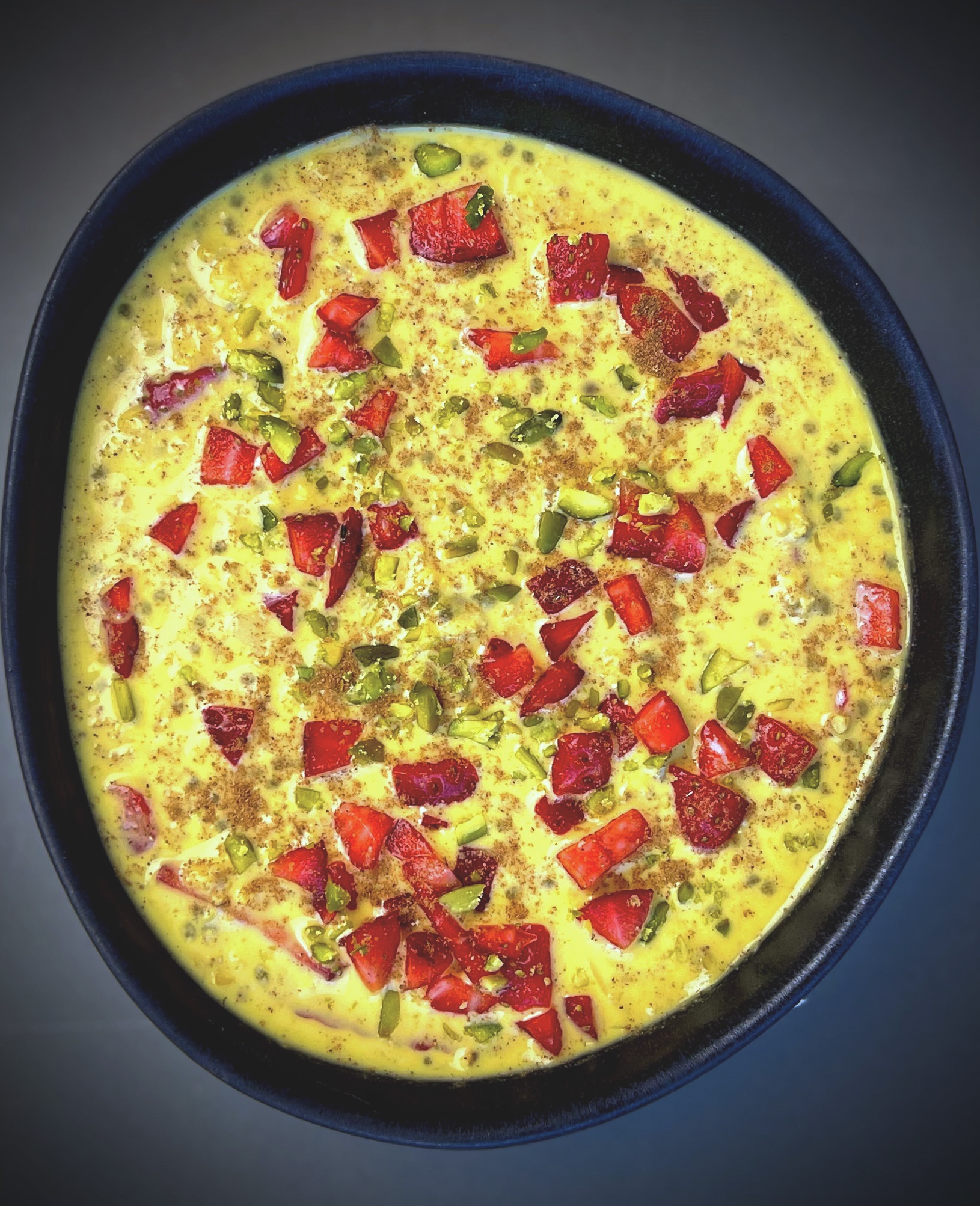
Tips for Making this Dish

You may have eaten Channa Masala, Channay or Chole before as this curry is known in the Indian subcontinent. As with all aromatic food, the longer you cook/leave it the more intense the flavours. I often prepare the chickpea curry the night before and let it simmer for over an hour to intensify the flavours.

I also make the parathas the night before and just heat them up in a dry frying pan or skillet the next morning so all I am cooking are the eggs on the day we want to eat this meal.

If you are making this dish all in one go, then make the chickpea curry first. While the tomato sauce is simmering (before you add the chickpeas), prepare the paratha dough. Then, after you add the chickpeas to the sauce, just let the curry simmer gently as you roll out and cook the parathas. Fry the eggs as the final stage.

How to Serve this Dish

Serve this dish with fresh herbs such as coriander, mint, Thai basil and tarragon alongside the parathas, curry and fried eggs. My family and I often eat this breakfast/brunch dish washed down with a homemade mango lassie or Persian tea.

Other Breakfast Inspiration

Breakfast is probably my favourite meal of the day so I invest as much time in it as I would an evening meal. Check out my other breakfast recipes to enjoy for weekend family brunches.


 A Baluchi-Style Breakfast

Prep Time30 minutes
Cook Time1 hour
Total Time1 hour 30 minutes
Course: Breakfast, Brunch
Cuisine: Iranian
Keyword: vegetarian, egg recipes
Servings: 6
Author: Mersedeh Prewer

Ingredients

For the chickpea curry

  • 2 tbsp vegetable oil
  • 1 onion (finely sliced)
  • 4 cloves garlic (crushed or minced)
  • Thumb-size piece fresh ginger (grated)
  • 1 tsp cumin seeds
  • 1 tsp ground coriander
  • 1 tsp turmeric
  • 1/4 tsp garam masala
  • 400 g tin of chopped tomatoes
  • 2 x 400 g tins of chickpeas (drained)
  • 200 mls water
  • Fresh lime juice (half a lime)
  • Salt and pepper (to taste)
  • Chopped fresh coriander (to garnish)

For parathas

  • 3 cups plain flour (UK standard measuring cup plus extra to sprinkle on parathas)
  • 1 tbsp vegetable oil
  • 2 tsp salt
  • Water (as required to form a sticky dough in the region of 1.5 to 2 cups)
  • Oil or ghee to brush and cook the parathas 

For the eggs

  • 6 large free-range eggs
  • 2 tbsp vegetable oil
  • Salt and pepper (to taste)

Instructions

For the chickpea curry

  • Take a saucepan and place it on medium-high heat. Add 2 tbsp oil.
  • Add onion and cook until it softens and turns golden. Then add garlic and ginger and stir.
  • Once aroma of garlic and ginger starts to permeate, add cumin seeds, ground coriander, turmeric and garam masala and stir. Allow mixture to cook with spices for about 2 mins.
  • Add chopped tomatoes and once bubbling lower the heat to low- medium to allow the mixture to simmer. Simmer for 20 to 30 mins.
  • Then add chickpeas, water, lime juice, salt and pepper and stir. Leave to simmer for 20 mins minimum until you are ready to serve. Garnish with fresh chopped coriander before serving.

For the parathas

  • Add flour, oil, salt, to a large mixing bowl and mix until incorporated and only tiny lumps remain. Initially add about 1 cup water and mix into flour mixture. Then add more water in small increments to form a dough (I usually require 1.5 to 2 cups of water in total to make a dough). Knead dough for about 5 mins and then leave to rest for 30 mins.
  • After resting time, the texture should be soft and dough lighter. Take the dough and split into 6 equal amounts and roll into a ball.
  • Sprinkle some flour onto work surface. Take one ball of dough and roll to approximately 10cm in diameter with a rolling pin. Brush with a little oil / ghee, sprinkle with a little flour and then fold the dough like a fan. Take one end and roll it along the edge of the dough until it forms back into a ball (like a Catherine wheel). Leave to rest in fridge while you repeat the process with the other balls of dough. This will create the layered, flaky texture for the final cooked parathas.
  • After preparing the ‘Catherine wheel’ dough balls, take a frying pan or skillet and place it on high heat. Drizzle some oil / ghee into pan.
  • Take dough balls out of fridge. Take the first dough ball and roll it until it is approximately 1/2cm thick. Then cook it in the hot pan for 3 minutes on each side, or until nicely charred. While cooking, brush with a little bit more oil / ghee on each side. Repeat with the remaining dough balls.
  • Once the parathas are cooked, turn off the heat and leave cooked parathas to one side until you are ready to serve.

For the eggs

  • Add oil to frying pan / skillet and place on medium-high heat.
  • Crack eggs into pan, cover with a tight lid and cook for 3 mins or until white is set.
  • Season with salt and pepper and serve alongside chickpea curry and parathas.

Sosis Bandari (Spicy Sausage Sandwich with Saffron Roasties)

A famous street-food sandwich from the South of Iran made with beef sausages, peppers and onions cooked in a spicy and rich tomato sauce. This recipe comes with a side of saffron tatties served with harissa mayo!

What is Sosis Bandari?

This dish is basically the Persian equivalent of a sausage sandwich! Beef sausages are cooked with onions and peppers in spicy tomato sauce and it is commonly served in a baguette-style bread.

Sosis Bandari translated is sausage from the port or port-style sausage. ‘Sosis’ is the Persian word for sausage, and ‘Bandar’ means port. Apparently this dish was invented in one of the northern ports of Iran, called Bandar Anzali where the first sausages were introduced from Iran (probably from Turkey). However, it became trendy amongst southern port residents, and the dish is now associated with Southern Iran. Iranians who live in the south of Iran mostly eat spicy foods and this dish packs a punch due to their revisions to the original recipe. 

Ingredients in Sosis Bandari

I love this dish as it is so easy to cook and, other than the sausage, all other ingredients are available at your local supermarket.

You will need:
  • Sucuk / Sujuk: a Turkish fermented sausage consisting of ground beef, garlic and other spices. they are encased in a red skin, which you peel off before cooking. You can buy them from most Middle Eastern supermarkets or online. If you cannot find sujuk, then use any other sausage you fancy including vegetarian or vegan varieties. Sujuk has a fair bit of oil in it and the heat of the pan should release sufficient amounts to cook the sausage and other vegetables. Add a dash of olive oil to your pan if required.
  • Garlic, turmeric and red chilli flakes: aromatics to flavour the dish.
  • Red onion, yellow pepper and cherry tomatoes: vegetables used for the dish.
  • Tomato puree and water: used to make the sauce for the Sosis Bandari.
  • Salt & Pepper: to season the dish.
  • Parsley: added as a garnish.

If you are using your local supermarket raw sausages then cook them first (as per the instructions on the packet) before slicing them up and adding to the recipe below.


Ingredients in Saffron Roasties and Harissa Mayo

Traditionally Sosis Bandari includes potatoes in the mixture itself, however my recipe extracts the potatoes and cooks them separately by making them into saffron flavour roasties to be eaten as a side dish and dipped into harissa mayonnaise. 

You will need:
  • Olive Oil: used to roast the potatoes.
  • New Potatoes: you can use any potatoes suitable for roasting. I use this variety as they are small, no need to peel and they cook quickly.
  • Saffron: used to flavour and colour the roasties.
  • Water: used to boil the potatoes. 
  • Salt & Pepper: to season the tatties.
  • Mayonnaise, Harissa Paste and Lime Juice: combined to make the Harissa may to dip the roasties in. I use Belazu Harissa paste either the rose or the standard version is fine.

How to Serve this Dish

I serve this dish as a sandwich using a rustic roll with a side of saffron roasties. I also love to put pickled cucumbers and some fresh herbs in the Sosis Bandari Sandwich. A cousin of mine recently mooted adding cheese to the sandwich which would also be an excellent addition.

Other Handheld Pockets of Deliciousness

Check out our other recipes:


Sosis Bandari

Persian spicy sausage with saffron roasties
Prep Time20 minutes
Cook Time45 minutes
Course: Main Course, lunch
Cuisine: Persian, Iranian
Keyword: spicy, easy recipe, sujuk, sucuk
Servings: 4
Author: Mersedeh Prewer

Ingredients

For the Saffron Roasties

  • 600 g new potatoes (halved – approx 150 grams per person)
  • 1/8 tsp ground saffron
  • Water to boil the potatoes
  • 2 tbsp olive oil
  • Salt and pepper (to taste)

For the Sosis Bandari

  • Approximately 300 grams of Sucuk Turkish sausages (remove outer skin / casing and slice diagonally) – see note above re: alternatives to sucuk
  • 2 cloves garlic (crushed)
  • 1 tsp turmeric
  • 1/2 tsp dried red chilli flakes
  • 1 large red onion (finely sliced)
  • 1 yellow pepper or red or green (finely sliced)
  • 1 heaped tbsp tomato purée 
  • 100 g cherry tomatoes (halved)
  • 100 ml water
  • Salt and pepper (to taste)
  • Fresh chopped parsley (to garnish)

For the Harissa Mayonnaise

  • 8 tbsp mayonnaise
  • 2 tbsp Harissa paste
  • A squeeze of a fresh lime

To Serve

  • 4 crusty rolls / mini baguettes
  • sliced gherkins or Persian pickled cucumbers and / or cheese can also be included in the sandwich

Instructions

Harissa Mayo

  • Combine mayo, harissa paste and lime juice in a small bowl. Cover and place in fridge until you are ready to serve the dish.

Roasties

  • Take a saucepan and fill with water, add halved new potatoes and saffron. Turn the heat to high and bring to a boil. Boil potatoes for approximately 8 to 10 minutes - you want them cooked through but not too soft as they will fall apart in the roasting stage.
  • While potatoes are cooking in the saucepan, pre-heat oven to 180°C (fan) / 200°C (conventional) / Gas Mark 6.
  • Turn the stove off and drain potatoes. Take a baking tray and place potatoes on it. Add oil, salt and pepper and toss potatoes until evenly coated. Place tray in oven and roast the potatoes for 30 minutes or until crispy to your liking.

Sosis Bandari

  • While potatoes are roasting, take a frying pan (about 30 cm diameter) and place on medium-high heat.
  • Add sliced sausages to pan, cook until they release oil and start to curl. Then add garlic, turmeric and chilli and stir until evenly distributed. Add sliced onions and pepper and stir until they start to soften.
  • Add tomato purée and stir. Add halved cherry tomatoes. Then add water and stir and lower heat to let the sosis bandari cook gently for about 5 minutes. Season to taste and scatter some chopped fresh parsley over the top.

Serving the dish

  • Turn oven and stove off. Remove the potatoes from the oven and place them on a paper towel to soak up any excess oil.
  • Fill rolls / baguettes with the sosis bandari (sliced gherkins or Persian pickled cucumbers and / or cheese can also be included in the sandwich).
  • Serve the sosis bandari sandwiches with a side of roasties and some harissa mayo to dip them in.

Persian Delights (Rose Water & Pistachio Cupcakes)

Make these Persian inspired cupcakes flavoured with rose water and pistachios. Beautifully elegant whether serving at home to friends or as wedding cupcakes.

I first made these cupcakes over 10 years ago for a friend’s wedding and they have been a firm favourite ever since.

I experimented with many flavours but these were the favourite amongst my family. Not surprising really as they are flavoured with rose water and pistachio. Had I found a use for saffron in the recipe, then I would have had the holy trinity of Persian desserts! But I felt the pink and ivory tones were perfect for the cupcakes’ presentation and that the yellow effect of incorporating saffron would not have been as aesthetically pleasing.

The Rise of the Cupcake

Cupcakes enjoyed a lot of attention and glamour following the episode in Sex and the City featuring Magnolia Cupcakes. The UK saw Violet’s Cakes, Hummingbird Bakery and Lola’s Cupcakes as the UK’s representation in the delicious world of luxury cupcakes.

Most people I speak to have baked cupcakes before but even if you are a first-timer, despite how pretty these mini cakes look, they are very easy to create. Many of us have cake-making equipment in our kitchen nowadays, such as electric beaters or stand mixers and if not it’s a great workout for the arms!

Standard Cake Batter Recipe

My go-to recipe for a basic cake batter is what I call the 4:225 ratio. For 4 eggs, I use a weight of 225 grams for the dry ingredients and butter.

  • Unsalted butter –  225 grams;
  • Caster sugar -225 grams;
  • Self-raising flour – 225 grams;
  • Free-range eggs x 4;
  • 1 teaspoon baking powder; and
  • 1 teaspoon Vanilla extract.

The above are the ingredients for a basic vanilla sponge. I then add other flavours, such as rose for this recipe or lime zest for my cherry and lime flavoured victoria sandwich. This standard cake batter recipe creates a lovely crumb and yields 12 cupcakes in a muffin-style tray or 1 x two layer victoria sandwich (8″ diameter). 

Decorating the Cupcakes

For the decoration, I use a standard buttercream icing flavoured with vanilla and rosewater. I use crushed fresh pistachio slivers and edible rose petals, which are both available from Iranian and Middle-Eastern supermarkets. If you cannot get your hands on rose petals, then crushed fresh pistachios are equally lovely for decorating.

Storing the Cupcakes

Store cupcakes in an airtight container for up to 3 days.


Persian Delights Instagram Reel


https://www.instagram.com/reel/CnjyceKAXQE/?utm_source=ig_web_copy_link


Persian Delights

Rose water and pistachio cupcakes
Prep Time25 minutes
Cook Time25 minutes
Total Time50 minutes
Course: Dessert, Sweet Treats
Cuisine: Persian, British, Cross-cultural
Keyword: cupcakes
Servings: 12 large cupcakes
Author: Mersedeh Prewer

Ingredients

Cake Batter / Sponge

  • 225 g unsalted butter (room temperature)
  • 225 g caster sugar
  • 4 medium free range eggs (room temperature)
  • 225 g self-raising flour
  • 1 tsp baking powder
  • 1 tsp vanilla extract
  • 1 to 2 tbsp rose water (depending on how floral you want it)
  • 1 to 2 tbsp ground fresh pistachios

Buttercream Icing and Decoration

  • 250 g unsalted butter (room temperature)
  • 450 g icing sugar
  • Pink food colouring (if you want your cupcakes to have a pink tint - I do a mix of ivory and light pink cupcakes)
  • 1 tsp vanilla extract
  • 1 to 2 tbsp rose water
  • 2 tbsp milk
  • Ground pistachios and edible rose petals (for decoration)

Instructions

For the Cupcake Sponge

  • Preheat oven to 160°C (fan) / 180°C (conventional) / Gas mark 4. Line a 12-hole cupcake tin with cases (deep fill cupcake tin).
  • In a mixing bowl, beat butter and sugar until light in colour and fluffy.
  • Crack eggs one by one and beat each one in before adding the next.
  • Add vanilla extract and rose water. Then sift flour and baking powder into bowl and gently fold into mixture.
  • Add ground pistachios and gently fold into mixture.
  • Divide mixture equally into cupcake cases and place in oven for 20 to 25 mins. To check if cupcakes are done, use a thin skewer to check one by gently poking to the bottom. It should come out clean of cake batter. Leave cupcakes to cool completely on a wire rack.

For the Buttercream Icing and Decoration

  • Make buttercream by beating butter until light in colour and then sift the icing sugar gradually and beat until fully mixed.
  • Then add vanilla extract, rose water and milk and mix. I halve my icing mixture and add pink food colouring to one batch and leave the other half an ivory colour. 
  • Make sure your cupcakes have cooled and then pipe or spread your icing onto the cupcakes.