Showing: 1 - 4 of 4 RESULTS

Sweet Potato & Leek Bolani with Coriander Chutney

This Afghan flatbread filled with sweet potato and leek, served with a coriander chutney is a wholesome and delicious vegan treat. 

What is Bolani?

Bolani (also called Periki) is a stuffed flatbread from Afghanistan. It is commonly cooked by frying and it has a thin crust, which can be filled with a variety of ingredients, such as potatoes, lentils, leeks or minced meat. It is usually served with a yoghurt and / or a coriander chutney. Bolani is made for special occasions but is also a popular street food available in Afghanistan.

It can be eaten as an appetiser, accompany a main meal or eaten as a snack. If you have ever eaten a stuffed Indian paratha or a Mexican quesadilla, then you will be familiar with the presentation of this dish. The main differences being that the Bolani is not flaky and layered like a paratha and not cheesy like a quesadilla, however the premise of of a stuffed type of flatbread is the same.

What is in this Recipe? 

A simple dough is made using plain flour, chapati flour (atta), salt, water and oil. The dough is rolled and then filled with a cooked a well seasoned sweet potato and leek mixture flavoured with fresh lime juice, aromatics and spices (garlic, turmeric, ground coriander, chilli, cinnamon and fresh coriander). The Bolani are then gently fried on a pan until toasted perfectly.

The Bolani is served with a simple chutney made by blitizing fresh coriander, the green ends of spring onions, garlic, gren chillies, walnuts, apple cider vinegar, olive oil, sugar, salt and pepper.

How to Serve this Recipe

This recipe is one of a series of recipes posted which forms an element of a larger family meal for my lot.  The others are Qorma-e-Lubia (Afghan red kidney bean curry) which I serve with rice, and  Maast O’Khiar (a yoghurt dip made with cucumber, mint and garlic). Whilst Maast O’Khiar is the Persian name for this dip, you may be familiar with the Mediterranean versions such as Tzatziki (Greek version), Cacik (Turkish version), Talattouri (Cypriot version). The Afghan version is called Jaan-e-ama and often eaten with Bolani.

Also serve with some finely chopped tomatoes and red onions dressed with olive oil, lime fresh coriander and salt and pepper as pictured.


Sweet Potato & Leek Bolani with Coriander Chutney

Afghan flatbread filled with sweet potato & leek, served with a coriander chutney
Prep Time45 minutes
Cook Time45 minutes
Resting time for dough30 minutes
Total Time2 hours
Course: lunch, Accompaniment, Appetizer, Main Course, Side Dish
Cuisine: Middle-Eastern, Afghan
Keyword: vegetarian, vegan
Servings: 4 (to 6)
Author: Mersedeh Prewer

Ingredients

Coriander Chutney

  • 1 bunch fresh coriander (about 100 grams)
  • 3 cloves garlic (crushed or minced)
  • The green ends of 4 spring onions
  • 1 to 2 green chilli peppers
  • 1/3 cup walnuts
  • 1/2 cup apple cider vinegar
  • 1 tbsp olive oil
  • 1/2 tbsp sugar
  • 1 tsp salt
  • 1/2 tsp pepper

Bolani Filling

  • 2 medium sweet potatoes (peeled and chopped into medium sized chunks)
  • 3 tbsp vegetable oil
  • 2 medium leeks (quartered and sliced)
  • 3 cloves garlic (crushed or minced)
  • 1 tsp turmeric
  • 1 tsp ground coriander
  • 1/2 tsp dried red chilli flakes
  • 1/4 tsp cinnamon
  • Juice of 1 lime
  • 3 tbsp chopped fresh coriander
  • Salt and Pepper (to taste)

Bolani Dough

  • 200 g plain flour
  • 100 g atta (chapati flour) (you can use wholemeal flour instead)
  • 1/2 tsp salt
  • 1 tbsp vegetable oil (plus extra to fry the Bolani)
  • 180 ml water

Instructions

Coriander Chutney

  • Make the chutney ahead (minimum 2 hrs before eating) to let the flavours settle.
  • Add coriander, garlic, walnuts, chillies and scallion ends to a food processor and pulse until finely chopped.
  • Add the vinegar and pulse a few more times - the chutney should have a coarsely chopped appearance. Add olive oil, sugar, salt and pepper and taste. Adjust seasoning if necessary. Pour chutney into a sterilised jar with a lid. Place in the fridge until you are ready to use. Any left over chutney keeps for 2 months in the fridge and can be used for other dishes including grilled meats, roast vegetables or curries.

Bolani Filling

  • Steam or boil the sweet potatoes until cooked / soft.
  • Add 3 tbsp of vegetable oil to a large frying pan / skillet and place over a medium / high heat. Add leeks and cook until softened. Add garlic and turmeric and stir into the leeks until evenly distributed and aroma released.
  • Add ground coriander, dried red chilli flakes and cinnamon and stir.
  • Add sweet potato and mash into the mixture until the leek mixture is fully integrated into the mashed sweet potato.
  • Add fresh lime juice and the finely chopped fresh coriander leaves. Add salt and pepper and taste, adjust seasoning if required. Take off the heat and set aside to cool until you are ready to stuff the Bolani dough.

Bolani Dough

  • Stir flours and salt together in a large mixing bowl. Make a well in the center and add the vegetable oil and water. Form a shaggy dough with your hands, then turn out onto a clean work surface. Knead the dough for 5-10 minutes until you have a smooth dough. Place the dough in the mixing bowl and cover. Set aside to rest for 30 mins,
  • Divide the dough into 6 equal pieces. Roll one piece of dough on a clean surface until the dough is 15cm in diameter.
  • Divide the sweet potato filling into six and fill half of the round of dough by spreading into a thin layer, leaving a 1cm empty space around the edge. Fold the empty top half of the dough over the filling and press down to seal, stretching parts of the dough to create an even crescent shape. Place on baking paper until ready to cook.
  • Heat a large non-stick frying pan or skillet over medium-low heat. Add 1 tsp of vegetable to the pan. When the oil is hot, add 1 Bolani and fry for about 2 minutes on each side until golden brown. Then place on a paper towel to soak up oil while the others fry. Feel free to keep the cooked Bolani in a low / medium heat oven to keep warm while you fry the others.
  • Serve the Bolanis warm / hot with the coriander chutney and / or yoghurt based (or non-dairy yoghurt) dip.

Qorma-e-Lubia (Afghan Kidney Bean Stew)

This vegan stew heralding from Afghanistan is a gorgeous dish full of goodness. Kidney beans are cooked in an aromatic tomato sauce, perfect for spooning over rice or eating with flatbread.

A Snippet on Afghanistan

Afghan cuisine includes dishes and cooking techniques also seen in Persian, Central Asian and Indian cuisines due to Afghanistan’s close proximity and historical cultural connections.

The two official languages spoken in Afghanistan are Dari and Pashto. Dari is the official name of the variety of Persian language spoken in Afghanistan. It is often referred to as Afghan Persian. Although still widely known as Farsi (the official language of Iran) to its native speakers, the name was officially changed to Dari in 1964 by the Afghan government. Pashto is an Eastern Iranian language Indo-European family. It is also the second-largest provincial language of Pakistan, spoken mainly in the northwestern province of Khyber Pakhtunkhwa and the northern districts of the Balochistan province.

I remember the first time I heard someone speaking Dari (1980 something). I asked my mother why I could understand a language which seemed familiar but unfamiliar at the same time. The words made sense to me but the rhythm the language was being spoken in was different to the Farsi I had grown up with. And that is when I learnt about Afghanistan, their languages and the relationship with Iran.

My journey into Afghan cuisine came later in my life but as with learning about our connections in language, their cuisine has brought me great joy and continues to do so. There are many Afghan dishes that feel familiar to me due to my Persian background, but there are also a huge amount of dishes new to me which I have loved learning to cook! And the first I am introducing to you is my version of Qorma-e-Lubia. 

What is Qorma-e-Lubia?

Qorma or Ghorma is the Afghan name given to an onion and tomato-based stew or casserole, usually served with rice (challow, Persians call their rice chelow). First, onion is caramelized, for a richly colored stew. Then tomato is added, along with a variety of meat and/or lentils, spices, and vegetables, depending on the recipe. The main ingredient, which can be meat, beans or vegetables, is usually added last. There are many different qormas including:

  • Qorma e gosht  – a meat stew usually served at gatherings;
  • Qorma e nadroo – lamb or veal, yogurt, lotus roots and coriander;
  • Qorma e alou-bokhara wa dalnakhod – veal or chicken, sour plums, lentils and cardamom;
  • Qorma e sabzi – lamb, sautéed spinach and other greens;
  • Qorma e lawand – chicken, lamb, or beef, plus yogurt, turmeric and coriander; and
  • Qorma e shalgham – a sweet and sour qorma made with lamb, turnips and sugar.

Qorma-e-Lubia is simply made with red kidney beans as the protein element and cooked with an onion and tomato base flavored with garlic, turmeric, coriander, cumin and dried mint. I also add a little garam masala to mine.

The flavour of this qorma (as with many stew style dishes) gets better if eaten the day after cooking. Therefore, I recommend making it a day before you want to serve it and then heating it up. The flavours really fuse together brilliantly with a little more time to get to know each other.

For those of you familiar with Indian cuisine, you will note this recipe is very similar to the North Indian dish Rajma Masala. Pakistan and Nepal also have a version of this dish.

How to Serve Qorma-e-Lubia

Serve it with flatbread such as the stuffed Afghan flatbread Bolani, rice (kateh or chelow), a nice crunchy salad with a citrus dressing and / or a yoghurt or non-dairy dip. I have served mine with Maast O’Khiar, the Persian yoghurt and cucumber dip, as pictured below.

Variations

You can use dried instead of canned kidneys beans. If you are using dried kidney beans you will need approximately 250 grams. Remember to wash, soak, drain and then cook the beans before adding them at step 7 below. Kidney beans are toxic if not prepared properly when starting with the dried form and can cause tummy upsets, so make sure you follow the instructions on the packet or google it.

Other Plantbased Recipes 


Qorma-e-Lubia

Afghan Kidney Bean Curry
Prep Time20 minutes
Cook Time1 hour 15 minutes
Total Time1 hour 35 minutes
Course: Main Course
Cuisine: Afghan
Keyword: vegetarian, vegan
Servings: 4
Author: Mersedeh Prewer

Ingredients

  • 3 tbsp vegetable oil
  • 2 tsp coriander seeds
  • 1 tsp cumin seeds
  • 1 large onion (finely diced)
  • 3 cloves garlic (crushed or minced)
  • 1 tsp turmeric
  • 1/2 tsp dried red chilli flakes
  • 1 tsp dried mint
  • 3 medium tomatoes (roughly chopped)
  • 3 tbsp tomato purée
  • 600 ml vegetable stock
  • 2 x 400 g cans of kidney beans (or 250 grams of dried kidney beans cooked in accordance with package instructions)
  • 1/2 tsp garam masala
  • Juice of 1 lime or half a lemon
  • Salt and Pepper (to taste)
  • Chopped fresh coriander leaves and sliced sping onions (to stir through / garnish before serving)

Instructions

  • Place a medium to large saucepan (which has a lid) on a medium / high heat and add the oil.
  • Bash the coriander and cumin seeds in a pestle and mortar and then add to the saucepan. Cook for about a minute. Keep a close eye on them so they don't burn. Lower the heat to medium, if necessary.
  • Then add chopped onions and cook until they brown / caramelise.
  • Add the garlic and turmeric and stir to distribute evenly into the onions. Then add dried mint and dried chilli flakes (feel free to exclude chilli or revise chilli levels down if half a teaspoon feels a bit too much for you).
  • Add the chopped tomatoes and stir now and again until they break down (roughly 5 to 10 minutes).
  • Add the tomato purée and stir until evenly distributed and follow with the vegetable stock. Give the mixture a good stir and let it come to a boil and then reduce the heat to low / medium to allow to simmer. Place the lid on the saucepan and let the sauce simmer for a minimum of 30 min or longer - ideally when you start to see the oil form a little round the edges of the sauce.
  • Then add your cooked kidney beans, garam masala, the lime (or lemon) juice, salt and pepper and stir. Leave to simmer with the lid on for a further 15 to 30 mins.
  • Taste and adjust seasoing if required. Before serving, stir through some fresh chopped coriander. Spoon the Qorma into your serving dish and sprinkle with the sliced spring onions. Serve with flatbread and / or rice, yoghurt-style dip and / or salad and pickles (torshi).


Maast O’Khiar (Persian Yoghurt & Cucumber Dip)

This Persian staple is a creamy dip made with Greek yoghurt, cucumber, fresh lime juice, mint and garlic. Often served as an appetiser or alongside main dishes. 

What is Maast O’Khiar?

Maast O’Khiar is a Persian dip made with salted strained yoghurt mixed with cucumbers, garlic, salt, pepper, olive oil, lemon or lime juice, and mint.

It is commonly served as a cold appetiser or as a side dish at Persian gatherings or restaurants. It is a creamy and fresh tasting dip, perfectly balancing Persian dishes ranging from the stews to the kebabs. 

Most of you will be familiar with this dip or similar-style dips eaten across the Levantine / Middle-Eastern and Mediterranean parts of the world. Maast O’Khiar is the Persian name for our version of the yoghurt and cucumber dip, but you may know it as Tzatziki (Greek version), Cacik (Turkish version), Talattouri (Cypriot version), Jaan-e-ama (the Afghan version).

Preparation

There are various ways of preparing this dip when it comes to the cucumber element. Some peel, de-seed and dice the cucumber. Others grate it. This recipe uses the whole cucumber, including the skin, grated and mixed into Greek yogurt. The yoghurt is further flavoured with a combination of dried and fresh mint, garlic and lime juice. 

My favourite Greek yoghurt is Total 5% which you can purchase from most British supermarkets. Any other Greek yoghurt or Greek-style yoghurt is fine to substitute.

This is a super easy dip to make but, in order for the flavours to intensify and settle properly into the dip, I would recommend making it a day before you want to tuck into it. At the very least a 1 hour resting time.

Variations

Persians also vary their Maast O’Khiar by mixing in sultanas and walnuts and / or sprinkling with dried rose petals as a garnish, so feel free to mix it up if you fancy!

Lemon juice can be used as a substitute to lime juice. Also feel free to use herbs such as dill, coriander or parsley if you don’t like mint.

How to Serve Maast O’Khiar

This dip can be eaten as an appetiser with a variety of crudités, crisps and flatbread. As an accompaniment to the main event, if you are making a Persian spread of food, a bowl of this dip will compliment all the dishes as pictured below.

Other Yoghurt Based Dips

Click on the link below for other delicious Persian yoghurt dips:


Maast O'Khiar

Persian yoghurt & cucumber dip
Prep Time15 minutes
Resting time1 hour
Total Time1 hour 15 minutes
Course: Appetiser, Accompaniment
Cuisine: Persian, Iranian, Middle-Eastern
Keyword: Tzatziki, Cacik, Talattouri, Jaan-e-ama, mast o khiar
Servings: 6
Author: Mersedeh Prewer

Ingredients

  • 500 g strained Greek Yoghurt (I use Total 5%)
  • 1/2 large cucumber (grated with skin and seeds)
  • 1 tsp dried mint
  • 1 tsp fresh mint (chopped)
  • 1 large clove garlic (crushed)
  • 1 tbsp extra virgin olive oil (and extra to drizzle on top)
  • Juice of half a lime
  • Salt and Pepper (to taste)
  • Fresh mint and chopped cucumber (to garnish)

Instructions

  • Take a bowl, add the yoghurt, grated cucumber, dried mint, fresh mint, crushed garlic, 1 tbsp of olive oil, lime juice, salt and pepper and stir. Taste and adjust seasoning or other flavours as desired.
  • Cover the bowl and leave in the fridge for the flavours to intensify and mix well through the yoghurt (no less than 1 hour). When you are ready to serve the Maast O'Khiar, drizzle some olive oil on top and decorate with fresh mint and / or cucumber and / or dried rose petals and / or dried mint.
  • Serve alongside a Persian spread, as part of a mezze-style spread of dishes, or as an appetiser. Or like some Iranians, sit in front of the telly with a bowl of Maast O'Khiar and a massive bag of crisps and dip away!

Simit (Turkish Sesame Encrusted Bread)

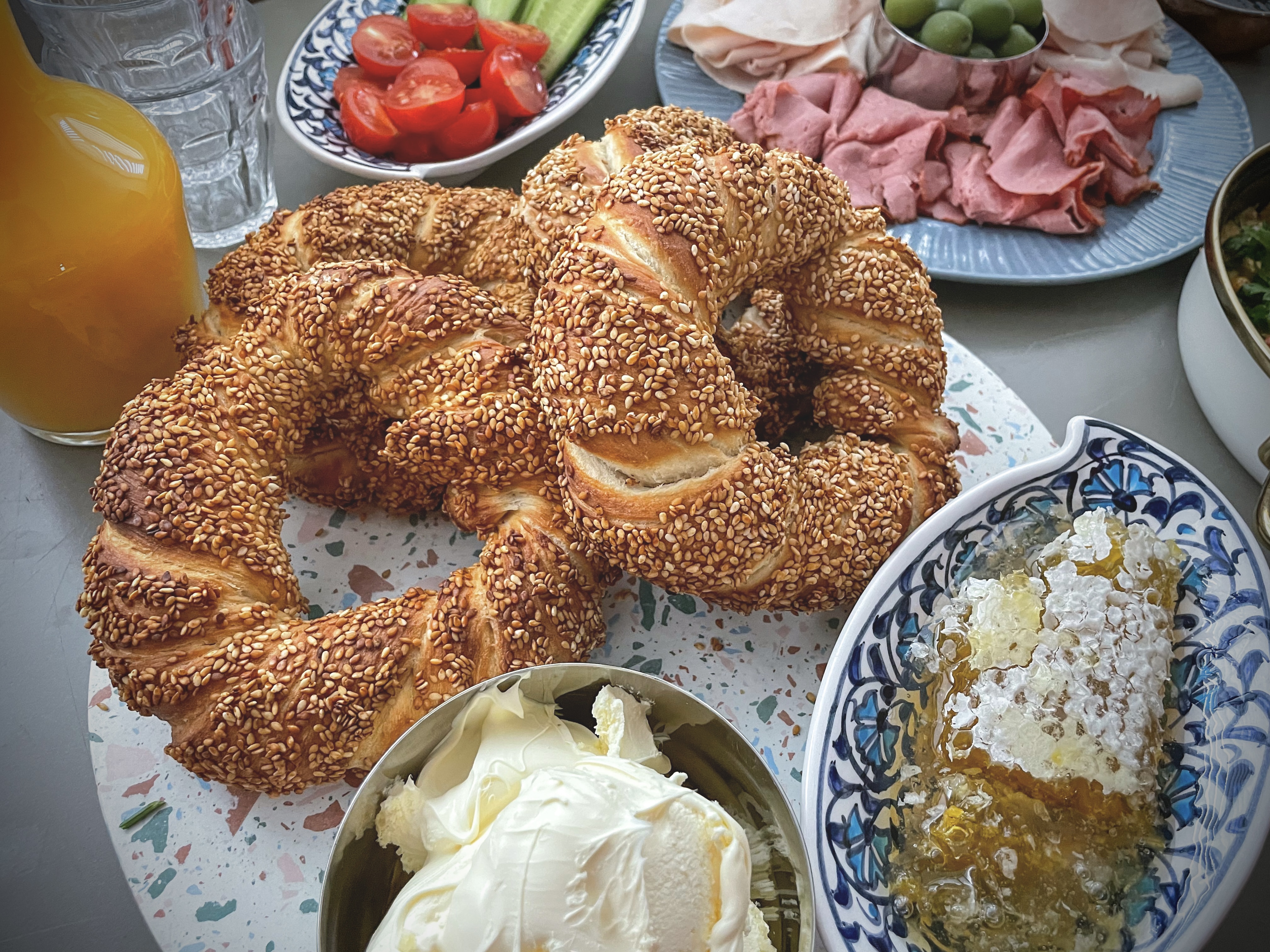
Also know as the Turkish Bagel, these beautifully doughy yet crunchy sesame encrusted bread rings are perfect for a Turkish-style breakfast or as sandwich bread.

What Is Simit?

Simit is a circular bread encrusted with sesame seeds, which is common to the cuisines of the former Ottoman Empire and the Middle-East. It is widely known as a Turkish bagel in the USA and Koulouri in Greece. They are commonly eaten at breakfast and are a much loved street food available on many corners in Istanbul. They have a crispy exterior and a soft doughy interior, which can be created using a standard bread dough mixture.

The distinctive taste of Simit comes from a combination of toasted sesame seeds and a grape molasses glaze. Grape molasses can be found online or at Middle-Eastern supermarkets. Sesame seeds are widely available in their raw form, so you will need to toast them in a dry frying pan before coating the Simit rings.

Kahvalti

I was first introduced to Simit during one of our holidays in Turkey. Many of us Iranians love holidaying in Turkey as it feels familiar but with the freedoms we cannot enjoy in our own motherland. In fact, I have travelled to Turkey more than I have to Iran. The hospitality, the food and the weather make for the perfect destination for my family and it feels like home. 

The variety of baked goods available in Turkey is incredible and Simit is no exception. You will often find it offered as part of the Turkish breakfast spread offering known as Kahvalti. The commitment to breakfast is incredible in Türkiye. Kahvalti translates to “before coffee” and is all about gathering and sharing dishes with your family. Turkish restaurants and families at home prepare many little dishes to fill the breakfast table, allowing you to sample them at your leisure .

How to serve Simit

When I bake them at home, we either eat them with feta and halva or with clotted cream and honey. We also love having them as an accompaniment to egg dishes (as pictured below). The recipe for Nargessi (Persian spinach Eggs as pictured) can be found here.

For a traditional Turkish breakfast serve alongside with Menemen (Turkish scrambled eggs with tomatoes).

Storing Simit

Simit is at its best fresh out of the oven. Store in an airtight container up to 3 days once it is cool. Just bake in  a medium to hot oven for 5 to 10 mins to refresh or slice and toast.


Simit

Turkish Bagels
Prep Time20 minutes
Cook Time20 minutes
Proving Time x 21 hour 30 minutes
Total Time2 hours 10 minutes
Course: Breakfast, Accompaniment
Cuisine: Turkish
Keyword: Simit, Turkish Bagel, Gevrek, Koulouri
Servings: 6
Author: Mersedeh Prewer

Ingredients

Simit Dough

  • 500 g strong white bread flour (plus extra for sprinkling on your surface when shaping the Simit)
  • 7 g fast-action yeast
  • 1 tsp salt
  • 300 ml tepid water
  • A little olive oil (to oil the bowl the dough proves in)

Simit Topping

  • 100 ml grape molasses (üzüm pekmezi)
  • 50 ml water
  • 2 tsp flour
  • 300 g toasted sesame seeds

Instructions

  • Mix strong white flour, salt and fast-action yeast in a large bowl making sure the salt and yeast are kept apart at this initial stage. Make a well in the centre, then add 300 ml water, and mix well.
  • Tip onto a lightly floured work surface and knead for around 10 mins. Once the dough is smooth, place it in a lightly oiled bowl and cover with cling film. Leave to rise for 1 hour or until doubled in size.
  • Mix the grape molasses, water and flour in a large bowl.
  • Prepare the toasted sesame seeds. Take the raw sesame seeds, toast in a dry pan until golden, shaking and stirring the pan regularly. Take care not to burn the seeds. It should only take a few minutes to toast the sesame seeds.
  • Preheat the oven to 220°C / fan 200°C / gas 7 / 425°F. Place a baking tray in the oven.
  • Once the dough has proved, cut into 12 equal sized pieces. Sprinkle some flour on the surface and roll each piece into a long sausage about 25cm long. Take two of the rolled dough pieces and place them alongside each other. Squeeze the ends together and roll the ends in opposite directions, causing them to braid. Squeeze the two ends together to form a ring. Repeat with the remaining dough.
  • Dip the simits into the grape molasses mixture until covered. Cover completely with sesame seeds. Stretch the dough a little as you do this to ensure the Simit is even but don't worry if it is not perfect - rustic is a great look! Place the ready Simits on a piece of baking paper, cover with a tea towel and let prove for a further 30 mins.
  • Bake for 15 to 20 mins until cooked through and golden brown on the outside. Check the Simit occasionally to make sure it doesn't burn and turn the heat down if necessary.
  • Leave to cool on a cooling rack. Simit is best eaten while still warm so if you don't eat them straight away, reheat in the oven before consuming.