Showing: 1 - 20 of 20 RESULTS

Meygoo Dopiyazeh (Persian Prawn, Pepper & Onion Curry)

Prawns are cooked in a spicy and fragrant sauce to create this curry-style dish heralding from Shiraz in the South of Iran.

What are Dopiyazeh Dishes?

You may be familiar with dopiaza dishes from South Indian cuisine where this curry-style dish made with lots of onions commonly features. This dish actually originates from  Khorasan (in present-day covering the East of Iran and the West of Afghanistan).  It was apparently introduced to South Asia by the Mughals. It apparently then spread to countries with a South Asian diaspora. Regional variants have evolved in locales such as Hyderabad, India and several regions of Pakistan. The name Dopiyazeh translates into two onions (‘do’ meaning two in Persian; and ‘piyaz’ meaning onion) which makes reference to the amount of onions used in this dish.

Dopiayzeh is now firmly established as a traditional dish from Shiraz. It can be made with cubed or ground lamb/beef, chicken, shrimp, potatoes, and a copious amount of sliced onions.  My recipe is made with prawns (‘meygoo’) and takes both the Persian origins and the South Asian development of this dish with a few extra additions of my own. There is a slight heat to my recipe, which you can leave out if you prefer.

How to Serve this Dish

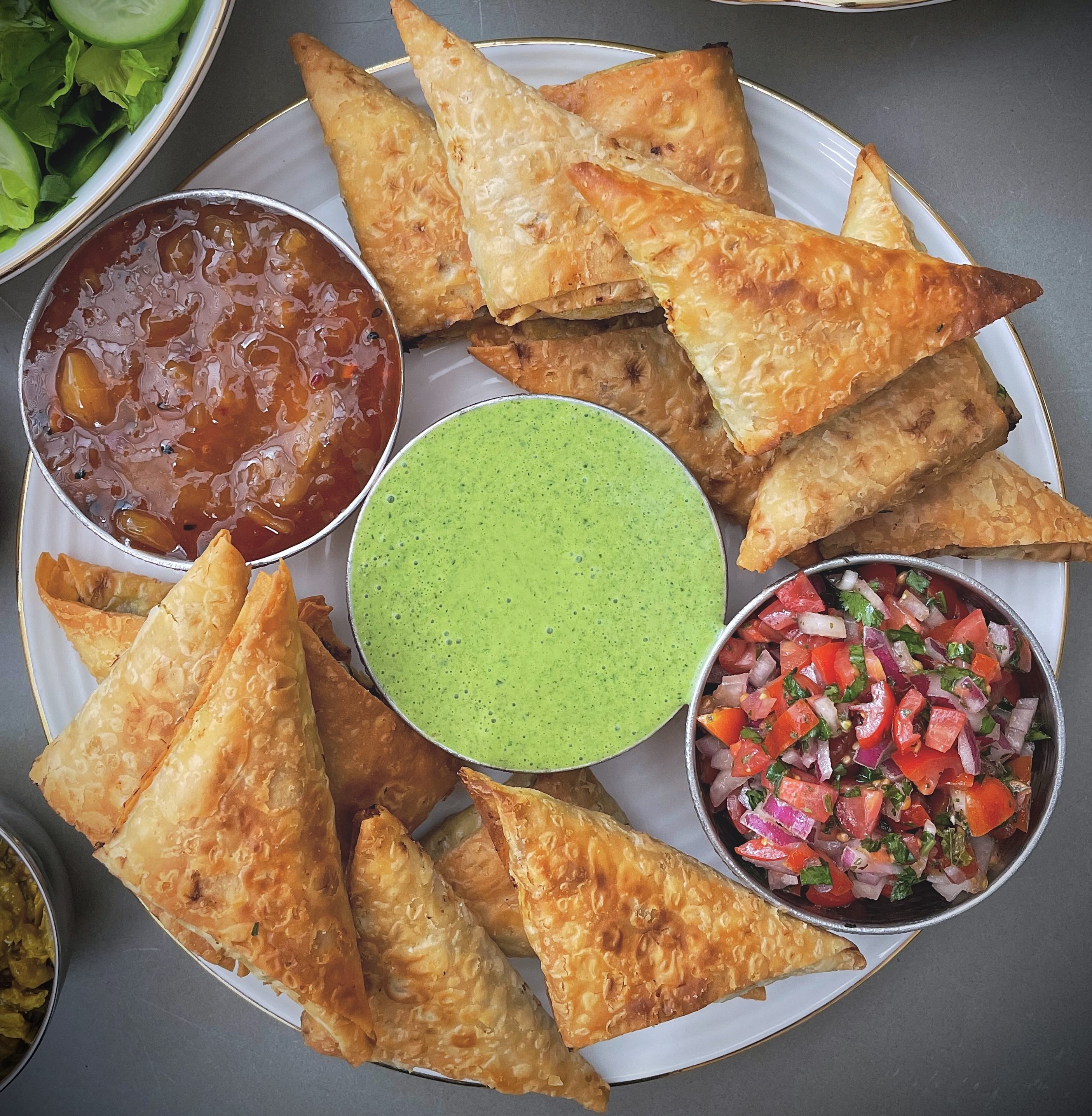
This dish pairs well with my Sambuseh-e Sabzijaat (vegetable samosas) recipe, rice and some delicious pickles and chutneys such as mango chutney and turmeric pickle as pictured above. The rice I have made is Persian-style rice with naan tahdig but I have flavoured it with turmeric, cardamom pods, some cloves and cinnamon to make it a pilau-style rice.


Meygoo Dopiyazeh

Prawn, pepper & onion curry
Prep Time20 minutes
Cook Time1 hour
Total Time1 hour 20 minutes
Course: Main Course
Cuisine: Persian, Iranian, Inspired by....
Keyword: curry, seafood, prawns
Servings: 4
Author: Mersedeh Prewer

Ingredients

  • 3 tbsp vegetable oil
  • 1 tsp cumin seeds
  • 2 tsp black mustard seeds
  • 1 tsp coriander seeds
  • 1 large brown onion (finely sliced)
  • 6 cloves garlic (minced or crushed)
  • 1 thumb size fresh ginger (grated)
  • 1 tsp turmeric
  • 1/2 tsp dried red chilli flakes
  • 1 tsp ground coriander
  • 3 tbsp tomato purée
  • 1 red pepper (finely sliced)
  • 1 red onion (finely sliced)
  • 800 ml water mixed with 1/8 tsp of ground saffron
  • Juice 1 fresh lemon
  • 1/2 tsp garam masala
  • 800 g frozen shelled tiger prawns (defrosted)
  • Salt and Pepper (to taste)
  • A small bunch of fresh coriander (finely chopped)

Instructions

  • Place a large casserole pan or skillet on medium-high heat and add oil. Add cumin seeds, coriander seeds and mustard seeds and heat until they sizzle. Then add finely sliced brown onion and cook until they start to caramelise.
  • Add garlic, then ginger and stir into the onion mixture. Follow with turmeric, red chilli flakes, ground coriander and stir until evenly distributed into the mixture.
  • Add tomato purée and stir into the mixture. Then add sliced red peppers and red onion and stir until softened. Add saffron water, lemon juice and garam masala and stir. Bring to a boil and then turn heat down to allow the sauce to simmer gently for 30 mins.
  • Add prawns to the sauce and stir. Add chopped fresh coriander and cook for a further 10 mins. Turn the heat off and serve the Meygoo Dopiyazeh with fresh chopped coriander sprinkled on top accompanied with rice and / or naan.

Sambuseh-e Sabzijaat (Persian Vegetable Samosas)

The Persian version of the samosa. This triangular snack takes lavash bread and fills it with a spicy vehetable mixture before frying to crispy perfection! PS they are vegan too!

A Little History on this Triangular Snack

Did you know that the samosa has a Central Asian origin? The earliest recipes are found in 10th–13th-century Arab cookery books, under the names sanbusaksanbusaq, and sanbusaj, all deriving from the Persian word sanbosag. In Iran, we have a version which we call Sambuseh. These delightful little parcels filled with meat and / or vegetables were introduced to the Indian subcontinent in the 13th or 14th century by chefs from the Middle East and Central Asia.

The Persian Version

The key difference with the Persian sambuseh is that we use lavash bread (a thin flatbread usually served with kebabs) as the outer casing. In Iran the lavash bread has large air pockets so it creates an amazing pattern on the Sambuseh that looks a little like bubble wrap in crispy fried bread form.

The fillings for sambuseh vary from meat and vegetable to vegetables only. My preferred filling for a samosa / sambuseh is veggie so the recipe I have developed below is virtuously meat-free. In fact the sambuseh, themselves, are vegan. The accompanying dip can be adapted by using a plant-based yogurt to make this recipe fully vegan. I have also been drawn to spices more common to South Asian cuisine including the use of chilli, mustard seeds, garam masala and ginger. The coriander and mint dip I have accompanied the sambuseh with is also inspired by South Asian cuisine.

Feel free to experiment with vegetables and / or meat fillings. And leave out and / or include spices as desired. I encourage people to experiment with and put their stamp on recipes. What I hope I am providing you is ideas for you to expand your catalogue of recipes, which you can dip in and out of.

How to Serve Sambuseh

The sambuseh can be served with any sauces and pickles you fancy. This recipe has a coriander and mint dip to go with it but I also serve mine with mango chutney and some chopped tomatoes and red onion, dressed with fresh coriander and a squeeze of lime juice.

You can also serve this alongside with Meygoo Dopiyazeh(Persian prawn, pepper & onion curry).


You can find a short video of me folding the Sambuseh to help with the recipe through the link to my Instagram below.


Just scroll across and you can see the video…

https://www.instagram.com/p/CifKuZloY3S/?utm_source=ig_web_copy_link


Sambuseh-e Sabzijaat

Persian vegetable samosas served with a coriander & mint dip
Prep Time20 minutes
Cook Time45 minutes
Total Time1 hour 30 minutes
Course: Snack, Appetiser, Accompaniment
Cuisine: Persian, Iranian, Cross-cultural
Keyword: vegetarian, vegan option
Servings: 20 (to 25)
Author: Mersedeh Prewer

Ingredients

Sambuseh

  • 3 tbsp vegetable oil
  • 2 tsp mustard seeds
  • 1 tsp cumin seeds
  • 1 red onion (finely diced)
  • 4 cloves garlic (crushed or minced)
  • 1 thumb size ginger (grated)
  • 1 tsp turmeric
  • 1/2 tsp dried red chilli flakes
  • 1 tbsp tomato purée
  • 450 g cooked potatoes (boiled and peeled) (finely diced)
  • 85 ml water
  • 1 cup peas
  • 1 cup sweetcorn
  • 1 tsp garam masala
  • Juice of half a lime
  • Small bunch fresh coriander (finely chopped)
  • Salt and pepper (to taste)
  • 10 sheets lavash bread
  • Vegetable oil (to fry the sambuseh)

Coriander & Mint Dip

  • 70 g fresh coriander (stalks included)
  • 10 g fresh mint leaves
  • 6 tbsp Greek yoghurt
  • Juice of 1 lime
  • Salt and pepper (to taste)
  • 1 clove garlic
  • 1/2 tsp sugar

Instructions

  • Coriander & Mint Dip:
    Add all ingredients to a blender / nutribullet / food processor and blend until smooth. Taste and adjust seasoning and / or lime juice to taste. Pour into a container (i.e. jar) cover and place in fridge until you are ready to serve the sambuseh.
  • Sambuseh:
    Place a frying pan or skillet on medium-high heat and add oil. Add mustard seeds and cumin seeds and heat until they start to sizzle.
  • Add red onion and cook until they start to caramelise. Add garlic and stir in and repeat process with ginger, turmeric and chilli.
  • Add tomato purée and stir until the mixture is evenly coated. Add the cooked, finely diced potatoes and water and stir into the mixture. Follow with peas and sweetcorn. Lower the heat and stir the mixture until the potato is a little mashed into the mixture.
  • Add garam masala, lime juice, fresh coriander, salt and pepper and stir. Taste and adjust seasoning / lime juice to your preference. Turn the heat off and let it cool before filling the lavash bread pockets.
  • To make the lavash bread pockets - cut into long strips about 10 cm in width. Lay the long rectangle strip on your work surface with the short edge facing you. Fold over the right half of the lavash strip to form a triangle with the long edge facing downwards, then fold the bottom of the triangle up so the long edge faces up. Then take the left corner of the triangle and fold up to the right hand corner to make the final triangle pocket. You will be left with a flap to tuck in after filling the sambuseh. Fill the sambuseh pocket with some filling, making sure not to overstuff. Then trim the flap of the sambuseh pocket and cut diagonal strip off one of the corners of the flap so you can tuck it in. Tuck the flap in and put the finished sambuseh aside until you are ready to cook. Repeat the process until you have used all the filling (makes between 20 to 25 sambuseh).
  • To cook the sambuseh, half-fill a deep, heavy-based pan with vegetable oil and heat until a cube of bread dropped in sizzles and turns golden-brown in 30 seconds (please be careful with the hot oil and do not leave unattended). Fry the samosas in small batches for 4-5 minutes, or until golden-brown and crisp. Remove from the oil with a slotted spoon and drain on kitchen paper.
  • Serve with the mint and coriander dip, mango chutney and some chopped tomato and onion, dressed in fresh lime juice as pictured above.


Khoresh Kadoo ba Aloo (Chicken, Courgette & Sour Plum Stew)

This sweet and sour chicken, courgette and plum stew, flavoured with cardamom, turmeric and saffron is a great addition to your catalogue of weekday meals. Ready to eat in an hour for you and your family.

Coming to the end of the Summer

Khoresh (Persian stew) season is awakening from it’s summer slumber after an array of kebabs, kuku and salads in my household.

I love this season with the deeply comforting stews to warm us through the colder months and, of course, any excuse to eat more Persian rice and Tahdig. I appreciate that cooking Persian food can appear daunting to some, but as with any recipe after you have cooked the dish say about 3 times, added your own little bit of magic to it too, the whole process is familiar and fairly swift. With all that said I am always looking for ways to produce delicious Persian food for weekday meals at a shorter time than sometimes prescribed for our dishes, particularly our slow-cooked stews.

AKA the 1 hour Stew

Let me introduce you to Khoresh Kadoo ba Aloo (chicken, courgette & sour plum stew). This khoresh is ready to eat about an hour from when you start chopping all the ingredients. The use of chicken breast means it doesn’t need to slow-cook and the meat remains juicy. Courgettes (‘kadoo‘) cook in no time at all and a few little tricks with additional spices / condiments means it is perfectly balanced and feels like the khoresh has fallen into place with its flavours (as if it has been simmering for hours). This dish is a great transition dish from summer to autumn as it uses courgettes which are still in season to October.

What is Aloo?

Aloo is the name we give to the dried sour plums (Aloo Bukhara) you can buy them from Asian (for example Indian and Pakistani) supermarkets. If you don’t use all the packet in one go then put the remaining plums in the freezer and they keep for ages until you want to cook this recipe again or try out my other recipe featuring them Khoresh-e Beh ba Aloo (chicken stew with quince, sour plums and apricots). Remember that the sour plums have pips in them which you can remove while you are eating – the plums will fall apart easily once cooked and you can remove them with your spoon and fork while eating.

How to Serve this Dish?

Serve Khoresh Kadoo ba Aloo with kateh (Persian easy cook rice) for dinner to be ready within an hour.

How to Store Leftovers?

Once cooled, store in an airtight container in the fridge up to 3 days. Gently reheat in a saucepan on the stove or in the microwave.


Khoresh Kadoo ba Aloo

Persian Chicken, courgette and sour plum stew (aka the 1 hr stew)
Prep Time15 minutes
Cook Time45 minutes
Total Time1 hour
Course: Main Course
Cuisine: Persian, Iranian
Keyword: easy recipe, stew, Middle-Eastern Food, khoresh, weekday meal
Servings: 4
Author: Mersedeh Prewer

Ingredients

  • 3 tbsp vegetable oil
  • 3 medium courgettes (quartered and then halved)
  • 1 large brown onion (finely diced)
  • 4 cloves garlic (crushed)
  • 1 tsp turmeric
  • 4 medium chicken breast (cut into bite size pieces)
  • 1 tbsp tomato purée
  • 3 cardamom pods
  • 1 bay leaf
  • 500 ml vegetable stock plus 1/4 tsp ground saffron dissolved in the stock
  • 15 to 20 Aloo Bukhara (dried sour plums)
  • Juice of 1/2 lime
  • 1 tbsp honey
  • Salt and pepper to season

Instructions

  • Take a large non-stick casserole pan / skillet with a lid and place over high heat. Add 3 tablespoons oil. Fry the courgette on all sides until browned and golden. Remove and place on a kitchen towel on a plate.
  • Add diced onions to pan and cook until golden. Add garlic and stir in, followed by turmeric. Stir until evenly distributed in the pan and you can smell the aromas.
  • Add chicken and stir until the chicken pieces turn white (from pink). Then add tomato purée and stir until the chicken mixture is coated evenly.
  • Throw in cardamom pods and bay leaf and then pour in the saffron infused stock. Add the Aloo Bukhara plums. Season with salt and pepper, squeeze in the juice of 1/2 lime and add honey. Stir the mixture.
  • Gently place the fried courgettes in the stew so they are part submerged. Bring the stew to a boil and then turn the heat down to allow the khoresh to simmer with the lid on (approx 30 mins).
  • Serve with Persian rice and salad.

Cherry and Feta Salad with Pistachios

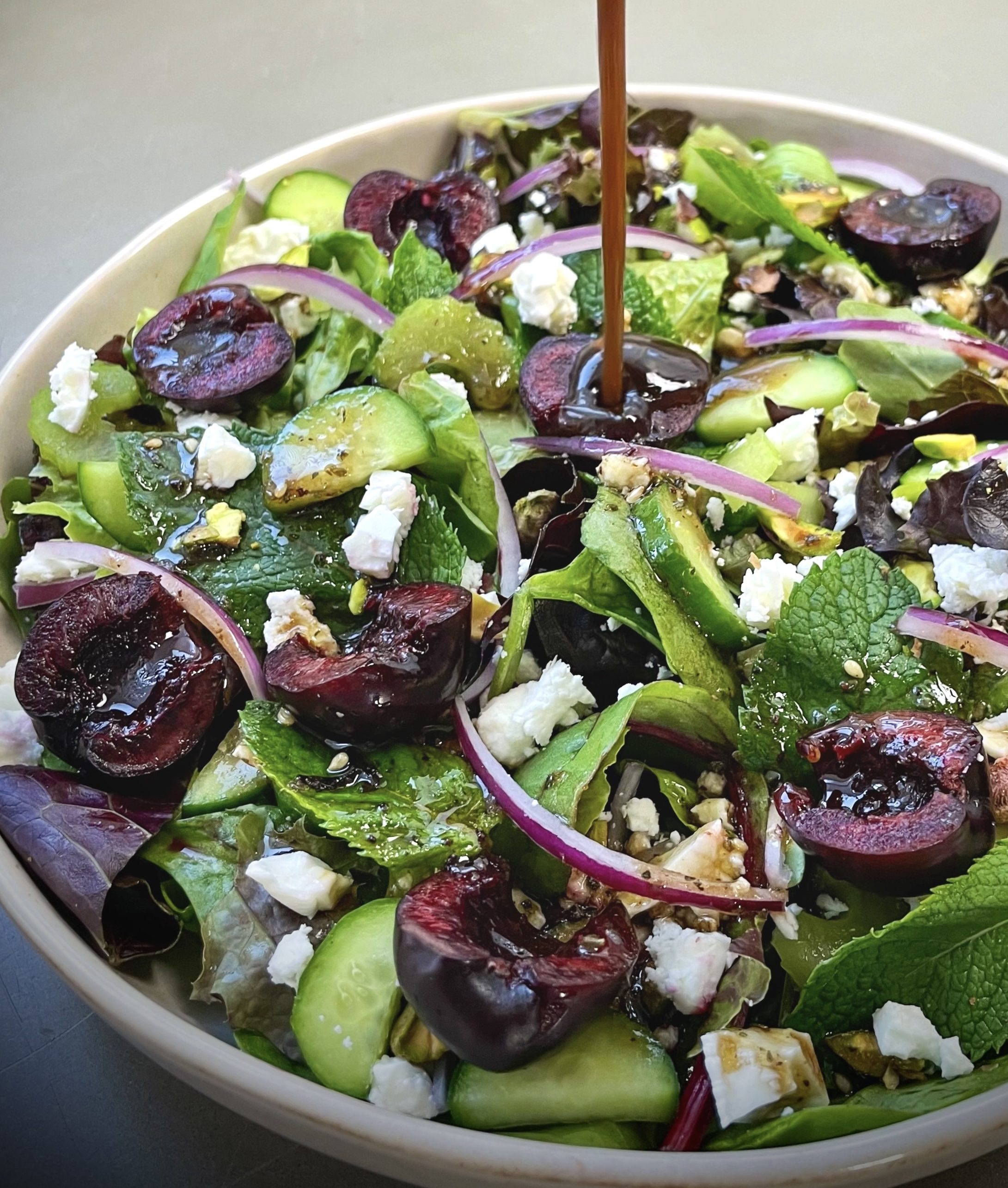
A lettuce-based salad, with a nod to Persian flavours, jewelled with crumbled feta, ripe cherries, crunchy pistachios and dressed with a pomegranate vinaigrette.

We Persians are not known for our salad recipes. In fact we generally only have two known salad recipes. The first is Salad Shirazi – our chopped cucumber, tomato and red onion salad with a lime, olive oil and mint dressing. The second is Salad Olvieh – our take on a Russian potato salad dish.

This salad is very much a homage to ingredients that are associated with Persian cuisine. It is also a homage to the summer season with its refreshing feel and seasonal ingredients.

What you will need to make this Dish

For the pomegranate vinaigrette you will need the following ingredients:
  • Olive Oil – use extra virgin olive oil. EVOO is a premium product made from cold-pressed olives. Regular olive oil is often a blend, combining processed oils in the mix. EVOO is a healthier choice as it retains vitamins and natural antioxidants, which can be lost during processing. And it has a superior flavour!
  • Pomegranate Molasses – is a thick syrup with a dark grape colour made from reducing pomegranate juice. You can pick up pomegranate molasses from most local supermarkets, Middle-Eastern food shops and online.
  • Red Wine Vinegar – a product made by oxidising red wine. Popular in Mediterranean cooking, it has a distinctive tangy flavour. It is a popular choice for vinaigrettes.
  • Lime – adds a citrus note to the vinaigrette.
  • Honey – a little sweetness to balance the sharpness of the vinaigrette.
  • Za’atar Spice Blend – is a herb and spice blend popular in Levantine cooking. It contains sumac, dried Za’atar leaves, sesame seeds and salt. A staple for Middle Eastern cooks, often sprinkled on hummus, salads, roasted vegetables, and grilled meats and fish. Mixed with olive oil, it becomes the perfect dip or a spread for flatbreads. It has a flavour profile which is musky, citrusy, and nutty. Find my recipe to make a homemade version of this blend here.
  • Salt & Pepper – to season the salad. The Za’atar spice blend and the feta contain salt so you may not need as much salt as you would normally add to a dressing.
For the salad you will need the following ingredients:

Make sure you use fresh ingredients for the salad.

  • Lettuce or mixed leaves – either is fine or a mix of both.
  • Celery, Red Onion, Cucumber – these hero ingredients add a crunchy texture and refreshing taste to the salad.
  • Cherries – are in season between June and July. Make sure they look plump and juicy and remember to pit them before adding to the salad.
  • Fresh Mint Leaves –  complements the other flavours in this salad brilliantly such as the feta and cherries.
  • Feta always use high quality feta sold in blocks and in stored in brine.
  • Pistachios – you can either use the green pistachio kernels or ones in shells. You will need to take the shells off before adding them to the salad!

What to Serve with this Salad

A great accompaniment to kebabs such as Persian saffron chicken kebabs (Jujeh Kabab) or pan-cooked kofte kebabs (Kabab Tabei).

Also great served alongside any of the Persian frittata dishes – kuku!


Cherry and Feta Salad with Pistachios

Prep Time20 minutes
Total Time20 minutes
Course: Appetizer, Main Course, Side Dish
Cuisine: Mediterranean, Middle-Eastern, Inspired by....
Keyword: cherries, feta, vegetarian, mint, salad
Servings: 6 (to 8)
Author: Mersedeh Prewer

Ingredients

Pomegranate Vinaigrette

  • 70 ml olive oil
  • 2 tbsp pomegranate molasses
  • 2 tbsp red wine vinegar
  • Juice of half a lime
  • 2 tbsp honey
  • 2 tsp Za'atar spice blend
  • Salt and Pepper (to taste)

Salad

  • 180 g lettuce / mixed leaves (roughly chop if using lettuce, mixed leaves should remain intact)
  • 1 - 2 celery sticks (medium sliced)
  • 1 red onion (finely sliced)
  • 150 g cucumber (I use baby or Persian cucumbers - quartered then medium sliced)
  • 250 g cherries (pitted and halved)
  • 15 - 20 g fresh mint leaves (small leaves can be kept, roughly chop larger leaves)
  • 100 g feta (crumbled)
  • 40 g pistachios (shelled and roughly chopped or bashed in a pestle and mortar)

Instructions

  • Pomegranate Vinaigrette:
    Make the dressing a minimum of 1 hour before you want to serve the salad to let the flavours infuse. Take a jar with a lid and add all the pomegranate vinaigrette ingredients. Screw the lid on and give it a good shake. Taste and adjust elements to taste. Place the jar in the fridge until ready to serve.
  • Serving the Salad:
    Layer your ingredients for the salad in a bowl. Give the jar of dressing a good shake and pour over the salad. Using salad tongs / spoons, toss the salad to ensure it is evenly coated with the pomegranate vinaigrette. Serve immediately after dressing.

Kuku Loobia Sabz (Persian Green Bean Frittata)

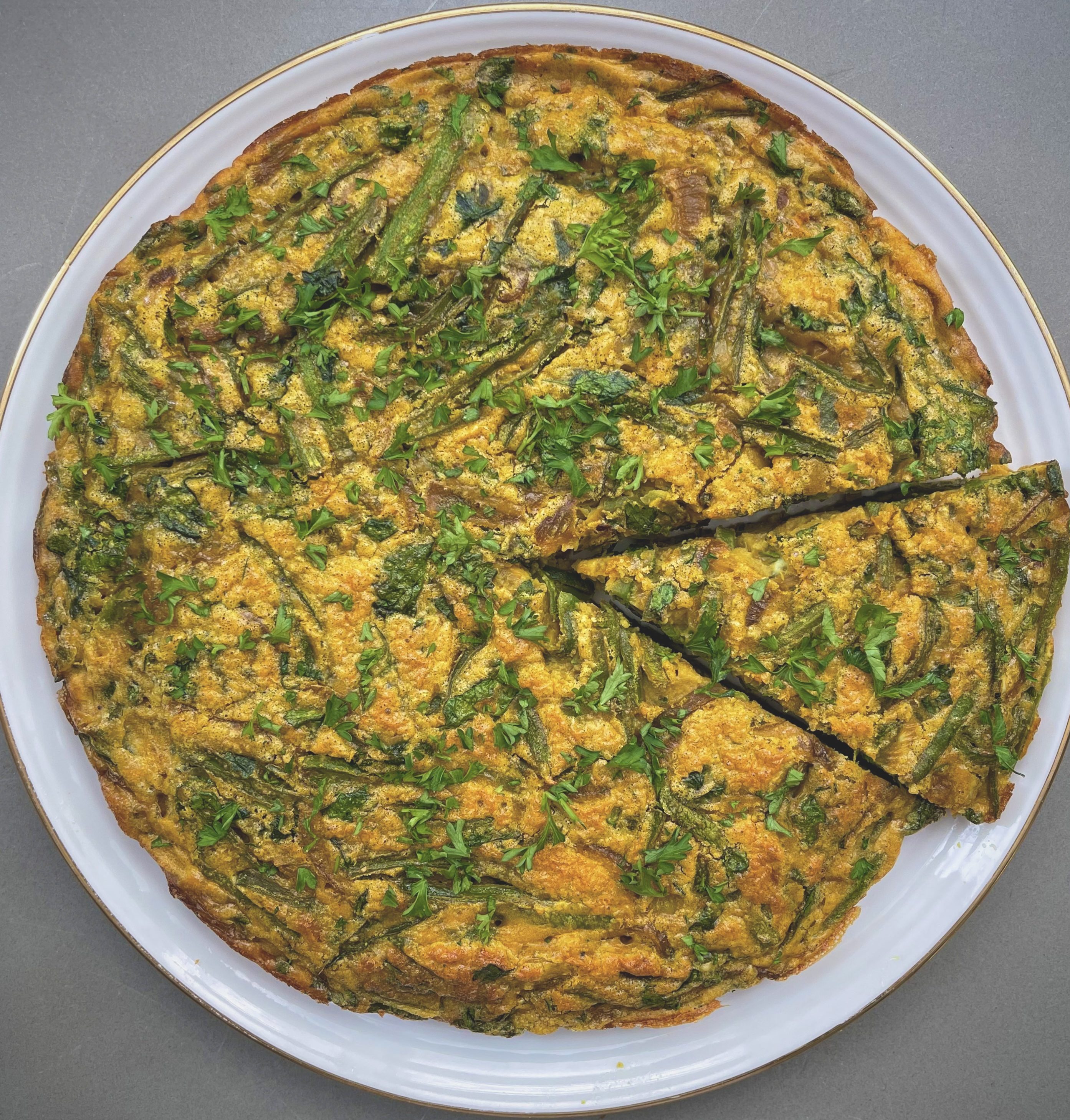
A delicious summer frittata made with eggs, green beans, caramelised onions and flavoured with turmeric, saffron and Persian mixed spice (advieh).

What is Kuku?

Kuku is an Iranian frittata-style dish. It is often vegetarian and is made with beaten eggs and various herbs and / or vegetables folded in. The main difference between kuku and its western counterparts is the ratio of egg to vegetables, with kuku favouring the latter. It is served either hot or cold as a starter, side dish or a main course, and is accompanied with bread or rice and either yoghurt or salad.

The two most well known kuku recipes are Kuku Sabzi (made with herbs and barberries and / or walnuts); and Kuku Sibzamini (made with potatoes). We also have Kuku Kadoo (made with courgettes). Ultimately there are no hard and fast rules about what you should put in your kuku – I have made ones with potatoes, feta and beetroot; curried mushrooms; kale and red pepper; bacon, cheese and tomatoes and the list goes on…

Origins of Kuku Loobia Sabz

This Kuku recipe hails from Tabriz, a city in northwestern Iran, serving as the capital of East Azerbaijan Province. It is the fifth most populated city in Iran and the largest economic hub and metropolitan area in northwest Iran. The population is overwhelmingly Azerbaijani who speak the Azerbaijani language, though Persian is spoken by residents as a second language.

This dish is a gorgeous addition to the summer catalogue of recipes as it is light and easy to prepare. some variations of this recipe include potatoes but the version I prefer is with caramelised onions and sliced green beans as set out in the recipe below. I use garlic, saffron, turmeric and advieh as the aromatics for the dish. You can buy the advieh I use for this recipe and others here.

How to Serve Kuku Loobia Sabz

Serve this dish with a salad like cherry and feta salad, hummus such as beetroot hummus and flatbread.

Leftovers

Store leftovers in the fridge in an airtight container up to 3 days. Cool the kuru down completely before refrigerating.


Kuku Loobia Sabz

Green Bean Frittata
Prep Time15 minutes
Cook Time40 minutes
Total Time55 minutes
Course: Accompaniment, Main Course, lunch, Appetiser
Cuisine: Iranian, Middle-Eastern
Keyword: vegetarian, frittata, Green beans
Servings: 4 (to 8)
Author: Mersedeh Prewer

Ingredients

  • 3 tbsp vegetable oil
  • 1 medium red onion (finely sliced)
  • 4 garlic cloves (minced or crushed)
  • 1 tsp turmeric
  • 250 g green beans (sliced)
  • 1.5 tsp Advieh (persian mixed spice)
  • 1/3 cup saffron water (bloom 1/8 tsp of ground saffron in the water)
  • Juice of half a lime
  • 20 g fresh coriander plus a bit extra for garnishing the kuku before serving (finely chopped)
  • 50 g plain flour
  • 1 tsp baking powder
  • 8 large eggs
  • 1 tsp salt
  • 1/2 tsp ground black pepper

Instructions

  • Preheat oven to 160°C (fan) / 180°C (conventional) / Gas mark 4.
  • Place a non-stick skillet or frying pan which can be placed in an oven on medium-high heat on the stove (size of pan anything between approx 10" and 12" i.e. 25 to 30 cm).
  • Add 2 tbsp oil and heat until it glistens. Then add finely sliced onion and cook until golden and caramelised. Stir in garlic, turmeric and advieh.
  • Add sliced green beans, the lime juice and saffron water and stir until the beans have wilted and the liquid has cooked off. Lower the heat if required. Stir in the freshly chopped coriander. Turn off the heat while you prepare the egg mixture.
  • Add flour and baking powder to a bowl. Crack in one egg and whisk until all the flour is incorporated and no flour lumps remain. Then add remaining eggs, the salt and pepper and whisk. Pour in the bean mixture and stir until fully incoprated with the egg mixture.
  • Turn the heat to medium-high on the stove. Place the skillet on the heat and add 1 tbsp oil. Pour the kuku mixture in and tip the pan gently side to side to make sure it is evenly distributed across the pan. Heat on the stove for approximately 3 minutes. Then place in the preheated oven and bake for a further 20 to 25 mins. To check the kuku is done, use a thin skewer and gently poke the middle of the kuku. It should come out clean.
  • Remove the kuku from the pan and serve with a sprinkle of freshly chopped coriander alongside a salad, flatbread and yoghurt-style dip and / or mezze-style dishes. Kuku can be served hot, warm or cold. Leftover kuku is a great sandwich filler too!

Beetroot Hummus with Feta and Anything-Green Topper

A beautifully vibrant hummus made with beetroot and topped with a contrasting medley of green vegetables, herbs, feta and nigella seeds. 

This gorgeous hummus with a contrasting and complementary green topper came about by chance one weekend. I love both beetroot and hummus – the combination of the two brings about a delicious hummus with a slightly sweet yet earthy flavour profile. The colour, as you can see, is a vibrant pink and will look incredible at any dinner party as an appetiser for your guests.

What’s in the Topper?

After making a batch, my eyes kept being drawn to green items in my fridge which I felt would look incredible as a topper for the hummus.  Luckily, the green items I had in my fridge all complemented a beetroot hummus perfectly including cucumber, olives, spring onions and dill. With the addition of feta (also a great friend of beetroot) and a few extra sprinkles (nigella seeds) and spice (cumin), a dash of olive oil and lemon juice, this hummus was complete.

Serve this Dish Alongside…


Beetroot Hummus with Feta and Anything-Green Topper

Prep Time30 minutes
Total Time30 minutes
Course: Dip, Appetiser, Accompaniment
Cuisine: Mediterranean, Middle-Eastern, Inspired by....
Keyword: vegetarian, vegan option, hummus
Servings: 6 (to 8)
Author: Mersedeh Prewer

Ingredients

Beetroot Hummus

  • 1 jar chickpeas (660g / drained weight 425g) (drained and rinsed)
  • 125 g cooked beetroot
  • 2 cloves garlic (minced or crushed)
  • 1 tsp ground cumin
  • 1/4 cup olive oil (60 ml)
  • 1/4 cup tahini (60 ml)
  • Juice of 1 lemon
  • 1/4 cup water (60 ml)
  • Salt & pepper (to taste)

Topper

  • 2 baby cucumbers
  • 2 spring onions
  • 5 green olives
  • 50 g feta cheese (non-dairy alternative if vegan or preferred)
  • 1/4 tsp ground cumin
  • 2 tsp nigella seeds
  • 1 tbsp finely chopped fresh dill
  • Drizzle of olive oil and a squeeze of lemon juice

Instructions

Beetroot Hummus

  • In order to get a smoother hummus (and if you can be bothered), after draining the chickpeas and rinsing, place the chickpeas on one half of a tea towel and rub gently with the other half of the tea towel to agitate the skins off. Then pick out the chickpea skins before blitzing.
  • Add all hummus ingredients, except water, salt and pepper to a food processor / nutribullet. Blend until smooth. Then add water and blend further until you have a creamy texture. Season to taste. Adjust seasoning and / or lemon juice to taste. I leave my hummus in the fridge while I prepare the topper to firm up the consistency a little.

Topper

  • Finely dice cucumbers, spring onions and olives. Crumble in feta and add cumin, nigella seeds and dill. Drizzle olive oil and lemon juice and stir gently to mix all the topper ingredients.

To Serve

  • Spoon the hummus onto a serving dish and arrange the topper in the shape of a crescent as pictured above. Drizzle with olive oil. Serve alongside flatbread, crisps / crackers or vegetables to dip into the hummus.

Persian Fried Chicken Burger aka PFC Burger

This crispy Middle Eastern inspired fried chicken burger is marinated in a turmeric and saffron infused buttermilk and then dredged with flour, Persian mixed spice and za’atar to create a real treat that’s finger licking good!

Jump to Recipe

Fried chicken in any form has a special place in my heart (and my belly)! I am continuously looking for ways to bring new joy to me eating crispy fried chicken, from my curried chicken schnitzel recipe to my shwarama flavoured crispy goujons, it was only a matter of time before I found a way to make a Persian version of a fried chicken burger and here it is in all its glory.

What makes PFC so special?

Chicken thighs marinated in a blend of buttermilk, saffron, turmeric, chili sauce, onions and garlic. Then coated with flour flavoured with Persian mixed spice (Advieh), Za’atar, onion and garlic powder and then deep fried to perfection. Served in a toasted brioche bun with lashings of moosir mayonnaise, crispy onions, Persian pickled cucumbers, Thai basil, tomato and lettuce. This amazing variation to the classic crispy chicken burger really is worth going the extra mile to get your hands on three Persian elements which are not readily available in your local supermarket.

Advieh

The Persian equivalent of mixed spice. It is used in many dishes with the combination of spices varying from region to region in Iran. Advieh is a fragrant mix of spices and can be compared in use to garam masala in Indian cooking, whereby its addition seasons the dish and adds a further layer of aromatics. It can simply be sprinkled on a plain rice dish, added to stews and marinades for meat. The one I use is a mixture of nutmeg, rose petals, cumin, cardamom, coriander, cinnamon and black pepper.

I buy it online from a supplier on Etsy. However, advieh can also be picked up from most Iranian or Middle Eastern food shops. This spice forms part of the flour dredge for the chicken thighs and takes the flavour profile to another level of delicious.

Moosir

Described in English as a Persian shallot, it is similar to a Solo or Elephant garlic. It has a flavour profile similar to garlic but slightly sweeter and softer in its spiciness. They grow wild in the foothills of the Zagros Mountains, and have to be found and dug out of the earth – a similar process to truffles. It adds an amazingly distinctive flavour to dishes.

You can buy moosir from most Middle Eastern food shops or online. It is available in its dried form and needs to be rehydrated by soaking in water overnight. Whilst we usually use this for our yogurt dip Maast O’Moosir, I started adding it to my mayonnaise and have not looked back. It is so delicious. I am pretty sure once you try it, you will also never want to have mayonnaise any other way. The Moosir Mayo compliments this chicken burger brilliantly.

Khiarshoor

They are baby cucumbers pickled in salt, vinegar and flavoured with tarragon. Our pickled cucumbers are not sweet like British pickled cucumbers and they really compliment this burger. You can buy them online or in most Middle Eastern supermarkets, but if you cannot get your hands on them then normal dill pickles usually used in burgers are absolutely fine.

With the exception of three items above, you should be able to source all the other ingredients from your local supermarket. Both Tescos and Waitrose now have Thai basil available but if you can’t get your hands on Thai basil, then Italian basil is totally fine.

How to Serve this Dish

Serve this burger with some french fries for the perfect fakeaway!


See my how to reel on instagram via the link below


https://www.instagram.com/reel/Cf4yljVIKlg/?utm_source=ig_web_copy_link


Persian Fried Chicken Burger aka PFC Burger

Prep Time45 minutes
Cook Time15 minutes
Total Time1 hour
Course: Main Course
Cuisine: Inspired by....
Servings: 4
Author: Mersedeh Prewer

Ingredients

Buttermilk Marinade

  • 500 ml buttermilk
  • 1/8 tsp ground saffron
  • 1/2 tsp turmeric
  • 1 tbsp chilli sauce
  • 1 tsp salt
  • 1/2 tsp ground black pepper
  • 4 cloves garlic (crushed or minced)
  • 1 onion (medium sliced)
  • 4 chicken thighs (skinless and boneless)

Moosir Mayonnaise

  • 8 discs dried moosir
  • 1/2 cup mayonnaise

Flour Coating

  • 250 g plain flour
  • 2 tbsp advieh (Persian mixed spice - Cardamom, Black Pepper, Dried Rose Petals, Cinnamon, Nutmeg)
  • 2 tbsp Za'atar spice blend
  • 2 tsp garlic powder
  • 2 tsp onion powder
  • 1 tsp salt
  • Vegetable oil (for deep frying)

To serve

  • 4 Burger Baps (such as Brioche buns)
  • Lettuce
  • Tomatoes
  • Thai Basil
  • Pickled cucumbers

Instructions

Marinade the Chicken Thighs

  • Take a large bowl, add buttermilk, ground saffron, turmeric, chill sauce, salt, pepper, garlic, onion and mix with spoon. Add the chicken thighs and ensure they are full submerged in the marinade. Cover and leave in the fridge to marinade anything between 8 hrs to 24 hrs.

Rehydrate the Moosir

  • Rehydrate the moosir by placing n a bowl and adding boiling water. Cover and leave overnight.

Moosir Mayo

  • Drain the rehydrated moosir discs and rinse. Mince finely with a sharp knife, discarding any tough parts. Take a bowl, add mix the moosir and mayo. Cover the bowl and leave in the fridge for the flavour of the moosir to permeate through the mayo (no less than 3 hours before you want to eat your burger).

Prepare the Flour Coating and Fry the Chicken

  • Make the coating by combining the flour, advieh, za'atar, garlic and onion powder, salt and pepper.
  • Drain the chicken thighs and sliced onion, reserving the marinade. One by one, dredge each thigh in the flour, then dip in the reserved marinade, then dredge again in the flour, pressing on as much as you can to coat. Transfer the coated thighs to a large plate. Do the same with the sliced onions.
  • Heat a 20cm depth of oil in a saucepan or deep-fat fryer until it reaches 175C (please be careful with the hot oil and do not leave unattended). Lower two of the thighs in at a time and fry undisturbed for 3 mins, making sure the temperature doesn’t drop below 160C (it should stay at about 170C). Fry until deeply golden and crisp on both sides. Lift the chicken out and transfer to a tray lined with kitchen paper to drain, then put on a rack and keep warm in a low oven while you fry the remaining thighs and sliced onions. When all the chicken and onions have been fried get ready to build your burger!

Serving the Chicken Burgers

  • Lightly toast your burger buns. Spread the Moosir Mayo on both ends of the buns, layer with lettuce, sliced tomates, Perisan pickled cucumbers, the fried chicken thigh, ketchup, the crispy fried onions and Thai Basil. Pop the top of the bun on and tuck in! A side of fries go very well with this burger and hoepfuly there will be some of the Moosir Mayo left to dip into.


Saffron & Sun-Drenched Tomato Focaccia

A Middle Eastern inspired simple no-knead focaccia recipe with the addition of saffron and sun-drenched tomatoes. Wonderfully fluffy and moreish.

What is Focaccia?

Focaccia is a flat leavened oven-baked Italian bread. It can be served as a side dish or as sandwich bread and it can be round, rectangular, or square shape. I love making focaccia in the summer and this recipe feels particularly summery with its warming saffron notes and the use of sun-drenched tomatoes.

The Difference between Sun-Drenched and Sun-Dried Tomatoes?

Sun-drenched tomatoes have had less time in the sun (to remove some of their water content) and are slightly less chewy and more juicy than sun-dried but you can totally substitute with sun-dried tomatoes. Feel free to add rosemary or other herbs to the focaccia. The sun-drenched tomatoes I use come in an oil and basil dressing so I just use that.

The Magic of ‘No Knead’

You achieve a rise from a no-knead focaccia by leaving the dough it in the fridge over night. But if you want the focaccia quicker, then mix all the dough ingredients and knead by hand for 10 to 15 minutes. Leave to prove until it has doubled in size (up to 2 hrs) and then follow steps 3 to 5 below.

How to Serve

Serve with a charcuterie-style board of Italian cold cuts and picky bits as pictured above. Also great served as part of a Mezze offering in light of the Middle Eastern flavours.

Picture above – before the focaccia is popped in the oven.

Other Bread Recipes


Saffron & Sun-Drenched Tomato Focaccia

No-knead focaccia
Prep Time20 minutes
Cook Time20 minutes
Total Time40 minutes
Course: Appetizer, Side Dish, Appetiser
Cuisine: Cross-cultural
Servings: 10
Author: Mersedeh Prewer

Ingredients

  • 400 g strong white bread flour
  • 5 g fast-acting dried yeast
  • 4 tbsp olive oil (plus extra for greasing)
  • 160 g pack sun-drenched tomatoes (I use Waitrose ones which have a basil dressing)
  • 1 tbsp sea salt flakes
  • 250 ml tepid water plus 1/4 tsp of ground saffron (bloom the saffron in the water for about 5 minutes before adding to flour)

Instructions

  • Add flour, yeast, 1 tbsp olive oil and 1 tsp salt into a large bowl. Add 250ml saffron water and mix with a wooden spoon to make a sticky dough. Cover with cling film and put in the fridge overnight or up to 24 hrs.
  • Once the dough has doubled in size, remove from the fridge and leave in a warm place for no less than 1 hr to bring up to room temperature.
  • Oil a 23cm (ideally square) roasting tin and scrape the dough in. Oil your hands and push the dough out towards the edge of a tin to create a rough square shape. Cover and leave for about an hour or two in a warm place.
  • After this further proving time, the dough will be very soft and airy and filled the tin comfortably. Scatter and push in the tomatoes, sprinkle the remaining salt over and drizzle with a little olive oil. Use your fingertips to create dimples in the dough, pressing in the tomatoes and spreading the dough to the corners. Cover and leave to rise for another 1 hr.
  • Heat oven to 220C/200C fan/gas 7 at least 15 mins before cooking the bread. Uncover the dough, drizzle with the remaining oil and bake on the middle shelf for 20 mins or until golden brown. Cool in the tin for about 10 mins before transferring to a wire rack, or eat warm.

Adasi (Persian Lentil Stew)

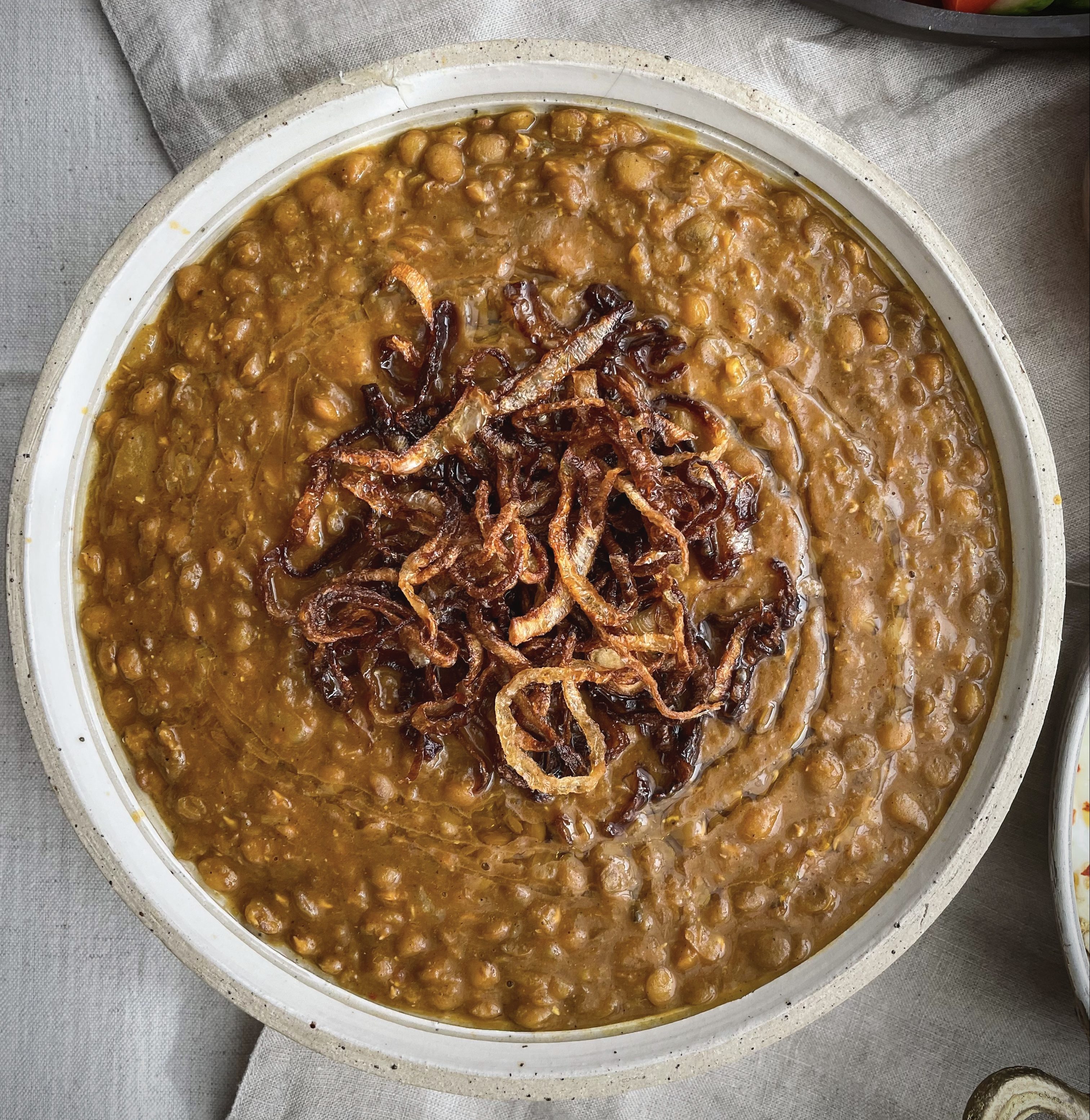
This traditional Persian breakfast dish is made with lentils slow-cooked with fresh aromatics and spices to create a stunning wholesome dish.

What is Adasi?

Adasi is a wholesome vegan dish, commonly eaten for breakfast in Iran. It is made with green lentils, onions and spices and is often described as a soup by Persians. I personally consider it is closer to the dal recipes from the Indian sub-continent but to compromise between the two I have called it a stew. Some add cubed potatoes to make it heartier but the version below excludes, but feel free to add them after step 1 below.

It is often topped with fried onions and a ground spice called Golpar or Persian Hogweed or Angelica.

Ingredients in this Recipe?

You will require the following ingredients for this recipe.

  • Dried Green Lentils. You can find large bags at a reasonable price form most supermarkets.
  • Olive Oil. Use extra virgin olive oil to cook the stew with and to drizzle over the final dish.
  • Onions. Used both in the lentil stew and as a garnish for the final dish. Adds depth to the lentils.
  • Garlic and Ginger Paste. Fresh aromatics to complement the flavours of this dish. They add both a sweet, zesty and spicy tone to the dish.
  • Turmeric, Cumin, Cinnamon and Bay. The spices used for this dish. They add a warming, woody, peppery and musky tones to the dish.
  • Tomatoe Purée. Thickens the stew and adds a mild tomato flavour to the dish.
  • Vegetable Stock. The cooking liquid. You can also use plain water in the alternative.
  • Lime. Lifts and complements the flavour profile of the Adasi by adding citrus notes.
  • Salt & Pepper. Seasoning for the dish.
  • Ground Golpar. An unsual spice which add a gorgeous depth of muskiness to this dish. Totally optional if you cannot find it. You can usually find it in Middle Eastern food shops or online.
  • Vegetable Oil. To fry the onions for the garnish.

I cook this recipe  the day before I want to eat it as the flavours intensify overnight. The recipe below yields a big batch (up to 8 people) and lasts up to 5 days if refridgerated, so it is a great dish to make and dip in and out of for various meals during a working week.

How to Serve Adasi

Serve  with flatbread such as Persian Noon-e-Sangak or Sesame and Nigella Seed Flatbread. Pairs well with eggs (poached, boiled or fried) and some fresh herbs as set out in the picture above. It can also be served with rice (chelo or kateh) for a heartier meal.


Adasi

Persian Lentil Stew
Prep Time15 minutes
Cook Time1 hour 15 minutes
Total Time1 hour 30 minutes
Course: Breakfast, Main Course, Brunch, lunch
Cuisine: Persian
Keyword: vegetarian, vegan
Servings: 6 (to 8)
Author: Mersedeh Prewer

Ingredients

For the Adasi

  • 400 g dried green lentils (washed and soaked in water for 2 hours)
  • 2 tbsp olive oil
  • 1 large brown onion (finely diced)
  • 1 tbsp garlic and ginger paste
  • 1 tsp turmeric
  • 1 tsp ground cumin
  • 1 tsp cinnamon
  • 2 tbsp tomato purée
  • 1.2 litres vegetable stock
  • Juice of 1 lime
  • 1 bay leaf
  • Salt and pepper (to taste)

For the Garnish

  • 1 large brown onion (finely sliced)
  • Vegetable oil (to fry the onions)
  • Ground golpar (Persian hogweed - optional)
  • Olive oil (to drizzle on top)

Instructions

  • Place a large saucepan over a medium-high heat. Add olive oil and heat until it glistens. Then add onions and cook, stirring regularly until they start to turn golden.
  • Add garlic and ginger paste, followed by turmeric, ground cumin, cinnamon and stir until evenly distributed into the onion mixture. Then stir in tomato purée.
  • Drain and add in pre-soaked lentils and stir until evenly mixed with the onion mixture.
  • Pour in the stock, lime juice and bay leaf and bring to a boil. Then turn heat down, put the lid of the saucepan on and let the Adasi simmer for approximately an hour or until the lentils are tender.
  • Whilst the Adasi is cooking fry finely sliced onion in vegetable oil over a high-medium heat until crispy.
  • When the Adasi is cooked take a stick blender and blitz some of the lentil mixture to thicken (about 1/3). Taste and season as required with salt and pepper (stock usually has salt in it so further salt may not be necessary). Squeeze some more lime juice if desired. Then ladle into a bowl, top with the crispy onions, a sprinkling of ground golpar and a drizzle of olive oil.

Havuç Tarator (Turkish Carrot, Walnut & Yoghurt Dip)

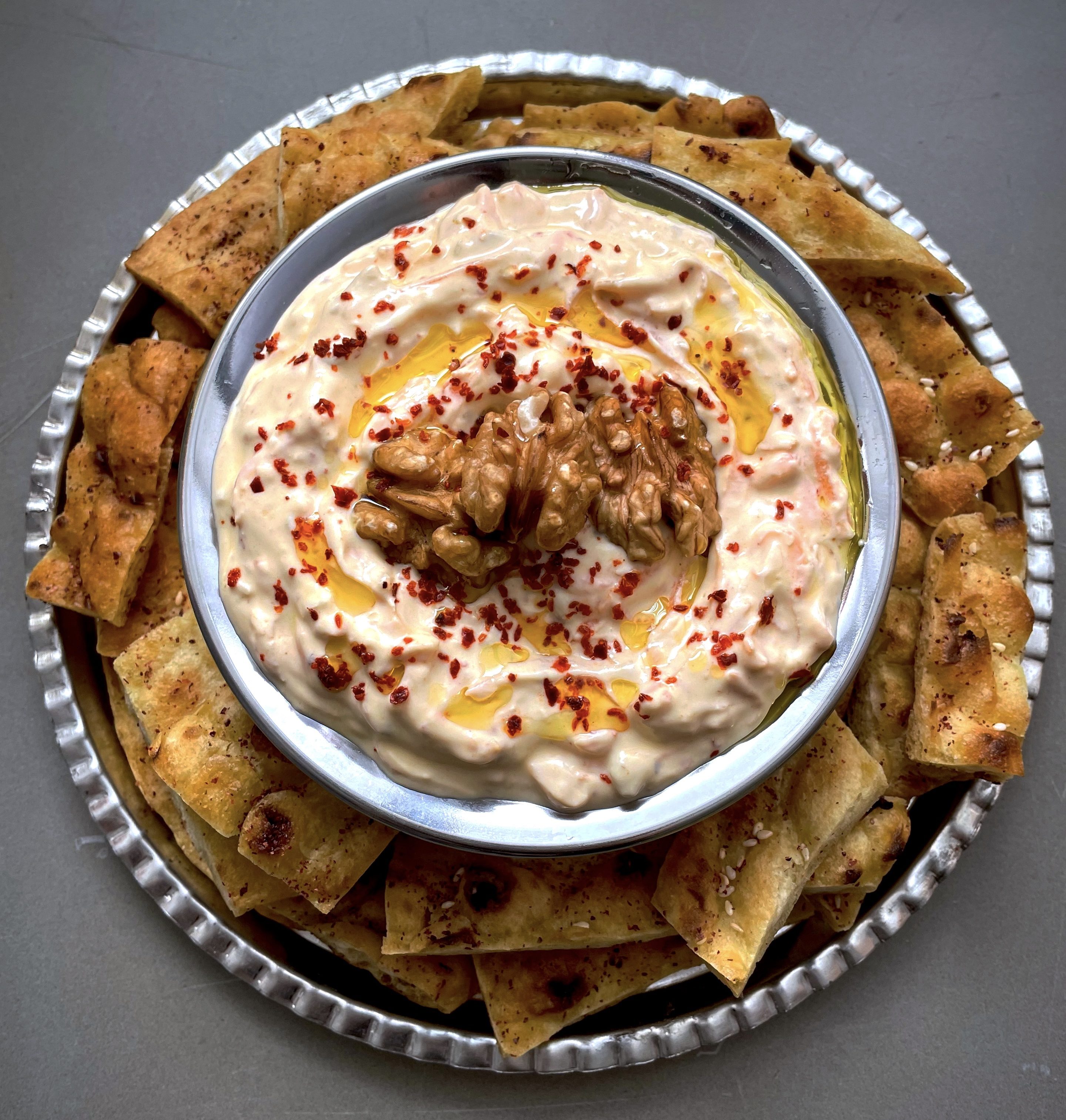
This delicious dip heralding from Türkiye is made using a handful of ingredients. Grated carrots are sautéed gently and then added to Greek yoghurt with olive oil, garlic, lemon juice and pul biber to make a divine addition to a Mezze-style spread.

Turkish Cuisine

Turkish cuisine is close to my heart almost as much as Persian cusine! I have travelled to Türkiye more times than i have to Iran, mostly because of the food but also the kindess of the people, the weather, the history and the sights!

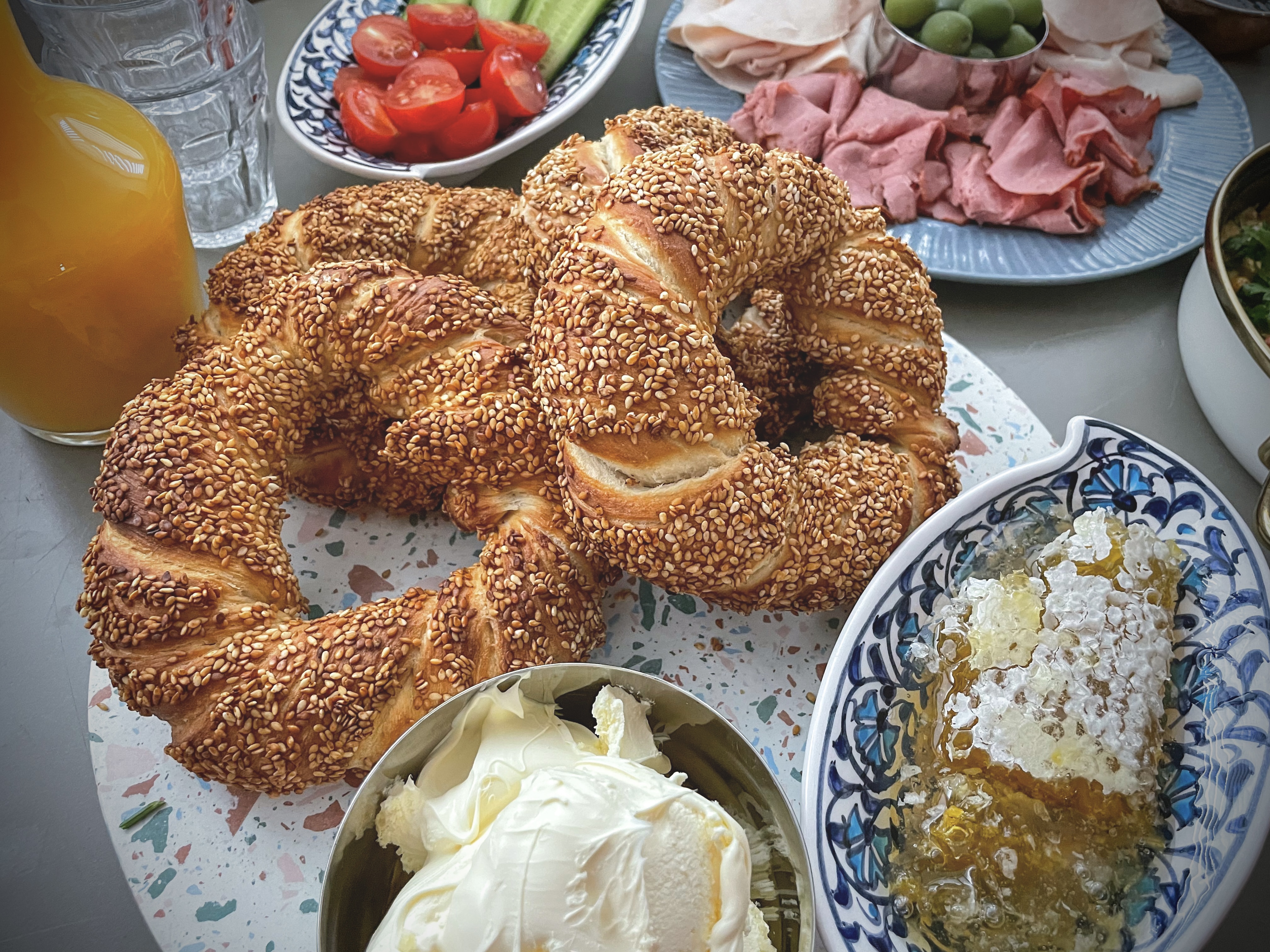
The culture surrounding food in this beautiful country is very like that in Iran. It is the essence of family, coming together, sharing and eating with your loved ones. Turkish patisseries are incredible, filled with cakes, breads and other baked goods. Around the streets of Istanbul you can pick up freshly baked simit (the Turkish equivalent of a bagel) and eat it while soaking up the sights and washing it down with Turkish tea of coffee! The kebabs and other main dishes are outstanding as are the arrays of appetisers and starters pre the main event.

One of the dishes I fell in love with while visiting Istanbul was Havuç Tarator.

What is Havuç Tarator?

Havuç Tarator is a simple yoghurt-based dip made with sautéed grated carrot, crushed walnuts. lemon juice, pul biber, olive oil and a hint of garlic.  It is absolutely delicious and easy to knock up.

For those of you who may not be familiar with pul biber, it is a dried, coarsely ground dark red pepper is grown in Syria and Turkey. It is used as a condiment and has a mildly smoky flavor with moderate heat. If you are unable to find it, you can substitute with dried red chilli flakes.

Serve Havuç Tarator alongside a mezze-style meal with lots of other dishes; as an accompaniment to kebabs or other BBQ dishes; or just with crackers or crisps.

Other Turkish Recipes


Havuç Tarator

Turkish Carrot & Yoghurt Dip
Prep Time15 minutes
Cook Time5 minutes
Total Time20 minutes
Course: Appetizer
Cuisine: Turkish
Keyword: vegetarian, dip
Servings: 6
Author: Mersedeh Prewer

Ingredients

  • 1 tbsp olive oil
  • 3 medium carrots (grated on the coarse side of a box grater)
  • 1 large garlic clove (crushed)
  • 500 g Greek yoghurt
  • 30 grams walnuts (coarsley crushed)
  • 1/2 tsp Salt
  • 1 tsp Pul Biber or Aleppo Pepper (red pepper flakes)
  • Squeeze or 2 of fresh lemon juice

To garnish

  • Pul Biber or Aleppo Pepper
  • Olive oil (to drizzle on top)
  • Walnuts halves

Instructions

  • Place a frying pan on a medium-high heat and add olive oil. Once the oil starts to glisten, add grated carrot. Then add crushed garlic and stir until the carrot wilts and the garlic is evenly distributed - this should only take a few minutes. Turn off the heat and let the carrot mixture cool.
  • Take a bowl, add yoghurt, grated carrot, crushed walnuts, lemon juice, salt, Pul Biber and stir. Taste and adjust seasoning or other flavours as desired.
  • Cover the bowl and leave in the fridge for the flavours to intensify and mix well through the yoghurt (no less than 1 hour).
  • When you are ready to serve the dip, drizzle some olive oil on top and decorate with walnuts and a sprinkle of Pul Biber. Serve as part of a mezze-style spread of dishes, or as an appetiser.

Roasted Red Cabbage with an Orange, Carrot & Cashew Dressing

The contrasting colours of the purple cabbage against the orange dressing make this a stunning and vibrant showstopper side dish. The roasted cabbage has a sweetness which is complemented by the citrus flavours of the dressing.

Inspiration for this Recipe

A while ago I ate an incredible Middle Eastern inspired salad bowl from Grain Kitchen – a lunchtime salad bar based in London, E1. They had a number of different themed salad bowl options such as the California Bowl or the Mediterranean Bowl but obvs I chose the Middle Eastern bowl!

Part of the salad offering was a charred red cabbage wedge with a cashew and carrot dressing. I fell in love with the vibrant colour and taste of this component and set about trying to recreate it in my own home. And after a few goes the recipe below is the one I am happy to share with you. This dish is very versatile, not complicated to make and will really brighten up your plate. The dressing recipe yields a fair bit, we usually use all of it but if any remains just drizzle over a green salad – it will last up to a week if kept in the fridge.

How to Serve this Dish

You can eat this dish as part of a mezze-style offering…

Or you can make your own little salad bowl…

You can even eat it as an accompaniment with a pie and chips..

Other Vegetarian Recipes

Check out some other vegetarian recipes written by the same author by clicking the links below.


Roasted Red Cabbage with an Orange and Cashew Dressing

Prep Time20 minutes
Cook Time40 minutes
Total Time1 hour
Course: Side Dish
Cuisine: Inspired by....
Keyword: vegetarian, vegan option
Servings: 4 (to 6)
Author: Mersedeh Prewer

Ingredients

Cashew and Orange Dressing

  • 75 g raw cashew nuts (soaked overnight)
  • 100 ml orange juice
  • 1 large carrot
  • 50 ml olive oil
  • 50 ml water
  • Juice of 1 lime
  • 2 tsp maple syrup or honey
  • 1 tsp grated ginger
  • 2 garlic cloves
  • Salt and Pepper (to taste)

Roasted Red Cabbage

  • 1 whole red cabbage (c. 1kg)
  • Olive oil (to drizzle over cabbage before roasting)
  • Finely chopped fresh parlsey (to garnish)

Instructions

  • Prepare the dressing by putting all the ingredients in a blender (if you have a nutribullet then blitz in that as it blends the almonds to a smoother consistency). Blitz until smooth. Pour into a container, cover and place in the fridge until ready to use.
  • Cut red cabbage into eighths so you have wedges. Then place in a saucepan of salted water and bring to a boil over a high heat. Cook until tender approx 8 minutes in boiling water.
  • While the cabbage is cooking, preheat oven to 200°C / Fan 180°C / gas 6.
  • When the cabbage is tender, remove from heat and drain water from saucepan. Drizzle the cabbage with olive oil until all the wedges are lightly coated. Place the wedges on a baking tray and place in the oven to roast for approx 20 mins until slightly charred on edges.
  • Remove the cabbage from the oven, plate up, drizzle with the dressing and sprinkle the finely chopped parsley. Can be eaten hot, warm or cold.

Sesame and Nigella Seed Flatbread

Follow the recipe below for fluffy, pillowy yet perfectly chewy flatbread. Great served as part of a Mezze to scoop up dips with or wrapped round a kebabs!

Hands down, this is the best flatbread recipe I have developed. After a a year of testing various quantities (with milk, without milk, with yoghurt, without yoghurt, yeast or no yeast – and the list of variations goes on), I am so happy with this fluffy, pillowy yet perfectly chewy flatbread.

What is Flatbread?

In general, flatbread is bread made with flour; a liquid such as water, milk or yogurt, and salt. Some are leavened (made with yeast) others are unleavened. They range from below one millimetre to a few centimetres thick. Flatbread can be baked in an oven, fried in hot oil, grilled over hot coals, cooked on a hot pan, or metal griddle, and eaten fresh or packaged and frozen for later use.

They are commonly eaten in Middle-Eastern and South Asian cuisine.

What are the Ingredients for this Recipe?

This flatbread recipe is a leavened one so will need proving time for the bread dough rise.

You will need the following ingredients to make these flatbreads.

  • Strong White Bread Flour. I always use strong bread flour for my bread as I love the texture. The main difference between strong bread flour and other types of flour is its high protein content. This creates more rise and structural support in the dough, allowing the final product to lift and hold shape. It also creates a chewier texture and more browning in the crust.
  • Stone Ground Wholemeal Bread Flour. The use of wholemeal flour brings about a lovely nuttiness to this flatbread.
  • Water, Caster Sugar and Fast Action Yeast. These ingredients are mixed together to activate the yeast, then added to the flour to create the rise in the flatbread.
  • Greek Yoghurt. Provides a lovely tanginess to the bread and helps to create the lovely soft and doughy texture.
  • Salt. Needed to season the bread otherwise it would be very bland.
  • Olive Oil. Added to the bread dough to help with the structure and texture of the bread. Also needed to oil the bowl for proving and to brush on the flatbreads before cooking.
  • Sesame Seeds. Provides a a crunchy texture to the flatbread and a lovely nutty flavour.
  • Nigella Seeds. Provides a lovely crunch and a slightly onion flavour to the bread. Also known as Kalonji or black Cumin Seeds.

What to Serve with Sesame and Nigella Seed Flatbread?

See below for a number of my recipes you can dip this flatbread into – dals, dips and curry!

From top left: Persian-Style Dal; Mirza Ghasemi; Borani Laboo; Maast O’Moosir; Kashke Bademjan; Rose Harissa Aubergines and Hummus; Borani Esfenaj; Coconut and Herb Chickpea curry; Maast O’Khiar.


Sesame and Nigella Seed Flatbread

Prep Time20 minutes
Cook Time40 minutes
Proving2 hours
Total Time3 hours
Course: Side Dish
Cuisine: Middle-Eastern
Servings: 6 flatbreads
Author: Mersedeh Prewer

Ingredients

  • 425 g strong white bread flour (plus extra for dusting surface if kneading by hand)
  • 75 g stone ground strong wholemeal bread
  • 250 ml tepid water
  • 1 tsp caster sugar
  • 7 g sachet of dried yeast
  • 100 g Greek yoghurt
  • 1 tsp salt
  • 1 tbsp olive oil (plus extra to oil proving bowl and to brush on flatbreads before cooking)
  • 2 tbsp sesame seeds
  • 2 tbsp Nigella seeds

Instructions

  • Pour water into a jug, add sugar and yeast and stir to dissolve. Leave loosely covered for 10 minutes until it activates and has a bubbly surface.
  • Sift the white and wholemeal flours into a large bowl or the bowl of your stand mixer. Stir in salt, sesame seeds and Nigella seeds. Pour in yoghurt and olive oil.
  • Gently pour in the activated yeast and bring the mixture together (either by hand or slow speed on the stand mixer). Then increase speed and / or knead by hand until smooth-ish and elastic for about 8 to 10 minutes (the wholemeal flour and seeds will not result in a typically smooth dough). If kneading by hand you may need to add a little extra flour for dusting your surface as the mixture is quite wet.
  • Tuck the dough under to form a ball and place in a bowl oiled with a drizzle of olive oil, cover with cling film and then a tea towel and leave in a warm part of your home to prove until it has doubled in size (usually between 1 to 2 hrs).
  • Once the dough has proved, knock back gently and remove from the bowl. Divide into 6 pieces, dust with a little flour, and using the palm of your hand roll into balls. Leave the balls of dough covered with a tea towel on your work surface for about 15 mins to prove further.
  • Roll the dough pieces one by one, using a rolling pin, into a circle shape approx 20 cm in diameter.
  • Heat a medium sized frying pan or flat skillet on medium heat (allow for about 1 minute).
  • Brush one side of the uncooked flatbread with olive oil and place that side down into the frying pan and cook until bubbles start to form on top of the flatbread (approx 1 to 2 minutes). Brush the topside of the flatbread with a little olive oil and then flip and cook on that side for about 30 second to 1 minute. The aim is to get the flatbreads golden and bubbly.
  • Remove from the heat and place the flatbread in a tea towel to keep soft and warm, while you cook the others.
  • Serve warm and straight after cooking, or reheat later on either by toasting in a toaster on a low heat or wrapping in foil and warming up in a medium / low oven circa (160°C (fan oven) / 180°C (conventional) / gas mark 4) for about 10 mins.

Harissa and Lime Chicken Kebabs

Simple yet delicious, this marinade for chicken can be used whether you are cooking on the BBQ, roasting in the oven, under the grill, on a griddle, in an air fryer or just frying the chunks of chicken in a pan.

An Easy Marinade

The ingredients for this powerhouse marinade are simple:

  • Harissa paste (any variety – I use Rose Harissa by Belazu but apricot or just the plain one is absolutely fine);
  • Crushed garlic;
  • Greek yoghurt;
  • Dried za’atar leaves;
  • Fresh lime juice; and
  • Salt & Pepper.

Just add to chicken breast or other cut and leave to marinade for a minimum of 4 hours (preferably overnight) and then cook.

Za’atar

For those of you who may not be familiar with za’atar, it is a herb grown in some Middle Eastern countries, like Lebanon, with a flavour like a cross between thyme and oregano. It is also the name for a spice and herb mixture used like a condiment. Use oregano as an alternative if you cannot get your hands on za’atar,

Harissa

Harissa originates from North Africa. While every region has its own variation and take on the paste, it’s particularly associated with Tunisia. It is a hot chilli pepper paste, the main ingredients of which are roasted red peppers, Baklouti peppers, spices and herbs such as garlic paste, caraway seeds, coriander seeds, cumin and olive oil.

Rose harissa contains dried rose petals, and, usually, rosewater too. This softens the heat and adds a subtle floral note to the dishes it is added to. The use of yoghurt in the marinade also tempers the heat a little further making this a recipe that can be enjoyed by the whole family. Using a shop bought paste like this really helps to reduce thinking and preparing time so I welcome these shortcuts. A little addition of extras like lime, garlic and yogurt make it more personal.

How to Serve Harissa and Lime Chicken Kebabs

One of my favourite ways to eat this chicken is an element to a salad bowl (kind of like a Buddha Bowl) with the fragrant and smokey flavours from North Africa and the Middle East, as pictured below.

But it can be eaten with anything or any way you want, whether you want to eat it as a kebab roll with the chicken wrapped in some flatbread with salad, pickles and some garlic and / or chilli sauce alongside some chips; or with some rice or Tabbouleh or other healthy grain based salad.

See my how to reel on Instagram via the link below…

https://www.instagram.com/reel/Cghf7BaISkY/?utm_source=ig_web_copy_link

Other Kebab Recipes


Harissa & Lime Chicken Kebabs

Chicken kebabs marinated in harissa & lime
Prep Time10 minutes
Cook Time25 minutes
Total Time35 minutes
Course: Main Course
Cuisine: Cross-cultural
Keyword: chicken, kebabs, harissa
Servings: 4 (to 6)
Author: Mersedeh Prewer

Ingredients

  • 1.2 kg chicken breasts (about 4 to 5 large chicken breasts)
  • 4 tbsp harissa paste (I use Belazu Rose Harissa)
  • 4 tbsp Greek yoghurt
  • 4 cloves garlic (crushed or minced)
  • Juice of 1 large lime
  • 2 tsp dried za'atar leaves or oregano
  • Salt and Pepper
  • 1 to 2 tbsp butter and / or olive oil (Melted - to baste the chicken while cooking)

Instructions

  • Chop your chicken into chunks (fairly large as they will shrink when cooking). Put the chicken pieces into a bowl and then add all the ingredients except the butter and massage into the chicken until all the marinade is mixed in and evenly distributed amongst the chicken pieces. It will be a bright red / orange colour.
  • Cover and leave in the fridge for the flavours to develop for a minimum of 4 hrs but best left overnight. Take the chicken out of the fridge about 30 mins before you want to cook to bring up to room temperature.
  • When you are ready to cook the chicken (either on your bbq or under the grill on the highest setting), divide the chicken on to about 4 / 6 skewers and cook, basting with the butter and / or olive oil and turning the skewers until the chicken is a little charred. It takes roughly 15 to 25 minutes on a bbq or grill (depending on how hot your bbq / grill is).
  • Serve alongside chips, rice or lavash bread / flatbread, salad, mezze-style dishes including hummus and yoghurt dips.


Coconut and Herb Chickpea Curry

A creamy coconut milk based curry made with chickpeas, aromatics, spices and herbs to create a dreamy dish to spoon over rice or dip flatbread into

Recipe Origins

This recipe came about one evening when I had a jar of chickpeas, a can of coconut milk and a pillow of herbs starting to look a little pathetic in my fridge. The resulting dish totally bowled my family over and is now in the top 5 of our go to vegan dishes.

The recipe below yields enough to feed 4. If you have fewer people to feed, honestly, don’t revise the measurements down! As with most curry-style or Persian khoresh (stew) dishes, leaving it a day for the flavours to intensify by the ingredients getting to know each other better makes the experience of eating leftovers even more spectacular than your first bite of this dish straight after cooking!

What is in this Recipe?

The spices used for this curry are turmeric and coriander seeds with the addition of red chilli, garlic, ginger and coconut milk to give those familiar aromatic curry notes. The use of herbs such as dill, parsley, coriander and fenugreek bring a about a flavour profile more common to Middle-Eastern cuisine. This dish is deeply savoury but with a kick of citrus from the use of fresh lime juice to make it an all-round delightful meal.

Other than the amazing herbs and spices, the real key to this dish is the type of chickpeas you can get your hands on. I always find that the chickpeas that are available in jars are larger and more buttery than tinned chickpeas. So I recommend finding them over canned ones if you can. 

How to Serve this Dish

Serve with rice such as kateh or chelo and a side of salad, such as Shirazi, and flatbread.

Storage

The curry can be stored in the fridge for up to 5 days.  It can also be stored in the freezer for up to 3 months. Remember to cool the curry down completely before storing and use an airtight container.

To reheat, make sure the curry is fully defrosted, and heat gently in a saucepan over a low heat or in the microwave in an approporiate dish.

Other Vegetarian Recipe Inspiration


Coconut and Herb Chickpea Curry

Prep Time10 minutes
Cook Time50 minutes
Total Time1 hour
Course: Main Course
Cuisine: Cross-cultural
Keyword: chickpeas, curry, vegetarian, vegan
Servings: 4
Author: Mersedeh Prewer

Ingredients

  • 2 tbsp vegetable oil
  • 1 large onion (finely diced)
  • 4 cloves garlic (crushed or minced)
  • 1 tsp turmeric
  • 2 tsp coriander seeds (crushed in a pestle and mortar)
  • Thumb size ginger (grated)
  • 2 tsp dried fenugreek
  • 1 bay leaf
  • 400 ml coconut milk
  • 720 g jar of chickpeas (drained weight aprox. 420g)
  • 1 vegetable stock cube (dissolved in 250ml water)
  • 30 g fresh dill (finely chopped either by hand or in a food processor)
  • 30 g fresh parsley (finely chopped either by hand or in a food processor)
  • 30 g fresh coriander (finely chopped either by hand or in a food processor)
  • Juice of 1 largish lime
  • 1 red chilli (sliced finely and diagonally along the chilli - remove seeds for a milder version)
  • Salt and Pepper (to taste)
  • Some extra fresh herbs and / or sliced red chilli to garnish (coriander or parlsey or dill or mint - or a sprinkling of all of them)

Instructions

  • Place a medium-sized pan on medium / high heat and add 2 tbsp of oil. Add finely diced onion and cook until it starts to caramelise.
  • Add garlic and turmeric and stir into mixture until the aromas are released. Then add crushed coriander seeds, followed by grated ginger and stir in.
  • Stir in the dried fenugreek and place bay leaf into the pan. Then pour in coconut milk and stir (lower the heat if required to get it to a gentle simmer).
  • Leave to simmer for 5 minutes and then add drained chickpeas and stock. Simmer for a further 10 minutes.
  • Add chopped fresh herbs, lime juice and sliced red chilli and stir the curry until evenly distributed. Place a lid on the curry and let simmer for a minimum of 20 mins.
  • Taste the curry and adjust seasoning and / or lime juice. Garnish with some more sliced chilli and / or fresh herbs. Serve with rice and / or naan.

Sweet Potato & Leek Bolani with Coriander Chutney

This Afghan flatbread filled with sweet potato and leek, served with a coriander chutney is a wholesome and delicious vegan treat. 

What is Bolani?

Bolani (also called Periki) is a stuffed flatbread from Afghanistan. It is commonly cooked by frying and it has a thin crust, which can be filled with a variety of ingredients, such as potatoes, lentils, leeks or minced meat. It is usually served with a yoghurt and / or a coriander chutney. Bolani is made for special occasions but is also a popular street food available in Afghanistan.

It can be eaten as an appetiser, accompany a main meal or eaten as a snack. If you have ever eaten a stuffed Indian paratha or a Mexican quesadilla, then you will be familiar with the presentation of this dish. The main differences being that the Bolani is not flaky and layered like a paratha and not cheesy like a quesadilla, however the premise of of a stuffed type of flatbread is the same.

What is in this Recipe? 

A simple dough is made using plain flour, chapati flour (atta), salt, water and oil. The dough is rolled and then filled with a cooked a well seasoned sweet potato and leek mixture flavoured with fresh lime juice, aromatics and spices (garlic, turmeric, ground coriander, chilli, cinnamon and fresh coriander). The Bolani are then gently fried on a pan until toasted perfectly.

The Bolani is served with a simple chutney made by blitizing fresh coriander, the green ends of spring onions, garlic, gren chillies, walnuts, apple cider vinegar, olive oil, sugar, salt and pepper.

How to Serve this Recipe

This recipe is one of a series of recipes posted which forms an element of a larger family meal for my lot.  The others are Qorma-e-Lubia (Afghan red kidney bean curry) which I serve with rice, and  Maast O’Khiar (a yoghurt dip made with cucumber, mint and garlic). Whilst Maast O’Khiar is the Persian name for this dip, you may be familiar with the Mediterranean versions such as Tzatziki (Greek version), Cacik (Turkish version), Talattouri (Cypriot version). The Afghan version is called Jaan-e-ama and often eaten with Bolani.

Also serve with some finely chopped tomatoes and red onions dressed with olive oil, lime fresh coriander and salt and pepper as pictured.


Sweet Potato & Leek Bolani with Coriander Chutney

Afghan flatbread filled with sweet potato & leek, served with a coriander chutney
Prep Time45 minutes
Cook Time45 minutes
Resting time for dough30 minutes
Total Time2 hours
Course: lunch, Accompaniment, Appetizer, Main Course, Side Dish
Cuisine: Middle-Eastern, Afghan
Keyword: vegetarian, vegan
Servings: 4 (to 6)
Author: Mersedeh Prewer

Ingredients

Coriander Chutney

  • 1 bunch fresh coriander (about 100 grams)
  • 3 cloves garlic (crushed or minced)
  • The green ends of 4 spring onions
  • 1 to 2 green chilli peppers
  • 1/3 cup walnuts
  • 1/2 cup apple cider vinegar
  • 1 tbsp olive oil
  • 1/2 tbsp sugar
  • 1 tsp salt
  • 1/2 tsp pepper

Bolani Filling

  • 2 medium sweet potatoes (peeled and chopped into medium sized chunks)
  • 3 tbsp vegetable oil
  • 2 medium leeks (quartered and sliced)
  • 3 cloves garlic (crushed or minced)
  • 1 tsp turmeric
  • 1 tsp ground coriander
  • 1/2 tsp dried red chilli flakes
  • 1/4 tsp cinnamon
  • Juice of 1 lime
  • 3 tbsp chopped fresh coriander
  • Salt and Pepper (to taste)

Bolani Dough

  • 200 g plain flour
  • 100 g atta (chapati flour) (you can use wholemeal flour instead)
  • 1/2 tsp salt
  • 1 tbsp vegetable oil (plus extra to fry the Bolani)
  • 180 ml water

Instructions

Coriander Chutney

  • Make the chutney ahead (minimum 2 hrs before eating) to let the flavours settle.
  • Add coriander, garlic, walnuts, chillies and scallion ends to a food processor and pulse until finely chopped.
  • Add the vinegar and pulse a few more times - the chutney should have a coarsely chopped appearance. Add olive oil, sugar, salt and pepper and taste. Adjust seasoning if necessary. Pour chutney into a sterilised jar with a lid. Place in the fridge until you are ready to use. Any left over chutney keeps for 2 months in the fridge and can be used for other dishes including grilled meats, roast vegetables or curries.

Bolani Filling

  • Steam or boil the sweet potatoes until cooked / soft.
  • Add 3 tbsp of vegetable oil to a large frying pan / skillet and place over a medium / high heat. Add leeks and cook until softened. Add garlic and turmeric and stir into the leeks until evenly distributed and aroma released.
  • Add ground coriander, dried red chilli flakes and cinnamon and stir.
  • Add sweet potato and mash into the mixture until the leek mixture is fully integrated into the mashed sweet potato.
  • Add fresh lime juice and the finely chopped fresh coriander leaves. Add salt and pepper and taste, adjust seasoning if required. Take off the heat and set aside to cool until you are ready to stuff the Bolani dough.

Bolani Dough

  • Stir flours and salt together in a large mixing bowl. Make a well in the center and add the vegetable oil and water. Form a shaggy dough with your hands, then turn out onto a clean work surface. Knead the dough for 5-10 minutes until you have a smooth dough. Place the dough in the mixing bowl and cover. Set aside to rest for 30 mins,
  • Divide the dough into 6 equal pieces. Roll one piece of dough on a clean surface until the dough is 15cm in diameter.
  • Divide the sweet potato filling into six and fill half of the round of dough by spreading into a thin layer, leaving a 1cm empty space around the edge. Fold the empty top half of the dough over the filling and press down to seal, stretching parts of the dough to create an even crescent shape. Place on baking paper until ready to cook.
  • Heat a large non-stick frying pan or skillet over medium-low heat. Add 1 tsp of vegetable to the pan. When the oil is hot, add 1 Bolani and fry for about 2 minutes on each side until golden brown. Then place on a paper towel to soak up oil while the others fry. Feel free to keep the cooked Bolani in a low / medium heat oven to keep warm while you fry the others.
  • Serve the Bolanis warm / hot with the coriander chutney and / or yoghurt based (or non-dairy yoghurt) dip.

Qorma-e-Lubia (Afghan Kidney Bean Stew)

This vegan stew heralding from Afghanistan is a gorgeous dish full of goodness. Kidney beans are cooked in an aromatic tomato sauce, perfect for spooning over rice or eating with flatbread.

A Snippet on Afghanistan

Afghan cuisine includes dishes and cooking techniques also seen in Persian, Central Asian and Indian cuisines due to Afghanistan’s close proximity and historical cultural connections.

The two official languages spoken in Afghanistan are Dari and Pashto. Dari is the official name of the variety of Persian language spoken in Afghanistan. It is often referred to as Afghan Persian. Although still widely known as Farsi (the official language of Iran) to its native speakers, the name was officially changed to Dari in 1964 by the Afghan government. Pashto is an Eastern Iranian language Indo-European family. It is also the second-largest provincial language of Pakistan, spoken mainly in the northwestern province of Khyber Pakhtunkhwa and the northern districts of the Balochistan province.

I remember the first time I heard someone speaking Dari (1980 something). I asked my mother why I could understand a language which seemed familiar but unfamiliar at the same time. The words made sense to me but the rhythm the language was being spoken in was different to the Farsi I had grown up with. And that is when I learnt about Afghanistan, their languages and the relationship with Iran.

My journey into Afghan cuisine came later in my life but as with learning about our connections in language, their cuisine has brought me great joy and continues to do so. There are many Afghan dishes that feel familiar to me due to my Persian background, but there are also a huge amount of dishes new to me which I have loved learning to cook! And the first I am introducing to you is my version of Qorma-e-Lubia. 

What is Qorma-e-Lubia?

Qorma or Ghorma is the Afghan name given to an onion and tomato-based stew or casserole, usually served with rice (challow, Persians call their rice chelow). First, onion is caramelized, for a richly colored stew. Then tomato is added, along with a variety of meat and/or lentils, spices, and vegetables, depending on the recipe. The main ingredient, which can be meat, beans or vegetables, is usually added last. There are many different qormas including:

  • Qorma e gosht  – a meat stew usually served at gatherings;
  • Qorma e nadroo – lamb or veal, yogurt, lotus roots and coriander;
  • Qorma e alou-bokhara wa dalnakhod – veal or chicken, sour plums, lentils and cardamom;
  • Qorma e sabzi – lamb, sautéed spinach and other greens;
  • Qorma e lawand – chicken, lamb, or beef, plus yogurt, turmeric and coriander; and
  • Qorma e shalgham – a sweet and sour qorma made with lamb, turnips and sugar.

Qorma-e-Lubia is simply made with red kidney beans as the protein element and cooked with an onion and tomato base flavored with garlic, turmeric, coriander, cumin and dried mint. I also add a little garam masala to mine.

The flavour of this qorma (as with many stew style dishes) gets better if eaten the day after cooking. Therefore, I recommend making it a day before you want to serve it and then heating it up. The flavours really fuse together brilliantly with a little more time to get to know each other.

For those of you familiar with Indian cuisine, you will note this recipe is very similar to the North Indian dish Rajma Masala. Pakistan and Nepal also have a version of this dish.

How to Serve Qorma-e-Lubia

Serve it with flatbread such as the stuffed Afghan flatbread Bolani, rice (kateh or chelow), a nice crunchy salad with a citrus dressing and / or a yoghurt or non-dairy dip. I have served mine with Maast O’Khiar, the Persian yoghurt and cucumber dip, as pictured below.

Variations

You can use dried instead of canned kidneys beans. If you are using dried kidney beans you will need approximately 250 grams. Remember to wash, soak, drain and then cook the beans before adding them at step 7 below. Kidney beans are toxic if not prepared properly when starting with the dried form and can cause tummy upsets, so make sure you follow the instructions on the packet or google it.

Other Plantbased Recipes 


Qorma-e-Lubia

Afghan Kidney Bean Curry
Prep Time20 minutes
Cook Time1 hour 15 minutes
Total Time1 hour 35 minutes
Course: Main Course
Cuisine: Afghan
Keyword: vegetarian, vegan
Servings: 4
Author: Mersedeh Prewer

Ingredients

  • 3 tbsp vegetable oil
  • 2 tsp coriander seeds
  • 1 tsp cumin seeds
  • 1 large onion (finely diced)
  • 3 cloves garlic (crushed or minced)
  • 1 tsp turmeric
  • 1/2 tsp dried red chilli flakes
  • 1 tsp dried mint
  • 3 medium tomatoes (roughly chopped)
  • 3 tbsp tomato purée
  • 600 ml vegetable stock
  • 2 x 400 g cans of kidney beans (or 250 grams of dried kidney beans cooked in accordance with package instructions)
  • 1/2 tsp garam masala
  • Juice of 1 lime or half a lemon
  • Salt and Pepper (to taste)
  • Chopped fresh coriander leaves and sliced sping onions (to stir through / garnish before serving)

Instructions

  • Place a medium to large saucepan (which has a lid) on a medium / high heat and add the oil.
  • Bash the coriander and cumin seeds in a pestle and mortar and then add to the saucepan. Cook for about a minute. Keep a close eye on them so they don't burn. Lower the heat to medium, if necessary.
  • Then add chopped onions and cook until they brown / caramelise.
  • Add the garlic and turmeric and stir to distribute evenly into the onions. Then add dried mint and dried chilli flakes (feel free to exclude chilli or revise chilli levels down if half a teaspoon feels a bit too much for you).
  • Add the chopped tomatoes and stir now and again until they break down (roughly 5 to 10 minutes).
  • Add the tomato purée and stir until evenly distributed and follow with the vegetable stock. Give the mixture a good stir and let it come to a boil and then reduce the heat to low / medium to allow to simmer. Place the lid on the saucepan and let the sauce simmer for a minimum of 30 min or longer - ideally when you start to see the oil form a little round the edges of the sauce.
  • Then add your cooked kidney beans, garam masala, the lime (or lemon) juice, salt and pepper and stir. Leave to simmer with the lid on for a further 15 to 30 mins.
  • Taste and adjust seasoing if required. Before serving, stir through some fresh chopped coriander. Spoon the Qorma into your serving dish and sprinkle with the sliced spring onions. Serve with flatbread and / or rice, yoghurt-style dip and / or salad and pickles (torshi).


Maast O’Khiar (Persian Yoghurt & Cucumber Dip)

This Persian staple is a creamy dip made with Greek yoghurt, cucumber, fresh lime juice, mint and garlic. Often served as an appetiser or alongside main dishes. 

What is Maast O’Khiar?

Maast O’Khiar is a Persian dip made with salted strained yoghurt mixed with cucumbers, garlic, salt, pepper, olive oil, lemon or lime juice, and mint.

It is commonly served as a cold appetiser or as a side dish at Persian gatherings or restaurants. It is a creamy and fresh tasting dip, perfectly balancing Persian dishes ranging from the stews to the kebabs. 

Most of you will be familiar with this dip or similar-style dips eaten across the Levantine / Middle-Eastern and Mediterranean parts of the world. Maast O’Khiar is the Persian name for our version of the yoghurt and cucumber dip, but you may know it as Tzatziki (Greek version), Cacik (Turkish version), Talattouri (Cypriot version), Jaan-e-ama (the Afghan version).

Preparation

There are various ways of preparing this dip when it comes to the cucumber element. Some peel, de-seed and dice the cucumber. Others grate it. This recipe uses the whole cucumber, including the skin, grated and mixed into Greek yogurt. The yoghurt is further flavoured with a combination of dried and fresh mint, garlic and lime juice. 

My favourite Greek yoghurt is Total 5% which you can purchase from most British supermarkets. Any other Greek yoghurt or Greek-style yoghurt is fine to substitute.

This is a super easy dip to make but, in order for the flavours to intensify and settle properly into the dip, I would recommend making it a day before you want to tuck into it. At the very least a 1 hour resting time.

Variations

Persians also vary their Maast O’Khiar by mixing in sultanas and walnuts and / or sprinkling with dried rose petals as a garnish, so feel free to mix it up if you fancy!

Lemon juice can be used as a substitute to lime juice. Also feel free to use herbs such as dill, coriander or parsley if you don’t like mint.

How to Serve Maast O’Khiar

This dip can be eaten as an appetiser with a variety of crudités, crisps and flatbread. As an accompaniment to the main event, if you are making a Persian spread of food, a bowl of this dip will compliment all the dishes as pictured below.


Other Yoghurt Based Dips

Click on the link below for other delicious Persian yoghurt dips:


Maast O'Khiar

Persian yoghurt & cucumber dip
Prep Time15 minutes
Resting time1 hour
Total Time1 hour 15 minutes
Course: Appetiser, Accompaniment
Cuisine: Persian, Iranian, Middle-Eastern
Keyword: Tzatziki, Cacik, Talattouri, Jaan-e-ama, mast o khiar
Servings: 6
Author: Mersedeh Prewer

Ingredients

  • 500 g strained Greek Yoghurt (I use Total 5%)
  • 1/2 large cucumber (grated with skin and seeds)
  • 1 tsp dried mint
  • 1 tsp fresh mint (chopped)
  • 1 large clove garlic (crushed)
  • 1 tbsp extra virgin olive oil (and extra to drizzle on top)
  • Juice of half a lime
  • Salt and Pepper (to taste)
  • Fresh mint and chopped cucumber (to garnish)

Instructions

  • Take a bowl, add the yoghurt, grated cucumber, dried mint, fresh mint, crushed garlic, 1 tbsp of olive oil, lime juice, salt and pepper and stir. Taste and adjust seasoning or other flavours as desired.
  • Cover the bowl and leave in the fridge for the flavours to intensify and mix well through the yoghurt (no less than 1 hour). When you are ready to serve the Maast O'Khiar, drizzle some olive oil on top and decorate with fresh mint and / or cucumber and / or dried rose petals and / or dried mint.
  • Serve alongside a Persian spread, as part of a mezze-style spread of dishes, or as an appetiser. Or like some Iranians, sit in front of the telly with a bowl of Maast O'Khiar and a massive bag of crisps and dip away!

Simit (Turkish Sesame Encrusted Bread)

Also know as the Turkish Bagel, these beautifully doughy yet crunchy sesame encrusted bread rings are perfect for a Turkish-style breakfast or as sandwich bread.

What Is Simit?

Simit is a circular bread encrusted with sesame seeds, which is common to the cuisines of the former Ottoman Empire and the Middle-East. It is widely known as a Turkish bagel in the USA and Koulouri in Greece. They are commonly eaten at breakfast and are a much loved street food available on many corners in Istanbul. They have a crispy exterior and a soft doughy interior, which can be created using a standard bread dough mixture.

The distinctive taste of Simit comes from a combination of toasted sesame seeds and a grape molasses glaze. Grape molasses can be found online or at Middle-Eastern supermarkets. Sesame seeds are widely available in their raw form, so you will need to toast them in a dry frying pan before coating the Simit rings.

Kahvalti

I was first introduced to Simit during one of our holidays in Turkey. Many of us Iranians love holidaying in Turkey as it feels familiar but with the freedoms we cannot enjoy in our own motherland. In fact, I have travelled to Turkey more than I have to Iran. The hospitality, the food and the weather make for the perfect destination for my family and it feels like home. 

The variety of baked goods available in Turkey is incredible and Simit is no exception. You will often find it offered as part of the Turkish breakfast spread offering known as Kahvalti. The commitment to breakfast is incredible in Türkiye. Kahvalti translates to “before coffee” and is all about gathering and sharing dishes with your family. Turkish restaurants and families at home prepare many little dishes to fill the breakfast table, allowing you to sample them at your leisure .

How to serve Simit

When I bake them at home, we either eat them with feta and halva or with clotted cream and honey. We also love having them as an accompaniment to egg dishes (as pictured below). The recipe for Nargessi (Persian spinach Eggs as pictured) can be found here.

For a traditional Turkish breakfast serve alongside with Menemen (Turkish scrambled eggs with tomatoes).

Storing Simit

Simit is at its best fresh out of the oven. Store in an airtight container up to 3 days once it is cool. Just bake in  a medium to hot oven for 5 to 10 mins to refresh or slice and toast.


Simit

Turkish Bagels
Prep Time20 minutes
Cook Time20 minutes
Proving Time x 21 hour 30 minutes
Total Time2 hours 10 minutes
Course: Breakfast, Accompaniment
Cuisine: Turkish
Keyword: Simit, Turkish Bagel, Gevrek, Koulouri
Servings: 6
Author: Mersedeh Prewer

Ingredients

Simit Dough

  • 500 g strong white bread flour (plus extra for sprinkling on your surface when shaping the Simit)
  • 7 g fast-action yeast
  • 1 tsp salt
  • 300 ml tepid water
  • A little olive oil (to oil the bowl the dough proves in)

Simit Topping

  • 100 ml grape molasses (üzüm pekmezi)
  • 50 ml water
  • 2 tsp flour
  • 300 g toasted sesame seeds

Instructions

  • Mix strong white flour, salt and fast-action yeast in a large bowl making sure the salt and yeast are kept apart at this initial stage. Make a well in the centre, then add 300 ml water, and mix well.
  • Tip onto a lightly floured work surface and knead for around 10 mins. Once the dough is smooth, place it in a lightly oiled bowl and cover with cling film. Leave to rise for 1 hour or until doubled in size.
  • Mix the grape molasses, water and flour in a large bowl.
  • Prepare the toasted sesame seeds. Take the raw sesame seeds, toast in a dry pan until golden, shaking and stirring the pan regularly. Take care not to burn the seeds. It should only take a few minutes to toast the sesame seeds.
  • Preheat the oven to 220°C / fan 200°C / gas 7 / 425°F. Place a baking tray in the oven.
  • Once the dough has proved, cut into 12 equal sized pieces. Sprinkle some flour on the surface and roll each piece into a long sausage about 25cm long. Take two of the rolled dough pieces and place them alongside each other. Squeeze the ends together and roll the ends in opposite directions, causing them to braid. Squeeze the two ends together to form a ring. Repeat with the remaining dough.
  • Dip the simits into the grape molasses mixture until covered. Cover completely with sesame seeds. Stretch the dough a little as you do this to ensure the Simit is even but don't worry if it is not perfect - rustic is a great look! Place the ready Simits on a piece of baking paper, cover with a tea towel and let prove for a further 30 mins.
  • Bake for 15 to 20 mins until cooked through and golden brown on the outside. Check the Simit occasionally to make sure it doesn't burn and turn the heat down if necessary.
  • Leave to cool on a cooling rack. Simit is best eaten while still warm so if you don't eat them straight away, reheat in the oven before consuming.