A traditional Persian dish from the North of Iran. Chicken is slow-cooked in a pomegranate and walnut sauce creating a rich stew – a sweet …
Fesenjan (Persian Chicken, Walnut & Pomegranate Stew)


COOKING WITH AROMATIC HERBS & SPICES
A traditional Persian dish from the North of Iran. Chicken is slow-cooked in a pomegranate and walnut sauce creating a rich stew – a sweet …


You may be familiar with dopiaza dishes from South Indian cuisine where this curry-style dish made with lots of onions commonly features. This dish actually originates from Khorasan (in present-day covering the East of Iran and the West of Afghanistan). It was apparently introduced to South Asia by the Mughals. It apparently then spread to countries with a South Asian diaspora. Regional variants have evolved in locales such as Hyderabad, India and several regions of Pakistan. The name Dopiyazeh translates into two onions (‘do’ meaning two in Persian; and ‘piyaz’ meaning onion) which makes reference to the amount of onions used in this dish.

Dopiayzeh is now firmly established as a traditional dish from Shiraz. It can be made with cubed or ground lamb/beef, chicken, shrimp, potatoes, and a copious amount of sliced onions. My recipe is made with prawns (‘meygoo’) and takes both the Persian origins and the South Asian development of this dish with a few extra additions of my own. There is a slight heat to my recipe, which you can leave out if you prefer.

This dish pairs well with my Sambuseh-e Sabzijaat (vegetable samosas) recipe, rice and some delicious pickles and chutneys such as mango chutney and turmeric pickle as pictured above. The rice I have made is Persian-style rice with naan tahdig but I have flavoured it with turmeric, cardamom pods, some cloves and cinnamon to make it a pilau-style rice.


Khoresh (Persian stew) season is awakening from it’s summer slumber after an array of kebabs, kuku and salads in my household.
I love this season with the deeply comforting stews to warm us through the colder months and, of course, any excuse to eat more Persian rice and Tahdig. I appreciate that cooking Persian food can appear daunting to some, but as with any recipe after you have cooked the dish say about 3 times, added your own little bit of magic to it too, the whole process is familiar and fairly swift. With all that said I am always looking for ways to produce delicious Persian food for weekday meals at a shorter time than sometimes prescribed for our dishes, particularly our slow-cooked stews.
Let me introduce you to Khoresh Kadoo ba Aloo (chicken, courgette & sour plum stew). This khoresh is ready to eat about an hour from when you start chopping all the ingredients. The use of chicken breast means it doesn’t need to slow-cook and the meat remains juicy. Courgettes (‘kadoo‘) cook in no time at all and a few little tricks with additional spices / condiments means it is perfectly balanced and feels like the khoresh has fallen into place with its flavours (as if it has been simmering for hours). This dish is a great transition dish from summer to autumn as it uses courgettes which are still in season to October.
Aloo is the name we give to the dried sour plums (Aloo Bukhara) you can buy them from Asian (for example Indian and Pakistani) supermarkets. If you don’t use all the packet in one go then put the remaining plums in the freezer and they keep for ages until you want to cook this recipe again or try out my other recipe featuring them Khoresh-e Beh ba Aloo (chicken stew with quince, sour plums and apricots). Remember that the sour plums have pips in them which you can remove while you are eating – the plums will fall apart easily once cooked and you can remove them with your spoon and fork while eating.

Serve Khoresh Kadoo ba Aloo with kateh (Persian easy cook rice) for dinner to be ready within an hour.
Once cooled, store in an airtight container in the fridge up to 3 days. Gently reheat in a saucepan on the stove or in the microwave.
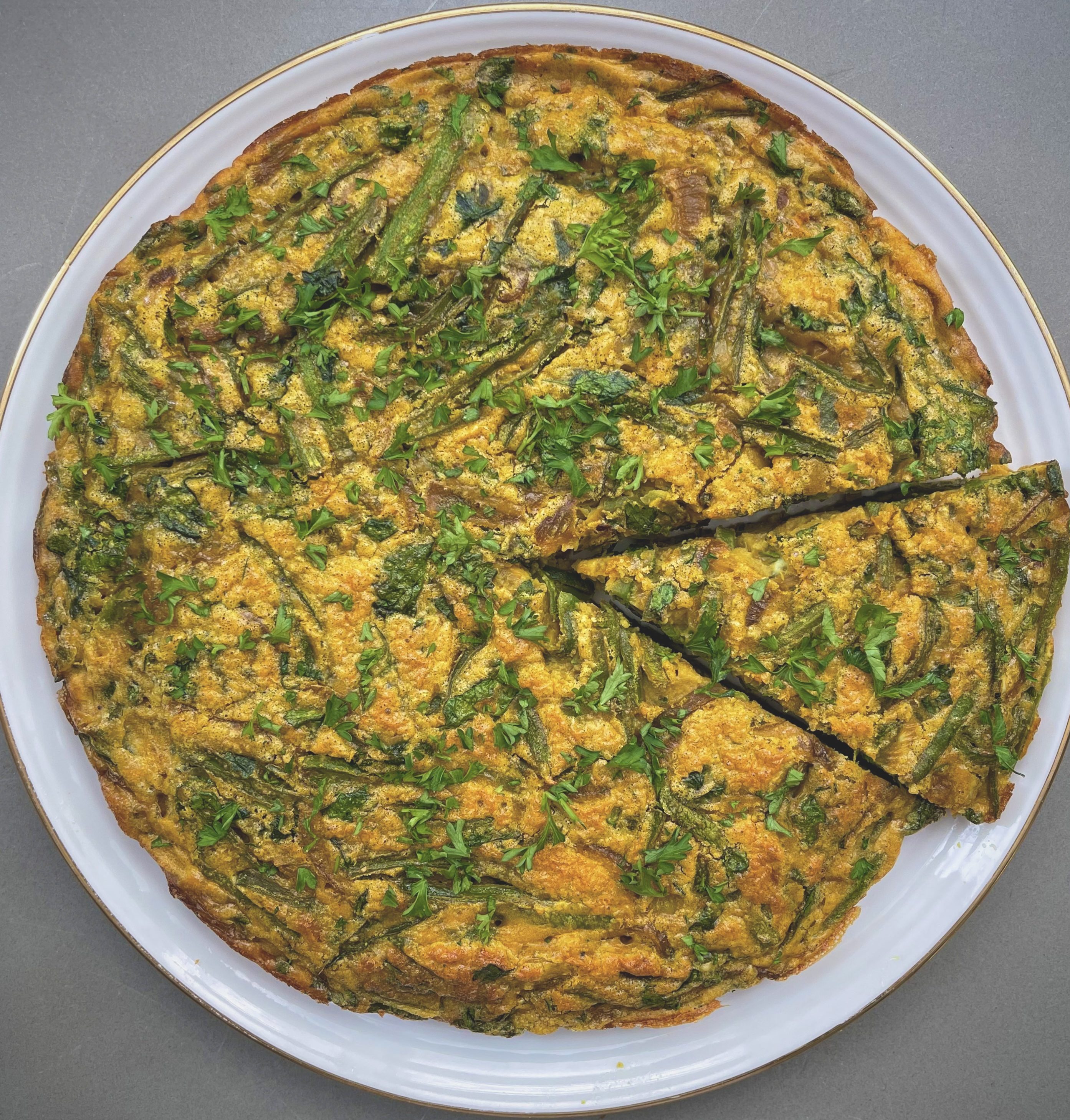

Kuku is an Iranian frittata-style dish. It is often vegetarian and is made with beaten eggs and various herbs and / or vegetables folded in. The main difference between kuku and its western counterparts is the ratio of egg to vegetables, with kuku favouring the latter. It is served either hot or cold as a starter, side dish or a main course, and is accompanied with bread or rice and either yoghurt or salad.
The two most well known kuku recipes are Kuku Sabzi (made with herbs and barberries and / or walnuts); and Kuku Sibzamini (made with potatoes). We also have Kuku Kadoo (made with courgettes). Ultimately there are no hard and fast rules about what you should put in your kuku – I have made ones with potatoes, feta and beetroot; curried mushrooms; kale and red pepper; bacon, cheese and tomatoes and the list goes on…
This Kuku recipe hails from Tabriz, a city in northwestern Iran, serving as the capital of East Azerbaijan Province. It is the fifth most populated city in Iran and the largest economic hub and metropolitan area in northwest Iran. The population is overwhelmingly Azerbaijani who speak the Azerbaijani language, though Persian is spoken by residents as a second language.
This dish is a gorgeous addition to the summer catalogue of recipes as it is light and easy to prepare. some variations of this recipe include potatoes but the version I prefer is with caramelised onions and sliced green beans as set out in the recipe below. I use garlic, saffron, turmeric and advieh as the aromatics for the dish. You can buy the advieh I use for this recipe and others here.

Serve this dish with a salad like cherry and feta salad, hummus such as beetroot hummus and flatbread.
Store leftovers in the fridge in an airtight container up to 3 days. Cool the kuru down completely before refrigerating.


Fried chicken in any form has a special place in my heart (and my belly)! I am continuously looking for ways to bring new joy to me eating crispy fried chicken, from my curried chicken schnitzel recipe to my shwarama flavoured crispy goujons, it was only a matter of time before I found a way to make a Persian version of a fried chicken burger and here it is in all its glory.
Chicken thighs marinated in a blend of buttermilk, saffron, turmeric, chili sauce, onions and garlic. Then coated with flour flavoured with Persian mixed spice (Advieh), Za’atar, onion and garlic powder and then deep fried to perfection. Served in a toasted brioche bun with lashings of moosir mayonnaise, crispy onions, Persian pickled cucumbers, Thai basil, tomato and lettuce. This amazing variation to the classic crispy chicken burger really is worth going the extra mile to get your hands on three Persian elements which are not readily available in your local supermarket.
The Persian equivalent of mixed spice. It is used in many dishes with the combination of spices varying from region to region in Iran. Advieh is a fragrant mix of spices and can be compared in use to garam masala in Indian cooking, whereby its addition seasons the dish and adds a further layer of aromatics. It can simply be sprinkled on a plain rice dish, added to stews and marinades for meat. The one I use is a mixture of nutmeg, rose petals, cumin, cardamom, coriander, cinnamon and black pepper.
I buy it online from a supplier on Etsy. However, advieh can also be picked up from most Iranian or Middle Eastern food shops. This spice forms part of the flour dredge for the chicken thighs and takes the flavour profile to another level of delicious.
Described in English as a Persian shallot, it is similar to a Solo or Elephant garlic. It has a flavour profile similar to garlic but slightly sweeter and softer in its spiciness. They grow wild in the foothills of the Zagros Mountains, and have to be found and dug out of the earth – a similar process to truffles. It adds an amazingly distinctive flavour to dishes.
You can buy moosir from most Middle Eastern food shops or online. It is available in its dried form and needs to be rehydrated by soaking in water overnight. Whilst we usually use this for our yogurt dip Maast O’Moosir, I started adding it to my mayonnaise and have not looked back. It is so delicious. I am pretty sure once you try it, you will also never want to have mayonnaise any other way. The Moosir Mayo compliments this chicken burger brilliantly.
They are baby cucumbers pickled in salt, vinegar and flavoured with tarragon. Our pickled cucumbers are not sweet like British pickled cucumbers and they really compliment this burger. You can buy them online or in most Middle Eastern supermarkets, but if you cannot get your hands on them then normal dill pickles usually used in burgers are absolutely fine.
With the exception of three items above, you should be able to source all the other ingredients from your local supermarket. Both Tescos and Waitrose now have Thai basil available but if you can’t get your hands on Thai basil, then Italian basil is totally fine.
Serve this burger with some french fries for the perfect fakeaway!
https://www.instagram.com/reel/Cf4yljVIKlg/?utm_source=ig_web_copy_link
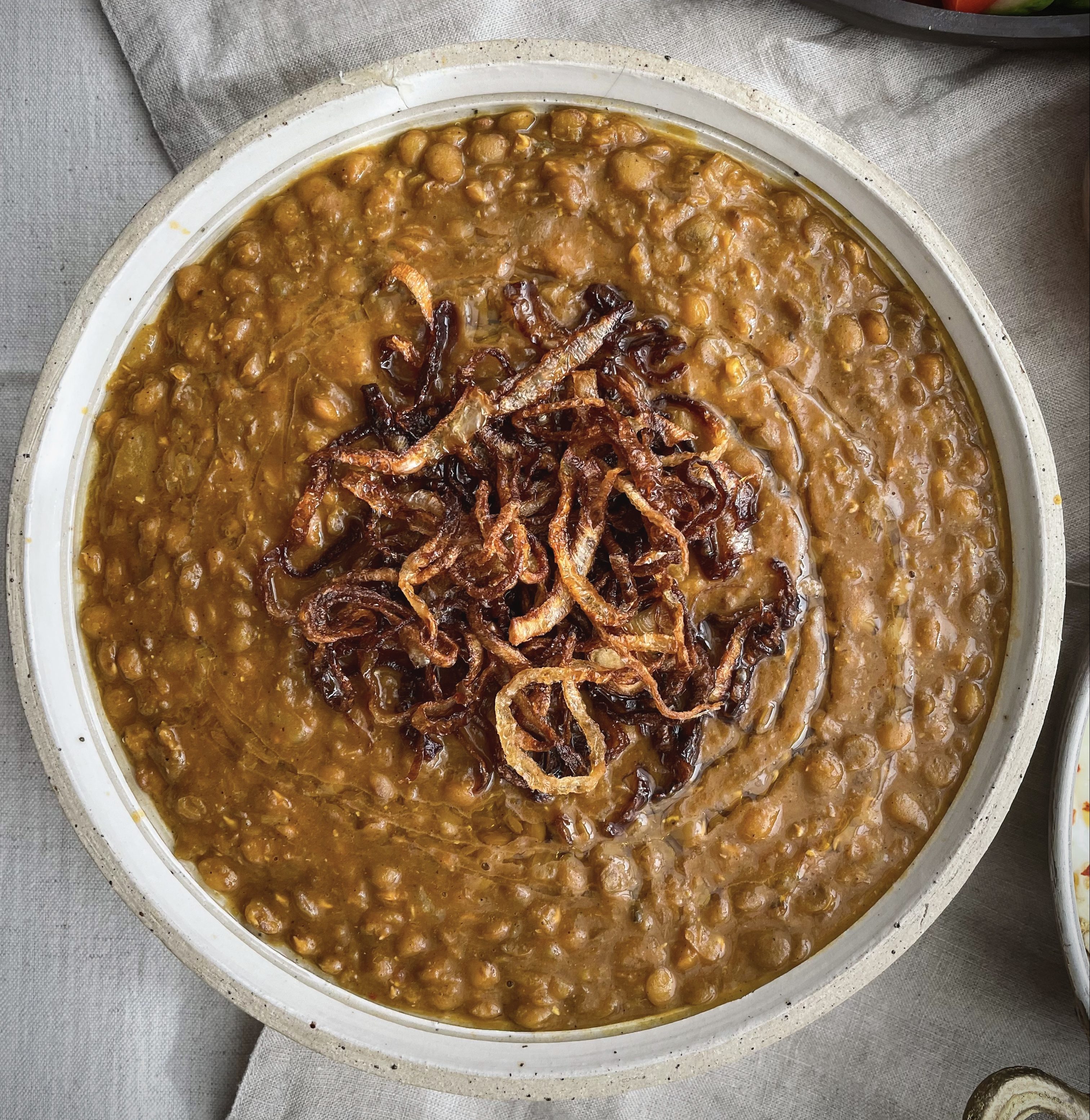

Adasi is a wholesome vegan dish, commonly eaten for breakfast in Iran. It is made with green lentils, onions and spices and is often described as a soup by Persians. I personally consider it is closer to the dal recipes from the Indian sub-continent but to compromise between the two I have called it a stew. Some add cubed potatoes to make it heartier but the version below excludes, but feel free to add them after step 1 below.
It is often topped with fried onions and a ground spice called Golpar or Persian Hogweed or Angelica.
You will require the following ingredients for this recipe.
I cook this recipe the day before I want to eat it as the flavours intensify overnight. The recipe below yields a big batch (up to 8 people) and lasts up to 5 days if refridgerated, so it is a great dish to make and dip in and out of for various meals during a working week.

Serve with flatbread such as Persian Noon-e-Sangak or Sesame and Nigella Seed Flatbread. Pairs well with eggs (poached, boiled or fried) and some fresh herbs as set out in the picture above. It can also be served with rice (chelo or kateh) for a heartier meal.
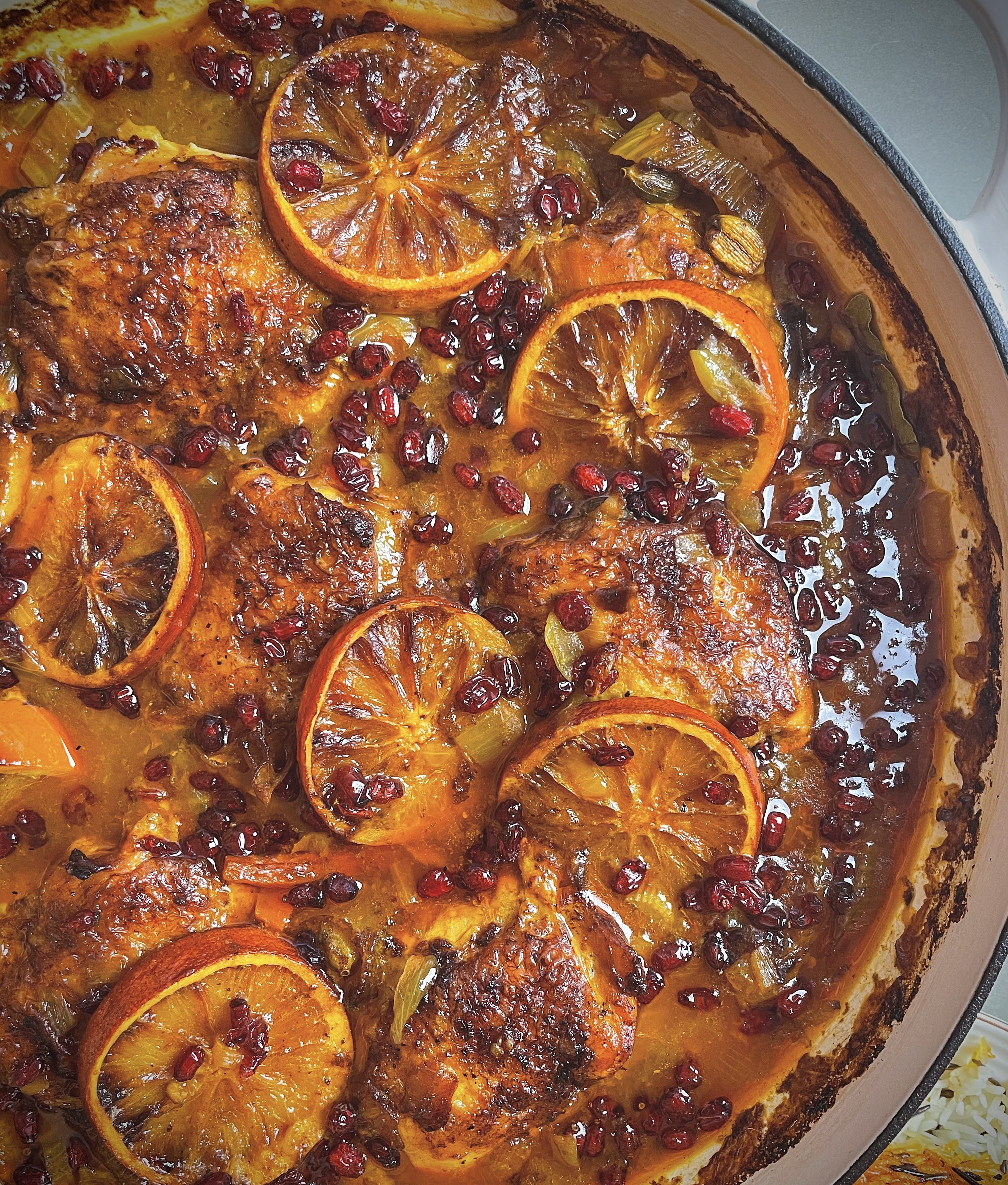
Slow cooked chicken thighs with fennel, oranges & barberries


The ingredients for this powerhouse marinade are simple:
Just add to chicken breast or other cut and leave to marinade for a minimum of 4 hours (preferably overnight) and then cook.
For those of you who may not be familiar with za’atar, it is a herb grown in some Middle Eastern countries, like Lebanon, with a flavour like a cross between thyme and oregano. It is also the name for a spice and herb mixture used like a condiment. Use oregano as an alternative if you cannot get your hands on za’atar,
Harissa originates from North Africa. While every region has its own variation and take on the paste, it’s particularly associated with Tunisia. It is a hot chilli pepper paste, the main ingredients of which are roasted red peppers, Baklouti peppers, spices and herbs such as garlic paste, caraway seeds, coriander seeds, cumin and olive oil.
Rose harissa contains dried rose petals, and, usually, rosewater too. This softens the heat and adds a subtle floral note to the dishes it is added to. The use of yoghurt in the marinade also tempers the heat a little further making this a recipe that can be enjoyed by the whole family. Using a shop bought paste like this really helps to reduce thinking and preparing time so I welcome these shortcuts. A little addition of extras like lime, garlic and yogurt make it more personal.
One of my favourite ways to eat this chicken is an element to a salad bowl (kind of like a Buddha Bowl) with the fragrant and smokey flavours from North Africa and the Middle East, as pictured below.

But it can be eaten with anything or any way you want, whether you want to eat it as a kebab roll with the chicken wrapped in some flatbread with salad, pickles and some garlic and / or chilli sauce alongside some chips; or with some rice or Tabbouleh or other healthy grain based salad.

See my how to reel on Instagram via the link below…
https://www.instagram.com/reel/Cghf7BaISkY/?utm_source=ig_web_copy_link


This recipe came about one evening when I had a jar of chickpeas, a can of coconut milk and a pillow of herbs starting to look a little pathetic in my fridge. The resulting dish totally bowled my family over and is now in the top 5 of our go to vegan dishes.
The recipe below yields enough to feed 4. If you have fewer people to feed, honestly, don’t revise the measurements down! As with most curry-style or Persian khoresh (stew) dishes, leaving it a day for the flavours to intensify by the ingredients getting to know each other better makes the experience of eating leftovers even more spectacular than your first bite of this dish straight after cooking!

The spices used for this curry are turmeric and coriander seeds with the addition of red chilli, garlic, ginger and coconut milk to give those familiar aromatic curry notes. The use of herbs such as dill, parsley, coriander and fenugreek bring a about a flavour profile more common to Middle-Eastern cuisine. This dish is deeply savoury but with a kick of citrus from the use of fresh lime juice to make it an all-round delightful meal.
Other than the amazing herbs and spices, the real key to this dish is the type of chickpeas you can get your hands on. I always find that the chickpeas that are available in jars are larger and more buttery than tinned chickpeas. So I recommend finding them over canned ones if you can.

Serve with rice such as kateh or chelo and a side of salad, such as Shirazi, and flatbread.
The curry can be stored in the fridge for up to 5 days. It can also be stored in the freezer for up to 3 months. Remember to cool the curry down completely before storing and use an airtight container.
To reheat, make sure the curry is fully defrosted, and heat gently in a saucepan over a low heat or in the microwave in an approporiate dish.

Persian lamb & aubergine stew


Bolani (also called Periki) is a stuffed flatbread from Afghanistan. It is commonly cooked by frying and it has a thin crust, which can be filled with a variety of ingredients, such as potatoes, lentils, leeks or minced meat. It is usually served with a yoghurt and / or a coriander chutney. Bolani is made for special occasions but is also a popular street food available in Afghanistan.
It can be eaten as an appetiser, accompany a main meal or eaten as a snack. If you have ever eaten a stuffed Indian paratha or a Mexican quesadilla, then you will be familiar with the presentation of this dish. The main differences being that the Bolani is not flaky and layered like a paratha and not cheesy like a quesadilla, however the premise of of a stuffed type of flatbread is the same.
A simple dough is made using plain flour, chapati flour (atta), salt, water and oil. The dough is rolled and then filled with a cooked a well seasoned sweet potato and leek mixture flavoured with fresh lime juice, aromatics and spices (garlic, turmeric, ground coriander, chilli, cinnamon and fresh coriander). The Bolani are then gently fried on a pan until toasted perfectly.
The Bolani is served with a simple chutney made by blitizing fresh coriander, the green ends of spring onions, garlic, gren chillies, walnuts, apple cider vinegar, olive oil, sugar, salt and pepper.

This recipe is one of a series of recipes posted which forms an element of a larger family meal for my lot. The others are Qorma-e-Lubia (Afghan red kidney bean curry) which I serve with rice, and Maast O’Khiar (a yoghurt dip made with cucumber, mint and garlic). Whilst Maast O’Khiar is the Persian name for this dip, you may be familiar with the Mediterranean versions such as Tzatziki (Greek version), Cacik (Turkish version), Talattouri (Cypriot version). The Afghan version is called Jaan-e-ama and often eaten with Bolani.
Also serve with some finely chopped tomatoes and red onions dressed with olive oil, lime fresh coriander and salt and pepper as pictured.


Afghan cuisine includes dishes and cooking techniques also seen in Persian, Central Asian and Indian cuisines due to Afghanistan’s close proximity and historical cultural connections.
The two official languages spoken in Afghanistan are Dari and Pashto. Dari is the official name of the variety of Persian language spoken in Afghanistan. It is often referred to as Afghan Persian. Although still widely known as Farsi (the official language of Iran) to its native speakers, the name was officially changed to Dari in 1964 by the Afghan government. Pashto is an Eastern Iranian language Indo-European family. It is also the second-largest provincial language of Pakistan, spoken mainly in the northwestern province of Khyber Pakhtunkhwa and the northern districts of the Balochistan province.
I remember the first time I heard someone speaking Dari (1980 something). I asked my mother why I could understand a language which seemed familiar but unfamiliar at the same time. The words made sense to me but the rhythm the language was being spoken in was different to the Farsi I had grown up with. And that is when I learnt about Afghanistan, their languages and the relationship with Iran.
My journey into Afghan cuisine came later in my life but as with learning about our connections in language, their cuisine has brought me great joy and continues to do so. There are many Afghan dishes that feel familiar to me due to my Persian background, but there are also a huge amount of dishes new to me which I have loved learning to cook! And the first I am introducing to you is my version of Qorma-e-Lubia.
Qorma or Ghorma is the Afghan name given to an onion and tomato-based stew or casserole, usually served with rice (challow, Persians call their rice chelow). First, onion is caramelized, for a richly colored stew. Then tomato is added, along with a variety of meat and/or lentils, spices, and vegetables, depending on the recipe. The main ingredient, which can be meat, beans or vegetables, is usually added last. There are many different qormas including:
Qorma-e-Lubia is simply made with red kidney beans as the protein element and cooked with an onion and tomato base flavored with garlic, turmeric, coriander, cumin and dried mint. I also add a little garam masala to mine.
The flavour of this qorma (as with many stew style dishes) gets better if eaten the day after cooking. Therefore, I recommend making it a day before you want to serve it and then heating it up. The flavours really fuse together brilliantly with a little more time to get to know each other.
For those of you familiar with Indian cuisine, you will note this recipe is very similar to the North Indian dish Rajma Masala. Pakistan and Nepal also have a version of this dish.
Serve it with flatbread such as the stuffed Afghan flatbread Bolani, rice (kateh or chelow), a nice crunchy salad with a citrus dressing and / or a yoghurt or non-dairy dip. I have served mine with Maast O’Khiar, the Persian yoghurt and cucumber dip, as pictured below.

You can use dried instead of canned kidneys beans. If you are using dried kidney beans you will need approximately 250 grams. Remember to wash, soak, drain and then cook the beans before adding them at step 7 below. Kidney beans are toxic if not prepared properly when starting with the dried form and can cause tummy upsets, so make sure you follow the instructions on the packet or google it.
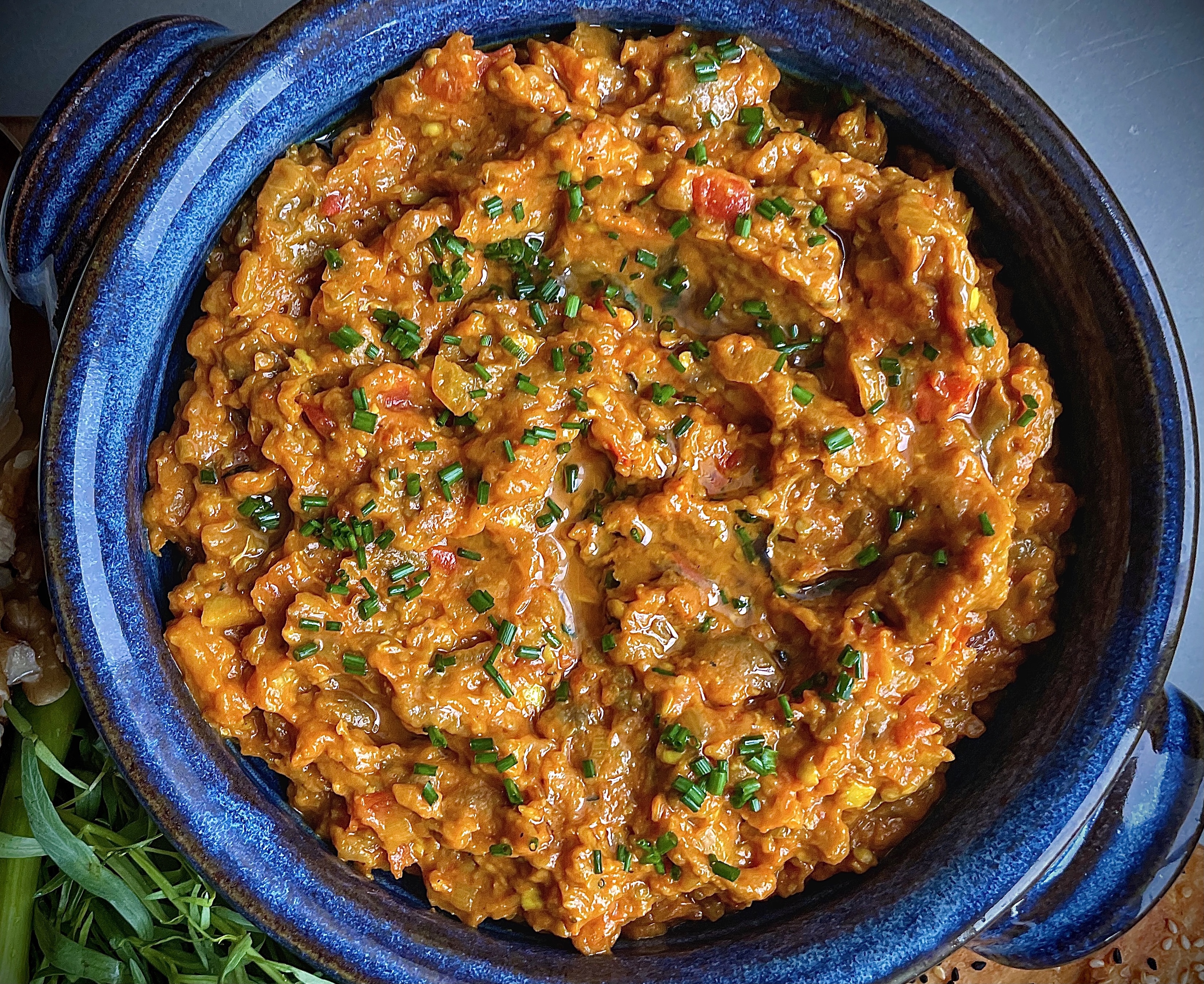
Smoked aubergine dip with tomatoes, garlic and eggs
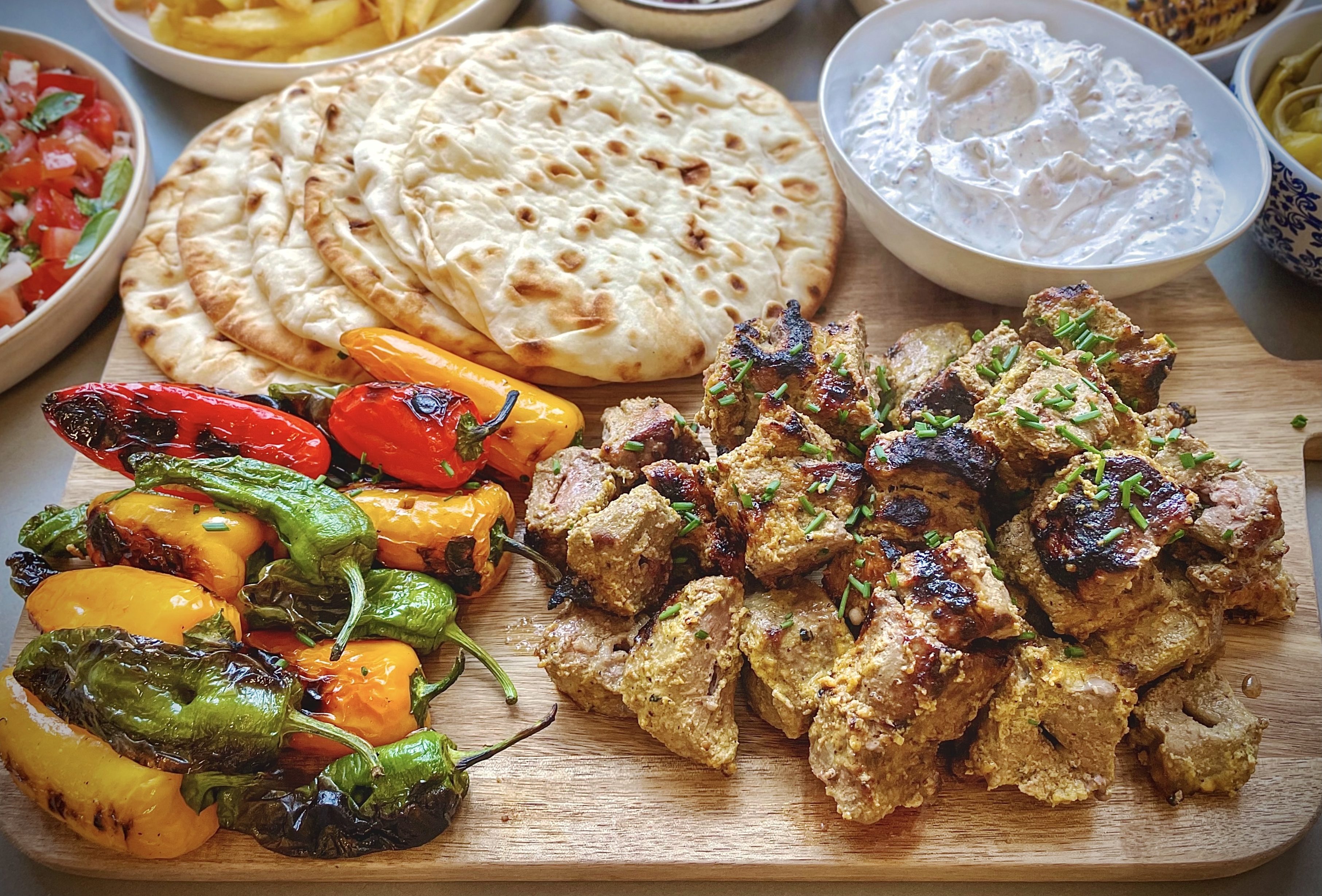

This is a recipe inspired by Persian flavours and one I developed by throwing various things together as a marinade for some cubed rump steak. With echoes of the Levantine shawarma, by using the Persian mixed spice advieh (a mix of nutmeg, rose petals, cardamom, cumin, black pepper, coriander, cinnamon), this kabab will not disappoint. You can use lamb or chicken as an alternative and you can cook it under your grill as opposed to on a BBQ.
The marinade combines yoghurt, garlic, olive oil, onion, lime juice, advieh, saffron, turmeric, sumac and chilli sauce. The meat is marinated for a minimum of 12 hrs to let the flavours fully intensify and be absorbed into the meat. You can get your hands on saffron from most supermarkets and advieh can be bought from most Middle-Eastern food shops – I buy mine online from Freshly Spiced on Etsy.
Build yourself the perfect kebab wrap fakeaway by filling flatbreads with the meat, salad, fresh herbs, chopped onion with parsley, pickled chillies and a dollop of Greek yoghurt. Serve alongside with homemade fried chips and bbq corn-on-the-cob with a butter, chilli and chive drizzle.


This recipe is pure summer on a plate! A light and easy meal – I often cook it the night before we want to eat it and store it in the fridge. It can be eaten warm or cold and it is a great way to get a hit of goodness into you.
Kuku (also spelled ‘kookoo’) is an egg-based, vegetarian dish from Iran made with beaten eggs, folding in various ingredients. It is similar to the Italian frittata, the French quiche or an open-faced omelette, but it typically has more vegetables than its Western counterparts. It is served either hot or cold as a starter, side dish or a main course, and is accompanied with bread and either yogurt, salad and / or rice.
The two most well known kuku recipes are Kuku Sabzi (made with herbs and barberries and / or walnuts); and Kuku Sibzamini (made with potatoes). Ultimately, you can make kuku with any vegetables you like.
This kuku recipe materialised after an Oddbox delivery. Oddbox is a wonderful company that rescues surplus or imperfect vegetables and fruit, which would otherwise not make it to the shopper, and offers it by way of a home delivery subscription services. It’s a fantastic initiative that helps me to eat more vegetables and fruit, while helping to save our planet. It is also been great for challenging my recipe ideas as sometimes I can fall into the routine of buying the same ingredients and cooking the same recipes.
One of my Oddbox deliveries had some kale and red peppers, which lead me down the path of experimenting with the medium of kuku. Kale has become very popular in the UK due to the health benefits. Our supermarkets are always well-stocked with kale and red peppers, potatoes and red onions – the vegetables used to cook this dish. I use garlic, smoked paprika and chillies for the aromatic notes, which results in a smoky and gently warming feel to eating this even when eaten cold.
Traditionally kuku is fried and flipped over to brown on the other side, but I prefer to oven bake mine so the recipe below is geared towards baking but feel free to fry it if you prefer, either omelette-style or like fritters.

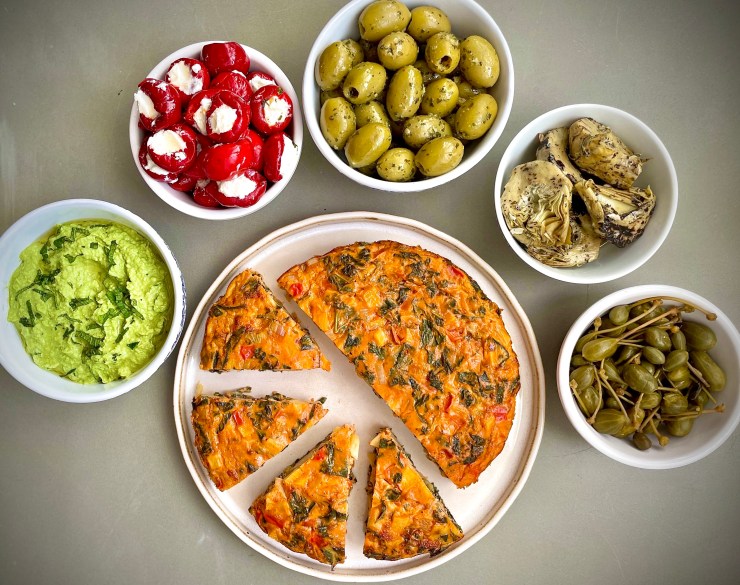
The beauty of kuku is that you can make a batch one evening and have it as a quick lunch on your working days. It is also a well-loved addition to a mezze-style meal or served with bowls filled with lots of antipasti.
I have paired this kuku recipe with a pea, mint and feta dip, making the overall experience fresh, light and summery.
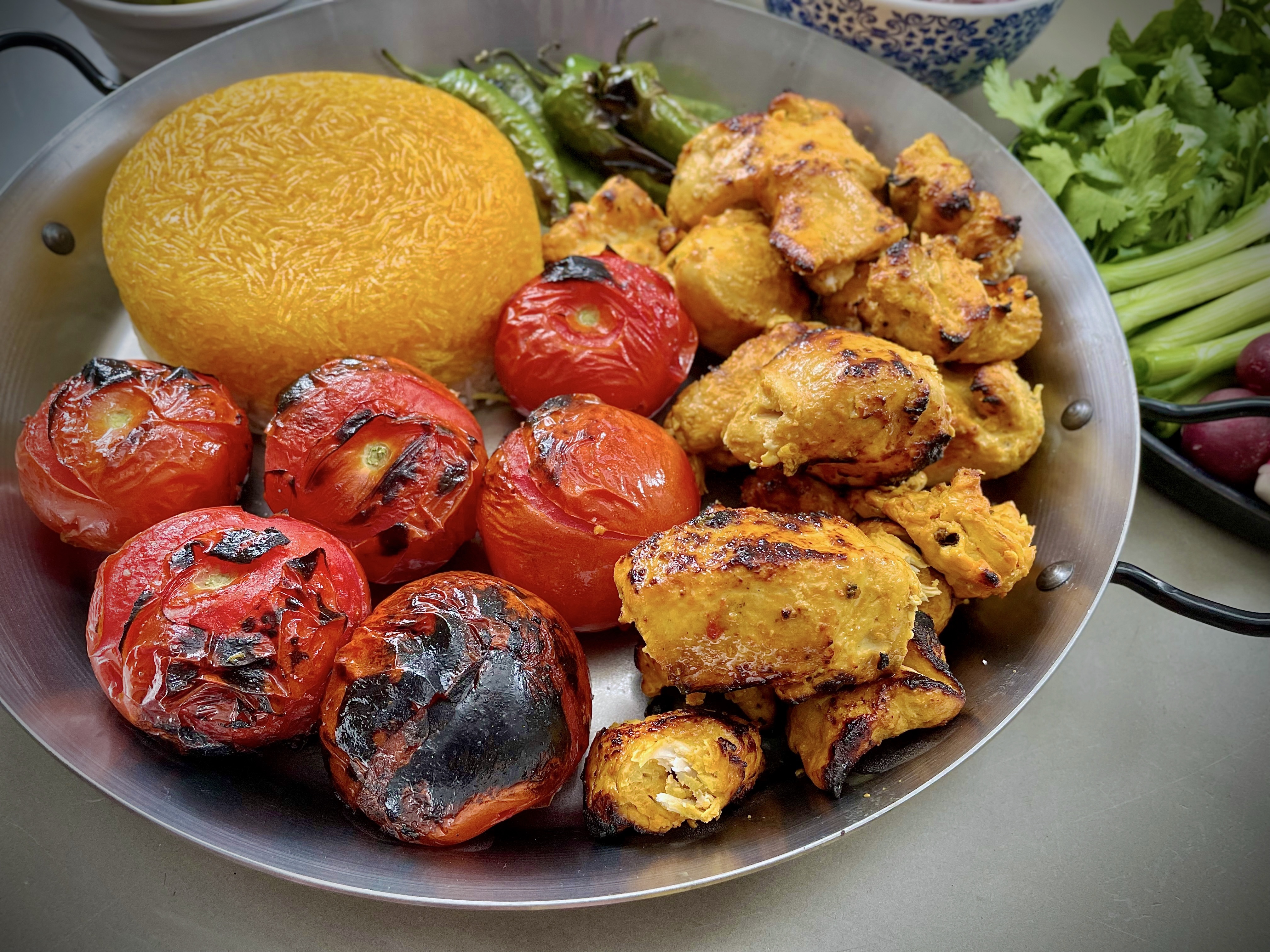
Persian Chicken Kebabs with Saffron and Lemon
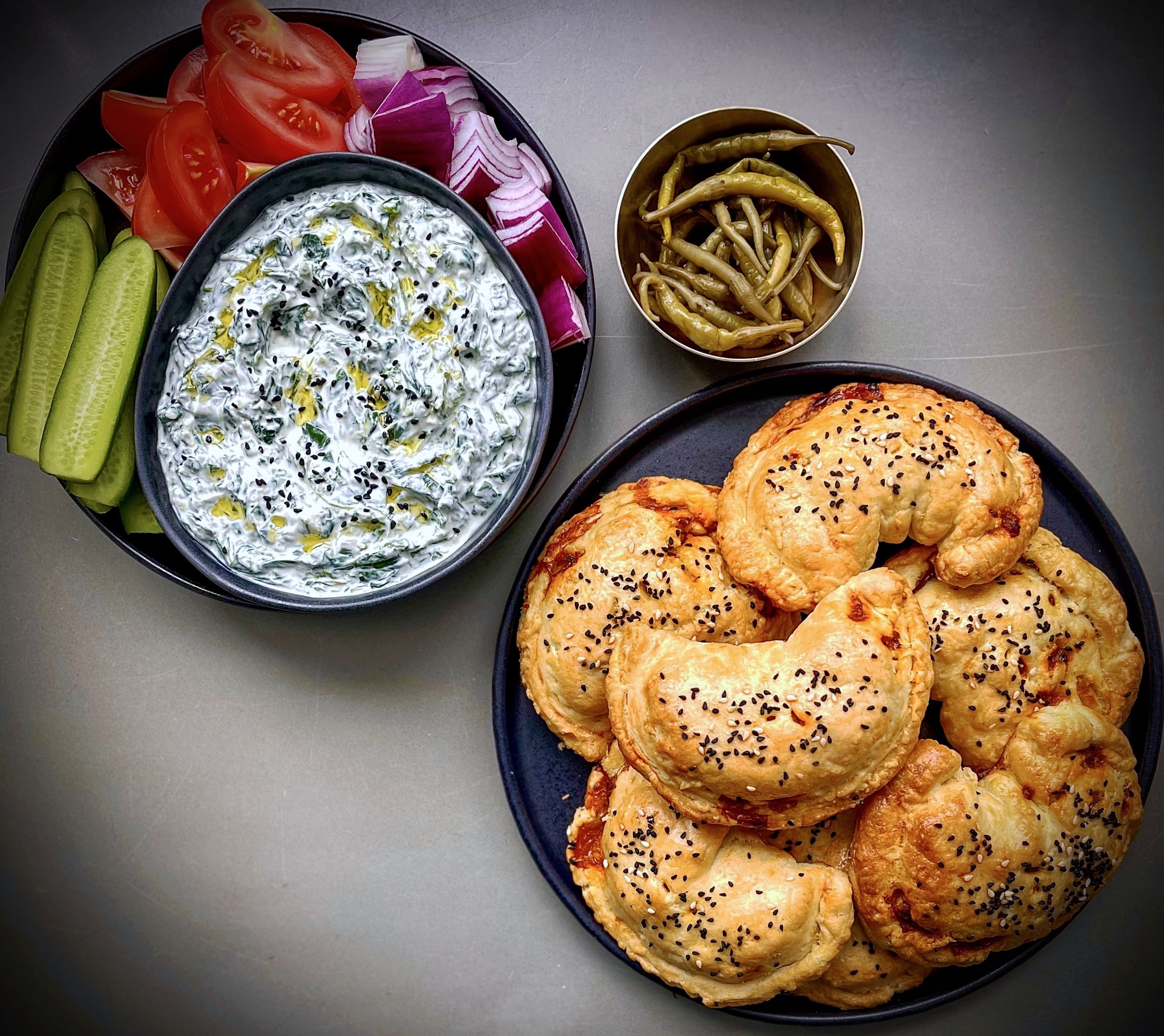

A pasty is a British baked pastry associated with Cornwall, South West England, but has spread all over the British Isles. It is typically made by placing an uncooked filling, usually meat and vegetables, in the middle of a flat shortcrust pastry circle, bringing the edges together in the middle, and crimping over the top to form a seal before baking. The humble pasty has been made with so many different fillings including chicken tikka or steak and blue cheese. The variations are endless and always welcomed!
The recipe below calls for pre-made and rolled shortcrust pastry making it very easy to make. You can buy this type of pastry from most leadking UK supermarkets. The pastry is filled with a cooked mixture of halloumi, potatoes, onions, pepper and fresh herbs cooked in a spicy tomato based and red pepper sauce. The pies are then baked to golden perfection.
The feel of this meal is very much Mediterranean-inspired and we happily eat this in the warmer seasons for either lunch or dinner. The pasties fare well eaten cold and we often eat the leftovers for our packed lunches on ensuing work days.

For the purposes of my recipe offering to you, I have paired the borani with some spicy halloumi pasties.
Borani Esfenaj is a delicious Persian dip made simply with yoghurt and spinach and flavoured with garlic, a little lemon or lime juice and some salt and pepper.
I have fond memories of this dip as my khaleh (maternal aunt) would make it regularly when I was a child. This dish and Nargessi (a Persian breakfast / brunch dish made with garlicky spinach and eggs) are the reasons I love spinach so much. Spinach cooked with lots of garlic is a perfect combination and, with the addition of thick creamy yoghurt, makes this dip a lovely addition to a table full of appetisers for your guests to dip in and out of or a mezze-style offering.
Borani Esfenaj can either be made with frozen or fresh spinach. If you are making it with frozen spinach use 500g for the recipe below. Using frozen spinach creates a creamier dip and is perfect if you are serving it alongside crisps or other crudites for people to dip in and out of. If you are serving it as part of a meal, as in this recipe, then the chunkier dip with fresh spinach works well both in texture and aesthetics.
I like to make the borani the day before so the flavours can intensify.

In addition to serveing alongside the Borani, I love serving these two dishes with pickles, olives or salad-type ingredients to pick at too. If you want some extra carbs with this dish, then roasted sweet potato wedges work really well and can be dipped into the borani as well.
Both the pies and the Borani will keep in an air tight container in the refrigerator up to 5 days.
The pies can be frozen and kept up to 3 months. Make sure the pies have fully cooled before freezing or palcing in the fridge. Make sure th epies a re fully defrosted before baking them if frozen.
Re-heat the pasties in a medium oven circa 160°C in a fan oven.

Persian lamb patties


Many Iranians are more familiar with our turnip soup for illnesses (Ash-e Shalgham) but for me it will always be our version of the classic concept of chicken soup that I turn to when in need.
Creamy, hearty and comforting – essential components for a medicinal chicken soup.
In Persian (Farsi) ‘Jo’ (pronounced ‘joh’) means barley – so we have simply named this soup ‘barley soup,’ despite the additional ingredients required to make this divine soup. This soup is easy to cook and as you can see below, the ingredients can be easily sourced from most local supermarkets.
Traditionally this soup is thickened with a roux, which I feel is unnecessary and makes the soup too thick and gloopy. With the availability of the handy stick-blender you don’t need to use a bechamel and can thicken the soup by blending a little bit of it. Also cream makes for a luxurious addition to the soup so my variations to the traditional recipe actually results in a velvety and lighter soup.
If you are not a fan of coriander, then replace with parsley, which is the herb more commonly used in this recipe.
You can convert this into a vegetarian recipe by using vegetable stock and using mushrooms as an alternative to the chicken. I recommend frying the mushrooms in a little butter and garlic and then adding them to the soup for the last 10 mins of simmering and before serving.
It is such a hearty soup you don’t need to have bread with it but do feel free to have a buttered crusty roll or whatever you fancy to dip into the soup.
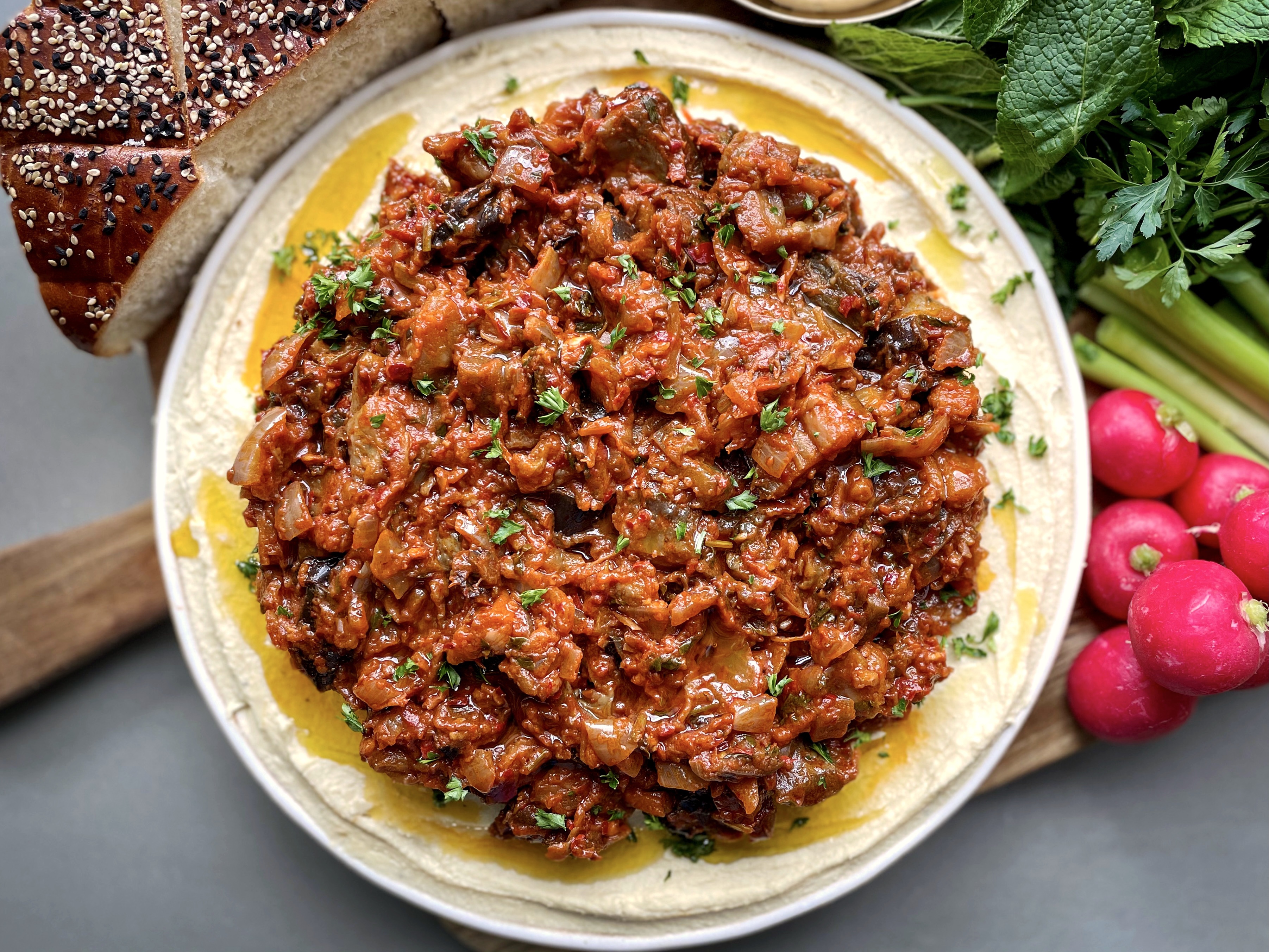

Most people are familiar with this incredible and versatile dip. For those who are new to velvety dip, hummus is a savoury Middle-Eastern dip made from cooked, chickpeas blended with olive oil, tahini (sesame paste), lemon juice, and garlic. It is difficult to pinpoint the exact origins of hummus as multiple different theories and claims of origins exist in various parts of the Middle-East but apparently the earliest known written recipes for a dish resembling it are recorded in Egyptian cookbooks written in the 13th century.
It can either be made with a chunky or smooth texture and comes in a variety of different flavours and different toppers. From plain hummus with a drizzle of olive oil and sprinkling of za’atar to Beetroot Hummus with Feta and Anything-Green Topper, the variations to the offering of hummus are endless.
For those of you who may not know, harissa originates from North Africa, while every region has its own variation and take on the paste, it’s particularly associated with Tunisia. It is a hot chilli pepper paste, the main ingredients of which are roasted red peppers, Baklouti peppers, spices and herbs such as garlic paste, caraway seeds, coriander seeds, cumin and olive oil.
Rose harissa contains dried rose petals, and, usually, rosewater too. This softens the heat and adds a subtle floral note to the dishes it is added to. I use Belazu rose harissa. They also do an apricot version which can be used as a substitute in the recipe below as can the standard harissa paste.
The topper to this hummus dish is simply sautéed aubergines and onion with the addition of rose harissa, garlic, tomato purée, balsamic vinegar and fresh coriander to create an aromatic dish with a little heat.
The aubergine mixture, which you can either have cold or warm, is then layered on hummus and served with some bread to dip into it. You can buy your favourite brand of hummus as opposed to making it from scratch but the recipe for hummus below is so easy, resulting in a beautifully creamy and smooth hummus, I can’t recommend it enough.
It is a really easy dish to prepare and one that can easily be cooked up after work. It is vegan so a great option for a ‘Meat Free Monday’ meal. Served with other mezze-style offerings such as bread, olives or, as pictured, a fresh herb and feta cheese platter, this dish can generously feed 4 people.
If there are any leftovers, place in an airtight container and store in the fridge up to 3 days. Makes a great sandwich or wrap filler.

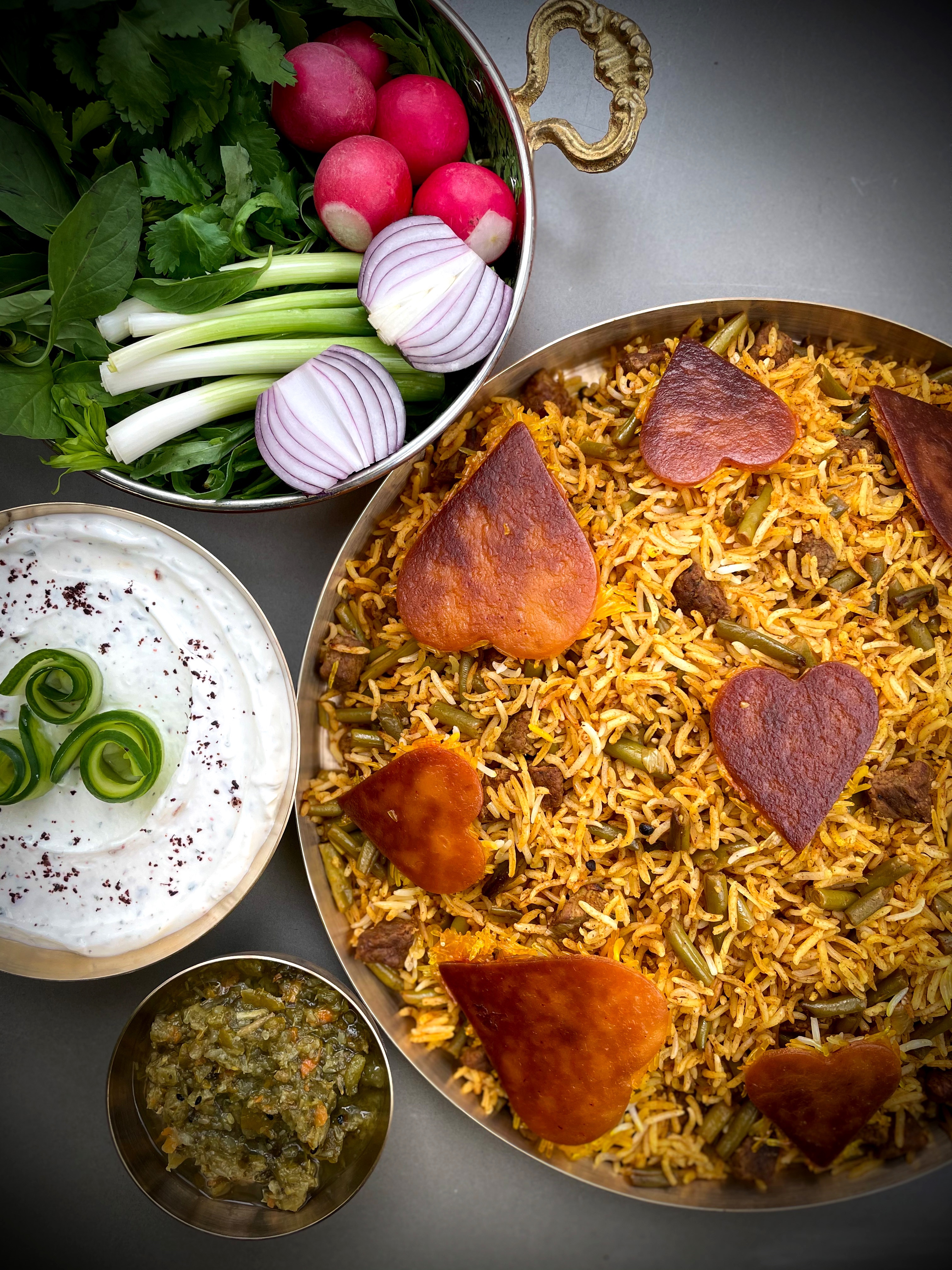

Loobia polo is an Iranian dish made with rice, green beans, and beef or lamb. Loobia means beans in Persian (Farsi) and ‘polo’ indicates it is a rice-dish layered with meat and / or vegetables.
Think of that dish that represents the ultimate comfort food for you, Loobia Polo is the equivalent to that to most (if not all) Iranians. Even the fussiest of kids will love this dish and that stays with them through to adulthood. Everyone squeals with delight when Loobia Polo is served with its warming cinnamon notes, tomato flavour, chunks of meat and green beans.
The rice I use for Loobia Polo is Kamran Basmati Sella Rice as opposed to Tilda Basmati rice. Kamran rice is very forgiving as it is a thicker kernel and holds its integrity against the bean and tomato mixture, which releases liquid into the rice. For this reason, if you are using the more delicate Tilda grain you have to remove it from the parboiling stage a little earlier than you would with the normal Chelow recipe. Alternatively buy yourself a packet of Kamran rice and be less exact and turn out a perfect Loobia Polo each time you cook it.
You can use lamb, chicken, turkey or mushrooms (if you are veggie) as an alternative to beef in this dish.
The recipe below includes the steps to make flatbread tahdig (using a tortilla wrap) but you can make tahdig with rice or potato,should you prefer. Just prepare a layer of saffron rice at the bottom of the pan at step 3 under the heading ‘For the rice’ below for rice tahdig; or layer your potato slices for potato tahdig.
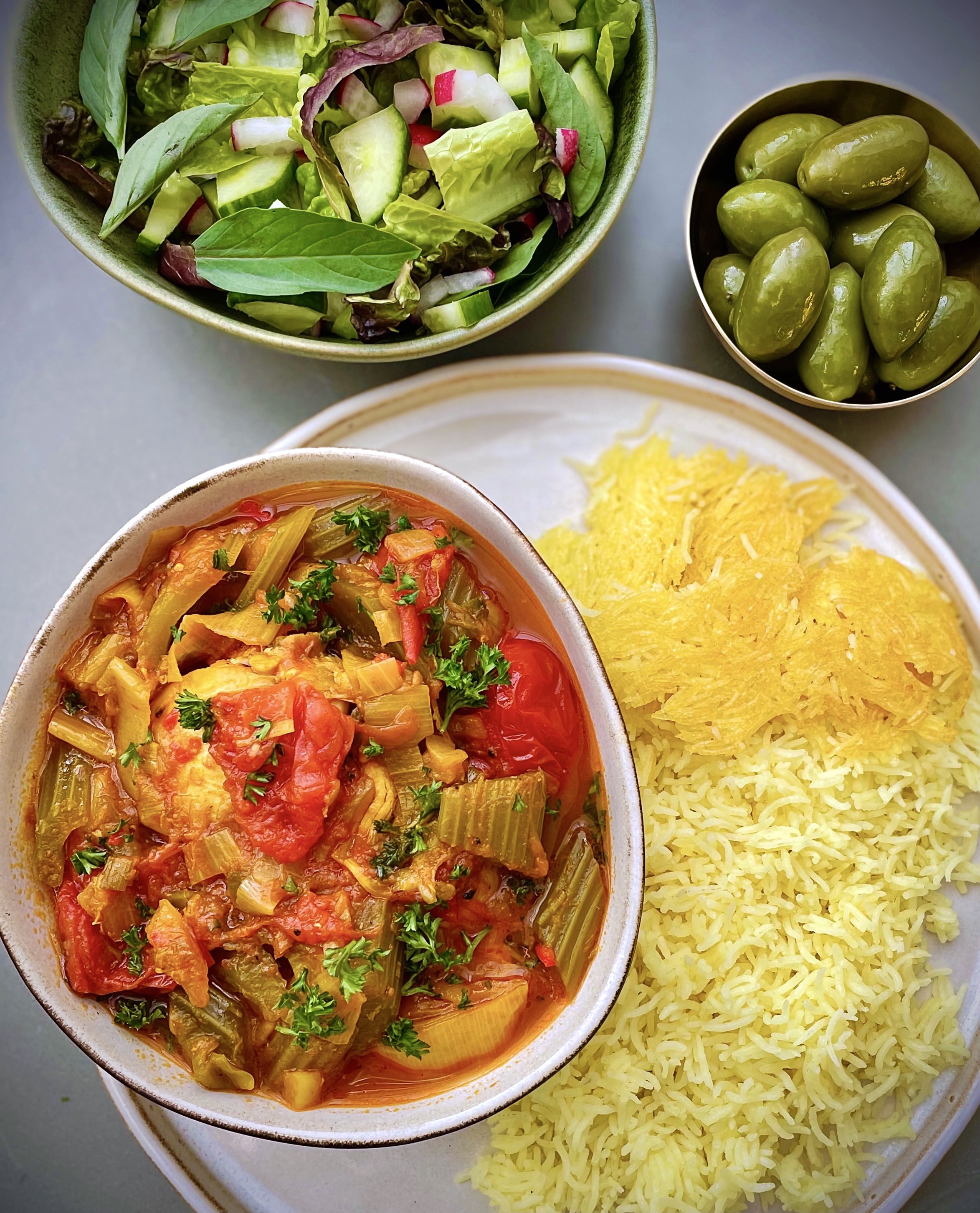

This stew is the lesser-known of the Persian celery stews. The famous one being Khoresh Karafs made with lamb, mint, parsley and celery. This version can be made with chicken, lamb or beef with the stew being tomato-based.
In my family, we distinguish between the two by referring to the colour: ‘Sabz,’ which translated means green in Farsi, for the herby version; and ‘Ghermez,’ which means red, for the tomato-based version. In fact, this version is probably the most popular among my mother’s side of the family, who primarily come from Mashhad in the Khorasan Province of Iran.
With tomatoes apparently only being introduced to Iran in the late 19th century, this stew is inevitably fairly young in the longstanding history of Iran and the Persian Empire. Some Iranians have never heard of this stew!
How to Serve Khoresh Karafs – Germez?
Serve with this stew with Kateh (Persian rice cooked the easy way). A simple salad with a citrus dressing, or fresh herbs, or pickle / olives also make complementary side dishes.
I cannot recommend this recipe enough with it being so easy to prepare and cook, using only a handful of ingredients but maximising on flavour. It is a comforting yet light stew so I love eating this in the earlier part of Spring as we make the gentle transition away from eating the heartier dishes and move towards salads, BBQ’s and a Mediterranean feel to our dishes.


I discovered a love for dal over the last ten years. My husband introduced me to the world of dal during one of our early dates. He is a big fan of Indian cuisine and always orders a dal dish to accompany his meal. I was reluctant at first but, after a spoonful, I fell in love with the creamy texture and the aromatics of the dish. I wanted to make a dal dish with a Persian twist so I started experimenting!
This dish is made with yellow split peas (Channa Dal) using the holy trinity of Persian cooking – onion, turmeric and saffron. I also added other familiar flavours from our cuisine during the recipe development including limoo amani (dried lime), advieh (Persian mixed spice) and nigella seeds. The resulting dish is deliciously savoury, packing an umami punch and satisfying even the die-hard carnivore.
Limoo amani can be bought online or from most Middle-Eastern food shops. It adds a musky and citrusy flavour to the dish. Be careful when piercing a hole into the dried lime as you do not want the seeds to fall out while it is cooking as it can make the dish bitter – just a gentle shallow poke into the lime with the end of a sharp knife.
Advieh can also be bought from most Middle-Eastern food shops – I buy mine online from Freshly Spiced on Etsy. The combination fo spices are nutmeg, rose petals, cardamom, cumin, black pepper, goriander, and cinnamon.
I like a little heat in my food so I add red chilli to my dal, but feel free to leave it out.
Serve it with roti or naan, rice if you want a hearty meal with fresh herbs, torshi or a yoghurt dip on the side such as Maast o’Moosir (yoghurt and Persian shallot dip) or Maast O’Khiar (Persian yoghurt and cucumber dip).
This dal dish will last in the fridge up to 5 says if kept in an airtight container. Always cool dishes completely before refridgerating.


This dish is synonymous with Norooz – Persian New Year. Rice is steamed with saffron, garlic and chopped herbs. It is usually served with fish and Kuku Sabzi (a herb and egg frittata).
In Persian, ‘Sabzi‘ refers to herbs or vegetables; ‘Polo‘ refers to the fact that the rice is cooked with another element mixed in, in this case the fresh herbs. The herbs used in Sabzi Polo vary, but typically include dill, coriander, parsley, Persian chives or the green ends of spring onions and in some cases fenugreek.
Iranians traditionally eat Sabzi Polo with a fried or smoked ‘mahi sefid’ (‘white fish’, the Caspian kutum or Caspian white fish which inhabits the Caspian Sea). It’s usually served with pickled garlic, other traditional pickles, Salad Shirazi and ‘Naranj’ – a tart and slightly bitter orange, which we squeeze over the fish and rice like a lemon adding a citrus note to the dish. You can buy Naranj from your local Middle-Eastern supermarket. Sainsbury’s also stock Naranj (bitter Seville marmalade oranges) during the season. Kuku Sabzi is also served alongside the rice on the day, a great alternative should fish not be your thing.
Below is my family recipe for Sabzi Polo. We tend to use a greater amount of fresh herbs compared to others. The herbs use in this recipe are fresh coriander, parsley and dill. In Iran chives are also used but the chives available in the UK are not as spicy so we replace these with the green ends of spring onions. The herbs and greens are mixed in while the rice is parboiling. After draining the rice, it is steamed with garlic butter drizzled over with a little saffron to add further aromatics to this dish.


The accompanying fish is grilled salmon marinated in a simple saffron, honey, garlic, lemon juice, olive oil infusion and smoked sea salt. You can make the Sabzi Polo with any fish you want, including smoked fish like many in Iran will eat on the day. You can pan fry, BBQ, grill, oven bake, poach or steam your fish if you prefer.


Due to the herbs, the tahdig (crispy rice formed at the bottom of the pot) will come out a dark green-brown as you can see in the first picture so do not panic when you flip the crispy stuff out – it’s meant to be that dark!
However, should you prefer you can prepare the dish with a saffron layer of Tahdig as you can see in the pictures above and below. All you need to do is parboil the rice without adding the herbs, drain it and then take 2 cups of rice and add to a little saffron water (1/4 teaspoon ground saffron bloomed in 3 tablespoons water). Mix the rice until fully coated and then line the bottom of the pan, following the addition of the oil/butter, as set out at the step entitled ‘Prepare the Tahdig Layer’ below. Then pat it down and layer the cooked rice with the fresh herbs and the garlic butter layer by layer on top.
You can also have potato or bread tahdig as an alternative. Just replace the rice layer with slices of potato or flatbread.
Serve this dish alongside all or one of the following.
Store in an airtight container, once cooled down, and in the fridge. The rice will last up to 5 days. The salmon will last up to 3 days. you can reheat the rice and salmon in a microwave. Or you can reheat the rice in a saucepan. Remember to add a tablespoon or so of water to rehydrate the rice if reheating. The salmon can also be reheated in a medium oven.

Norooz is the day of the vernal equinox and marks the beginning of spring in the Northern Hemisphere. It marks the first day of the first month of the Iranian calendar (Farvardin). The moment the Sun crosses the celestial equator and equalises night and day is calculated exactly every year. Families gather together to observe the rituals. Due to this calculation, the day Persian New Year falls upon can vary but generally it is either on the 20th or 21st March. The Persian name translated means ‘New Day.’
The festivities and rituals we observe are focussed on letting go of the winter and all the negativity that may be associated with it. We look forward to new life, prosperity and have great optimism which is brought by spring and then the summer months.
In the lead up to the the New Year celebrations, many Iranians will undertake a ritual familiar to many – the ‘Spring Clean.’ I always do a major spring clean and this year was no exception. By day 3 into my efforts my house was messier than when I started, but by the end of the process I felt physically and mentally lighter from the purge of the clutter and the deep clean of the house.
The evening of the last Tuesday before Norooz is the night we celebrate Chaharshanbeh Soori – a festival of fire where we gather together and jump over bonfires. The tradition of jumping over the bonfire originates from people believing that the fire would take their problems, sickness and winter pallor and be replaced by energy and warmth, contributing towards their success for the upcoming year. As we jump, we chant the following words: ‘Zardiye man az toh (my pallor to you); Sorkhiye toh az man (your redness to me).’ See my post about Chaharshanbeh Soori and the dish we eat on that day here.

On the day of New Year we will go to one family member’s house and gather together for the turn of the New Year. We gather around the Sofreh Haft-Seen, a table or other surface, which is set with the symbols of Persian New Year and await the exact moment of the March equinox to celebrate the New Year (even if it happens at 3 am in the morning for some Persian families).
Traditionally, the Haft-Seen (seven things beginning with the letter ‘س‘ pronounced ‘seen’) are:
The Haft-Seen may also include a mirror (self-reflection), candles (enlightenment), eggs (fertility), goldfish (progress), coins (wealth), hyacinth (spring’s arrival), and traditional confectioneries. A “book of wisdom” such as the Quran (religious text of Islam), or the Book of Kings – the Shanameh of Ferdowsi (an epic and long poem on the Persian Empire), or the Divān of Hafez (an anthology of the famous Iranian poet Hafez’s poems) may also be included.
Music will play and we will eat Sabzi Polo ba Mahi and Kuku Sabzi. Many of us continue the celebrations by having a separate organised event for the wider family and friends at a hotel or restaurant where we dress up and dance the night away.
During the Norooz holidays, we make short visits to the homes of family and friends. Typically, young people will visit their elders first. Visitors are offered tea and pastries, cookies, fresh and dried fruits and mixed nuts or other snacks. Gifts are given from the elders to the younger members of the family.
On the 13th day of the Norooz celebrations we celebrate Sizdah Bedar. Iranians spend the day outdoors. Many will go out for a family picnic in a local park. Come rain or shine we will gather outdoors and celebrate this day – throwing our sabzeh into a nearby river or stream marking the end the Persian New Year celebrations.


Although we have translated this dish to be described as a soup, Persian ash (pronounced ‘aash’) recipes tend to be a hearty bowl of goodness. Ash Reshteh is no exception to the rule. A wholesome bowl packed full of Persian noodles (‘reshteh’), kidney beans, chickpeas, green lentils, cooked with fresh herbs and greens and flavoured with kashk (a fermented / preserved food made with the whey left over from cheese-making). The texture of this ash is less soup and more like a chilli.
My version of this recipe differs to my maman’s recipe. I don’t use flour to thicken my ash. I also use slightly more herbs than her. The resulting ash feels fresher and lighter than the traditional recipe / method. If you cannot get your hands on Persian noodles, the closest alternative are udon noodles. You can also use spaghetti or linguine. If you are vegan, leave the kashk out and add some freshly squeezed lemon or lime juice to taste. You can also use a dairy-free yoghurt in addition to the fresh citrus.
This dish is served during the winter time and at special Iranian events like Chaharshanbeh Soori; and Sizdah Bedar. The noodles in the ash are supposed to symbolize good fortune for the new year.
See my next post which is about Norooz and the dish Sabzi Polo ba Mahi (rice layered with herbs and served with fish) which we Persians eat on the day. This post focusses on Chaharshanbeh Soori and Sizdah Bedar, when my family come together to celebrate and eat Ash Reshteh.
The first event in our Norooz festivities takes place on the evening of the last Tuesday before Persian New Year. It is a Festival of Fire. People in all parts of Iran and those of us who live outside of Iran celebrate this festival by setting up bonfires in almost all the public places in Iran – in our gardens or at organised events for the diaspora community.
We eat Ash Reshteh and other Persian delights and jump over the bonfires. The tradition of jumping over a bonfire originates from people believing that the fire would take their problems, sickness and winter pallor and be replaced by energy and warmth, contributing towards their success for the upcoming year. Therefore, jumping over fire on Chaharshanbeh Soori night is like a purification rite or a phrase familiar to the West ‘out with old, in with the new.’
As we jump, we chant the following words: ‘Zardiye man az toh (my pallor to you); Sorkhiye toh az man (your redness to me).’

Another tradition is to bang on pots and pans with spoons that are named as ‘Ghashogh Zani,’ with the objective of beating out the last Wednesday of the year.
It is a celebration of good health and light – the end of winter and the beginning of Spring. It is believed that the ritual guarantees the dissipation of the misfortunes and evils and the materialization of hopes and desires for the next year.
Sizdah Bedar is considered the final day of the Persian new year celebration. It is celebrated on the thirteenth day of Norooz. The festival’s name translated means ‘getting rid of the thirteenth.’ As with many cultures, the number 13 was considered bad luck by Iranians and so they believed that by being outside with nature the bad luck would dissipate. Therefore, on Sizdah Bedar, Iranians spend the day outdoors. Many will go out for a family picnic in a local park. One family member will be entrusted with bringing a pot of Ash Reshteh and the rest of us the sandwiches and other Persian treats!
Come rain or shine we will gather outdoors and celebrate this day – throwing our sabzeh (sprouted lentils or wheat and one of the symbols of Norooz representing rejuvenation and new life) into a nearby river or stream. Other than eating, another ritual for the day is knotting greens. Usually, the young unmarried people knot the green of the sabzeh to find their soulmate prior to throwing it into the water.
https://www.instagram.com/reel/Ch75lI9ImZ0/?utm_source=ig_web_copy_link


This dish literally translates as ‘kashk and aubergine.’ It is a dip make with aubergine, which is cooked and flavoured with turmeric, onion and lots of garlic. Kashk is mixed through to give a slightly tart and creamy flavour. The dip is then topped with mint oil, kashk, crushed walnuts and cispy onions. It is a unique tasting dip with its rich and earthy tones.
Kashk is a range of fermented dairy products used in Iranian, Turkish, Balkan and Arab cuisines. Kashk has been a staple in the Persian diet for thousands of years.
Persian “kashk” is a fermented / preserved food that comes in liquid or dried form. It is traditionally made with the whey left over from cheese-making. It is used in dishes like Ash Reshteh (a herb, lentil, bean and noodle soup) and Kaleh Joosh (a soup made with walnuts, onions and mint). In its dried form it needs to be soaked and softened before it can be used in cooking.
The taste of kashk is distinctive and almost indescribable. It is well worth purchasing and not substituting with an alternative, such as yoghurt. Kashk provides a sour, salty, creamy and slightly cheesy flavour to the dishes it is added to.

When I was growing up, my maman used dried balls of kashk which she would soak in a bowl before adding it to a recipe. Apparently before she knew she was pregnant with my sister, a relative surmised she was as she saw her sucking on kashk like they were sweets! Nowadays, you can buy kashk in liquid form in jars from Middle-Eastern food shops or online. I use Kambiz Kashk and buy it online here or by popping into a local Middle-Eastern supermarket.
I fry the aubergines, as do most Iranians when they cook this dish. But you can oven roast the aubergine, if you prefer. Brush them with a little oil and roast for 30 – 40 minutes or until they are cooked through and soft (oven temp – 180°C (fan) / 200°C (conventional) / Gas Mark 6). If you roast your aubergine, you will need to add a little oil to your frying pan to cook the garlic step 5 and 6 below).
In our family we tend to serve it as a starter with flatbread at our larger family gatherings. At home, as a family of 3, we eat it as a main course with a hearty salad like tabbouleh, Nan-e Barbari (Persian Flatbread) and some fruit for afters as pictured.
Check out these other great dip recipes.


This recipe is an adaptation of the dish ‘Estamboli Polo.’ A rice dish that comes in many different iterations. Some do a vegetarian version. Others include meat. Some include green beans. Some don’t use potatoes. My version is a vegetarian version with onions, potatoes and tomatoes layered through the rice. In addition, as found in most Persian cooking, turmeric and saffron provide the rich flavour to this rice dish. I have added some extras to my version including garlic, parsley and coriander for extra flavour.
I wanted a quick version of this dish for my family. Instead of using the traditional method of cooking Estamboli Polo by draining the rice after par-boiling, I used the kateh method. Simply boiling and steaming the rice without draining the water. The resulting rice is delicious, quick and involves less washing up. Also it still creates tahdig – the crispy rice at the bottom of the pot.
Perfect when accompanied with a salad like Salad Shirazi, or Maast O’Khiar (Persian yoghurt, mint and cucumber dip), or torshi and/or fried eggs.
Make sure the rice has completely cooled down, then store in an airtight container in the fridge up to 5 days.
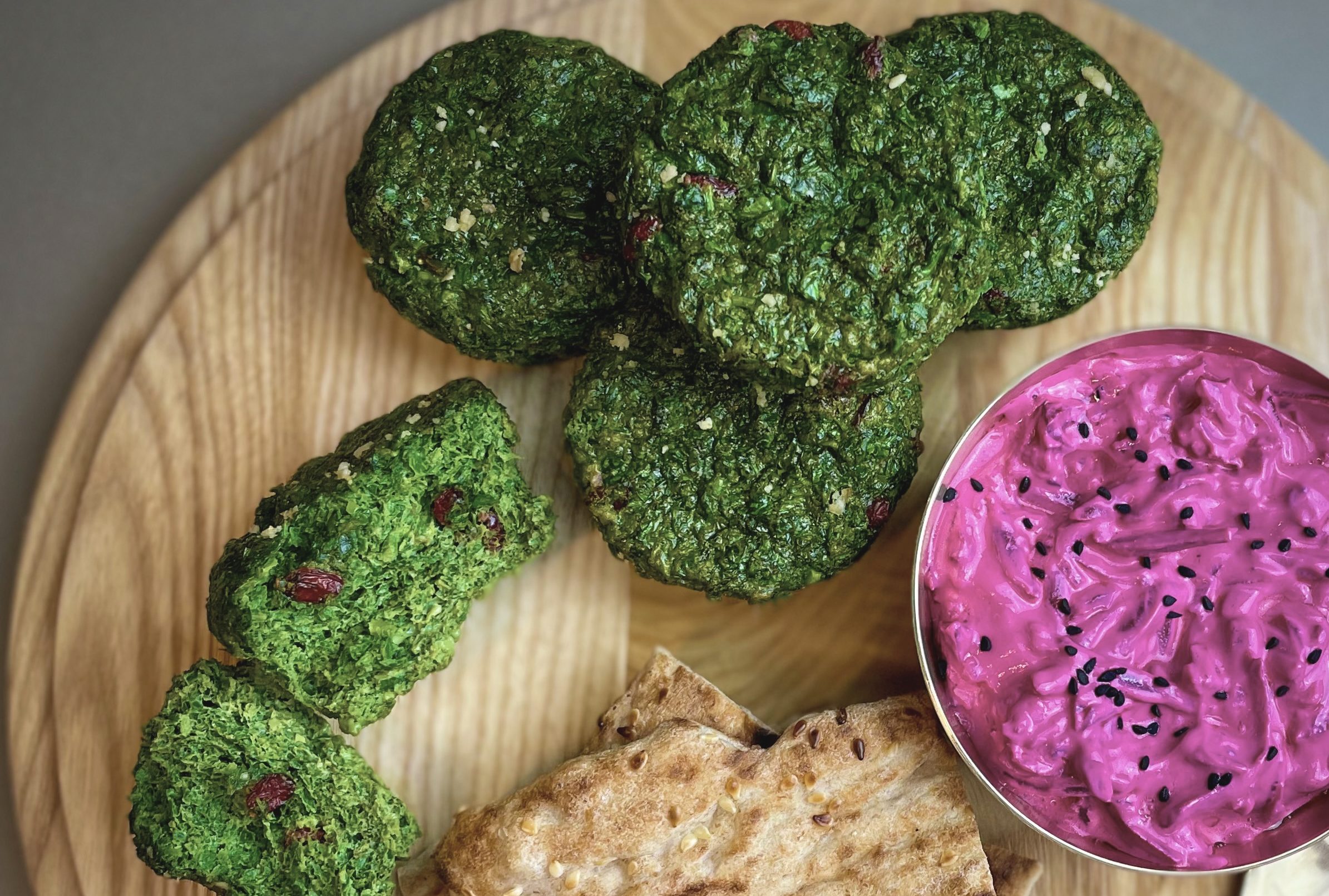

Kuku Sabzi is a frittata-style dish traditionally made with eggs, turmeric, coriander, parsley, dill, chives, barberries and crushed walnuts. It is usually fried and then sliced into triangles. You can serve it either hot or cold as a starter, side dish or a main course. It can be accompanied with bread or rice and either yogurt or salad.
The key difference between a kuku and a frittata is the egg to vegetable ratio, with the kuku favouring the latter.
Kuku Sabzi is eaten during the celebrations for Persian New Year (‘Norooz’). Norooz is the day of the vernal equinox, and marks the beginning of spring in the Northern Hemisphere. It usually falls on 21 March each year. This festival dates back over 3000 years and is rooted in the ancient Persian religion of Zoroastrianism.
It is estimated that Norooz is celebrated by over 300 million people including communities in Afghanistan, the Kurdish regions of Iraq and Turkey, Parsis in India, and their related diaspora around the world.
The herbs in Kuku Sabzi symbolise rebirth, and the eggs symbolise fertility. We serve it alongside Sabzi Polo ba Mahi (Persian herbed rice and fish).
As with the traditional recipe, dried barberries are added to the kuku mixture. This gives a tart burst of flavour from the berries with each bite. You can buy barberries from most Middle-Eastern food shops or, alternatively, buy them online. I also add coarsely ground walnuts to the mixture to give a little crunch to the kuku.
To prepare the herbs, wash them and remove the toughest parts of the stems. There is no need to remove all the leaves from all the stems if you have a food-processor to chop the herbs finely for you. Dill and parsley will require a bit more time removing the tough stems unlike coriander which you can usually chuck in and blitz.
Silicon baking moulds are excellent for baking kuku but if you don’t have any, use a standard muffin tin but make sure you grease and line it properly.
Serve alongside vibrant Beetroot Borani (yoghurt and beetroot dip) as pictured. You can find the recipe for this delicious dip here.
https://www.instagram.com/reel/CbRvGrjI-84/?utm_source=ig_web_copy_link
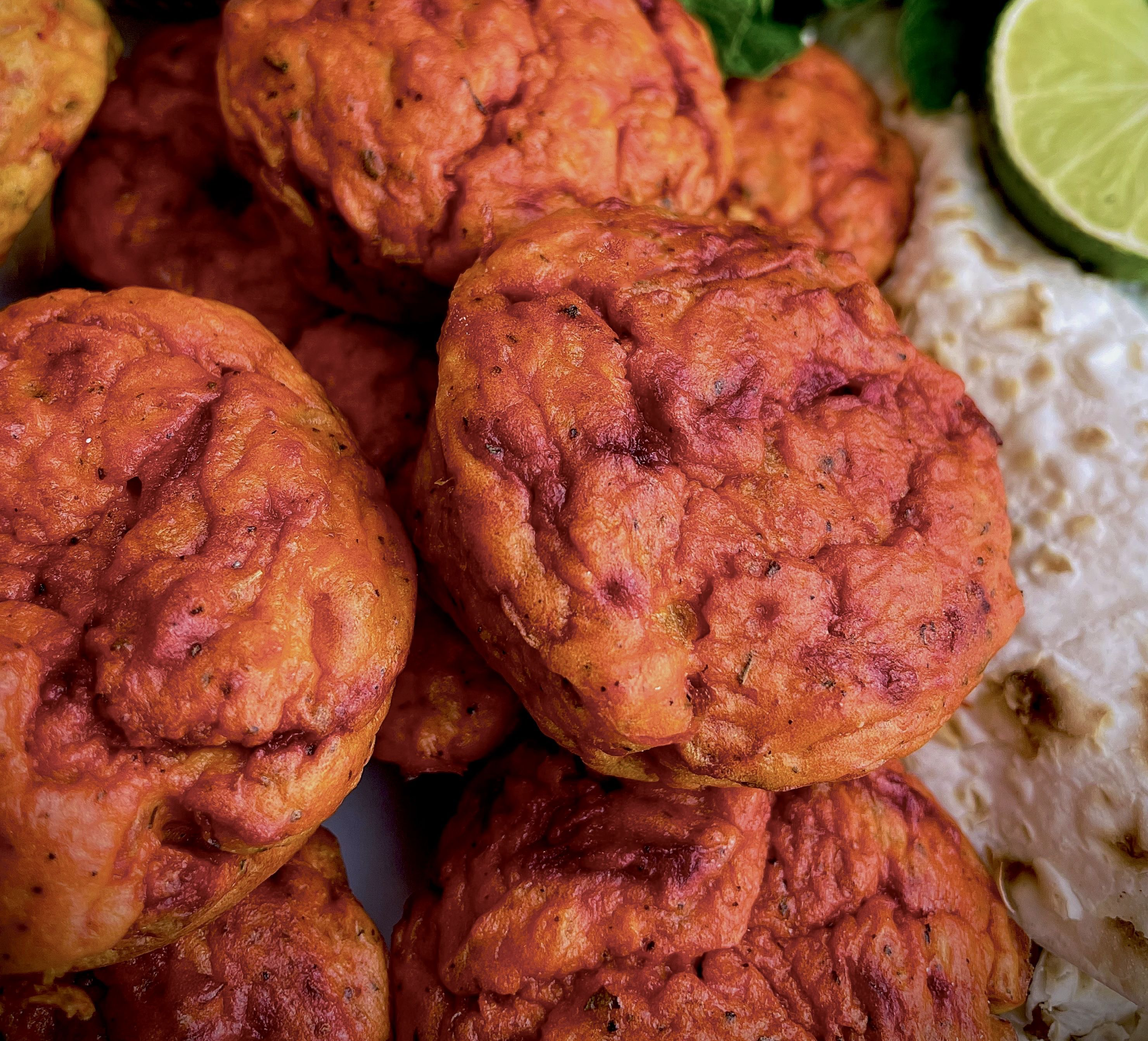

Kuku is a Persian frittata-style dish. Usually vegetarian, it is made with beaten eggs, herbs or vegetables folded in. The main difference between kuku and its western counterparts is the ratio of egg to vegetables, with kuku favouring the latter.
The two most well known kuku recipes are Kuku Sabzi (made with herbs, barberries and walnuts); and Kuku Sibzamini (made with potatoes). We also have Kuku Kadoo (made with courgettes). There are no hard and fast rules about what you should put in your kuku. I have made ones with curried mushrooms; kale and red pepper; cheese and tomatoes; and the list goes on.
The traditional Kuku Sibzamini recipe is made using mashed potatoes, grated onion, turmeric, saffron, dried mint and egg. The mixture is then made into patties and fried.
This recipe is my variation to Kuku Sibzamini. I have added beetroot, garlic and feta to the recipe. The resulting kuku has a vibrant colour and delicious depth to the flavour. I also bake the kuku instead of frying.
Always use fresh and good quality ingredients. Make sure the feta you use is block feta in brine and not crumbled. My favourite brand is Aytac.
It is a great addition to a mezze platter or a sandwich filler. You can serve it either hot or cold; as a starter, side dish or a main course. Serve kuku with flatbread, yoghurt and/or salad. The picture below is one of our kuku platters.


Chicken is slow-cooked in a saffron and turmeric-infused sauce with apricots, sour plums and quince to give an amazing sweet and sour flavour.
This khoresh (stew) is not as well-known as other stews from Iran such as Ghormeh Sabzi (lamb stew with herbs and dried limes) or Fesenjoon (chicken stew with pomegranate molasses and walnuts). This is probably due to the hero ingredient of the stew – quince. Quince is in season between October and January in the UK and during these months I suspect most Iranian households (like my family) will try to cook this dish a few times before the season ends.
Quince is the fruit from a deciduous tree. It has a similar appearance to a pear but the fruit is generally not eaten raw but processed. Many of you may be familiar with quince being used to flavour gin, eaten as a paste with cheese or made into jam.
For those of you new to quince, let me tell you about this lovely fruit. It is a member of the apple and pear family. It has a yellow, lumpy hard flesh with a bitter flavour when raw. Due to the unpalatable flavour when raw, quince is generally consumed after cooking. When cooked, quince becomes soft and dense and develops a sweet, slightly tart flavour with hints of apple, pear, and citrus. Quince can last up to several weeks if stored in a fridge.
The best quince is grown in Esfahan in Iran and unsurprisingly the dish originates from this beautiful city. There are a few variations of this khoresh with some cooking it with lamb; using tomato purée; adding lentils. The recipe I have shared below results in a sweet and sour stunning golden stew, an unusual colour by comparison to the other stews we Iranians cook.
This dish is delightfully easy to cook with minimal preparation. The final dish is comforting and loved by adults and children alike, so it is a great family recipe.
Serve this khoresh with Chelow (Persian steamed rice) and Salad Shirazi. Alternatively, serve it with a parsley mash and steamed green vegetables or just eat it with crusty bread.


It definitely tops my list of Persian comfort foods, reminding me of my childhood and the big family gatherings my mother would host.
Zereshk polo is Persian steamed rice, layered and/or topped with barberries. It is a sweet and sour dish. The barberries are gently sautéed on a low heat with sugar and bloomed saffron water before being added to the rice.
Where rice dishes are referred to as ‘polo’ (pronounced ‘pawlaw’) it usually indicates that the rice has been mixed with some other ingredient. Our plain white rice, served with our kebabs and khoresh (stews) is referred to as ‘chelow.‘ In the case of this dish, barberries are the additional ingredient.
Barberries are edible red berries which grow in the wild in Europe and West Asia. They are rich in vitamin C and tart in flavour. They are called ‘zereshk’ in Persian and are bought and used in their dried form. You can buy zereshk from most Middle-Eastern food shops or online.
‘Morgh’ means ‘chicken’ in Persian and refers to the accompanying protein served with the rice. It is commonly served with poached saffron chicken or chicken stewed in a saffron sauce and either layered through the rice or on the side. Some Persian restaurants serve it with Jujeh Kabab (grilled chunks of chicken, marinated in onion, lemon juice and saffron). Either way, you must be getting a sense that some kind of saffron flavoured chicken complements this sweet and sour rice dish!

My mother and other members of our family would always poach chicken breast and layer it in the zereshk polo. I appreciate now that, when cooked for too long, this cut of meat can be quite dry. My recipe below uses chicken breast but the cooking method ensures it remains juicy. I generally source chicken from a butcher (online or the old-fashioned method of dropping into a local establishment).
For this recipe I bought chicken breasts with the skin left on and a partial wing (the drumette) in tact. I marinate the chicken overnight, pan fry them and then finish it off in the oven as per the recipe instructions below.
You can also eat this rice with saffron stewed chicken (see picture below). I will post a recipe for this in due course, but for now the recipe below is a homage to the dish I grew up with. The recipe below will also result in the delicious crispy rice formed at the bottom of the pot (tahdig). Tahdig adds a lovely crunchy texture to the dish.
Because of the layer of barberries and saffron rice, the key to serving this dish is to spoon the rice out on to a platter (as seen in the pics). The tahdig is usually served separately as a side dish.

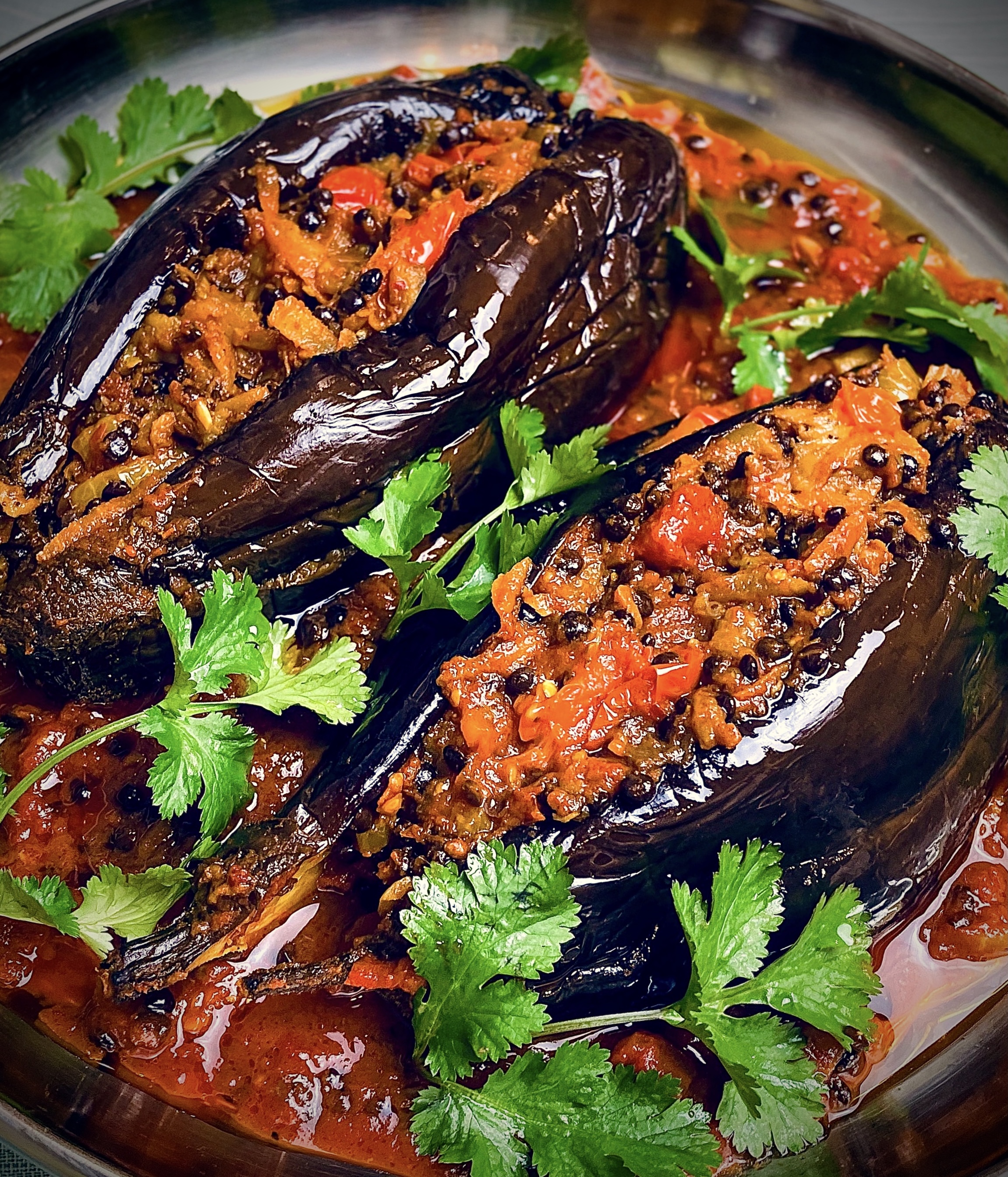

Garni Yarikh comes from the Azerbaijani province of Iran (northwestern Iran bordering Iraq, Turkey, Armenia, and the Republic of Azerbaijan). The region is mostly populated by Azerbaijanis also known as Iranian Azeris, who tend to speak Azerbaijani (a Turkic language) as their first language.
Garni Yarikh translated is ‘torn belly’ with the Persian equivalent being ‘Shekam Pareh’. Traditionally the aubergine is stuffed with a mixture of mince meat and then simmered in a rich and tangy tomato-based sauce. The Turkish version, and where it originates from, is called ‘Karnıyarık.’
The recipe below is a vegan version, as Iranian food can be quite heavy on the meat. Where an opportunity presents itself, I like to adapt a recipe to be plant-based. To make the recipe vegan, I have replaced the mince meat with lentils and added vegetables to the stuffing mixture. You can use any lentils you want. I buy pre-cooked lentils as it reduces the preparation and cooking time.
My go-to lentils for this dish are Merchant Gourmet Beluga Lentils. They absorb the sauce brilliantly and have a lovely texture.
If you have time, I recommend salting and leaving the aubergines for 30 minutes to draw out some of the water. Aubergines can afford to lose a little water pre-cooking but it isn’t an issue if you just want to launch into the recipe as per the steps below.
What to Serve with this Dish
Eat Garni Yarikh with a salad like tabbouleh and hummus on the side. This dish can also be served with rice (kateh or chelow). Also flatbread is a great accompaniment.
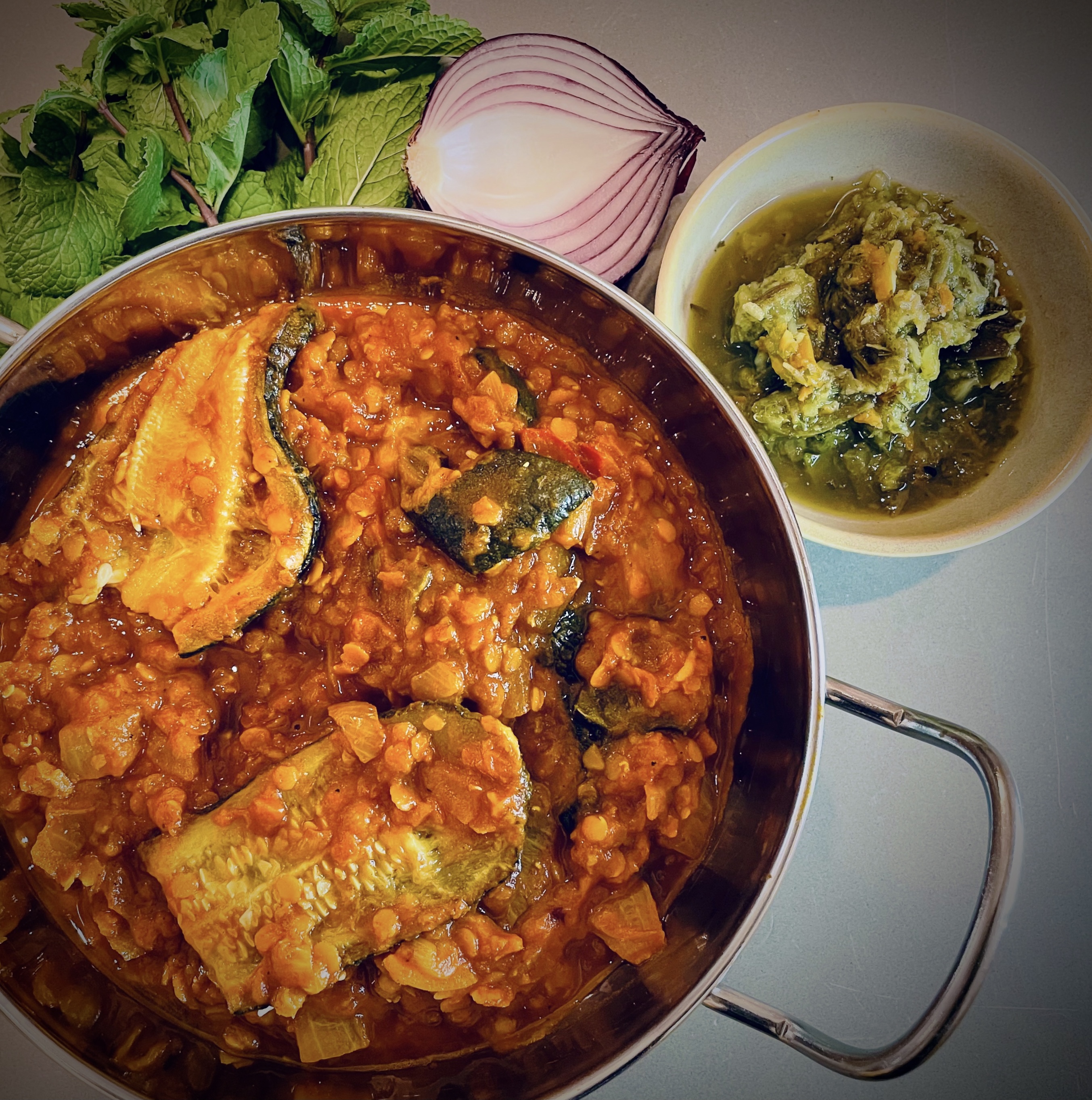
Spicy courgette and red lentil stew
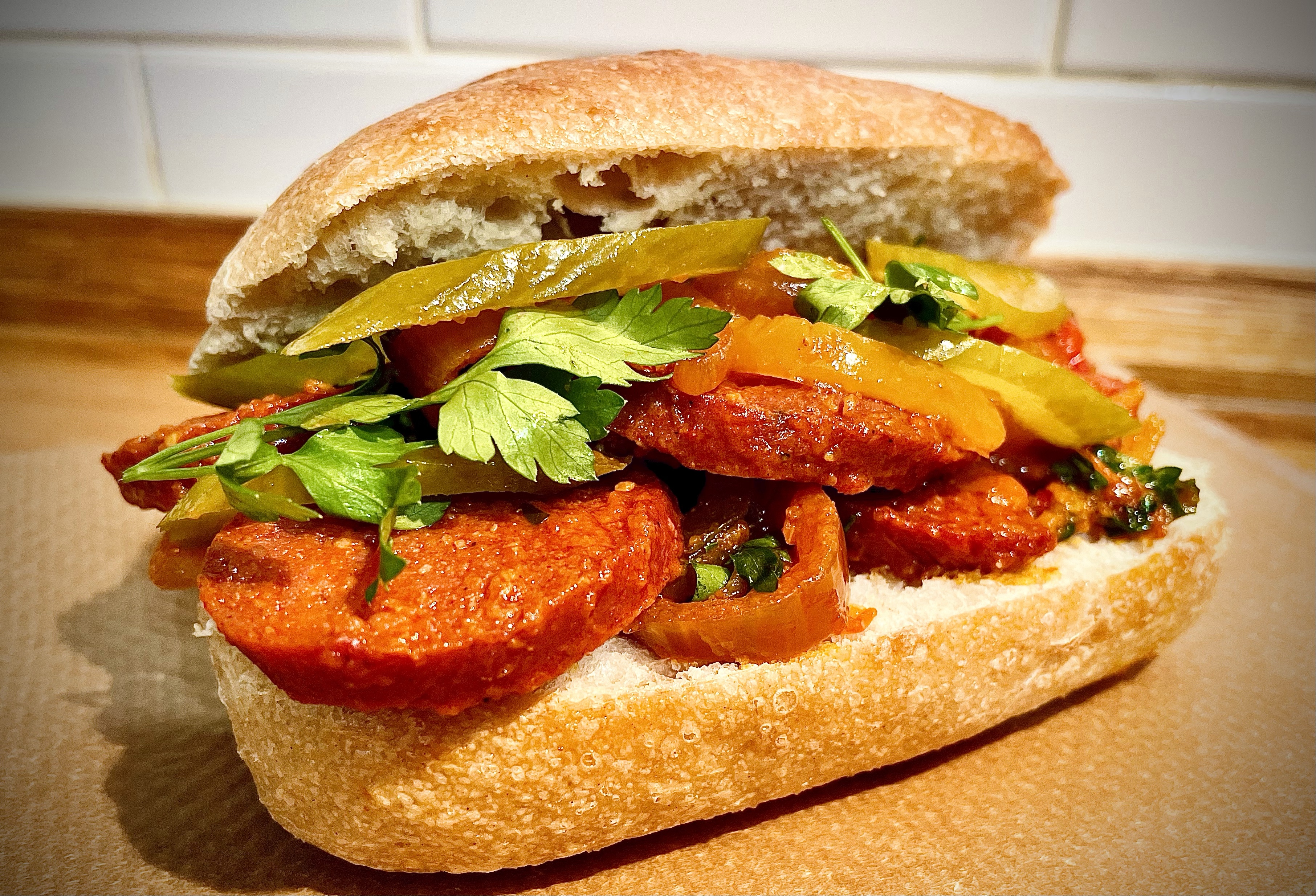

This dish is basically the Persian equivalent of a sausage sandwich! Beef sausages are cooked with onions and peppers in spicy tomato sauce and it is commonly served in a baguette-style bread.
Sosis Bandari translated is sausage from the port or port-style sausage. ‘Sosis’ is the Persian word for sausage, and ‘Bandar’ means port. Apparently this dish was invented in one of the northern ports of Iran, called Bandar Anzali where the first sausages were introduced from Iran (probably from Turkey). However, it became trendy amongst southern port residents, and the dish is now associated with Southern Iran. Iranians who live in the south of Iran mostly eat spicy foods and this dish packs a punch due to their revisions to the original recipe.
I love this dish as it is so easy to cook and, other than the sausage, all other ingredients are available at your local supermarket.
If you are using your local supermarket raw sausages then cook them first (as per the instructions on the packet) before slicing them up and adding to the recipe below.


Traditionally Sosis Bandari includes potatoes in the mixture itself, however my recipe extracts the potatoes and cooks them separately by making them into saffron flavour roasties to be eaten as a side dish and dipped into harissa mayonnaise.

I serve this dish as a sandwich using a rustic roll with a side of saffron roasties. I also love to put pickled cucumbers and some fresh herbs in the Sosis Bandari Sandwich. A cousin of mine recently mooted adding cheese to the sandwich which would also be an excellent addition.
Check out our other recipes:
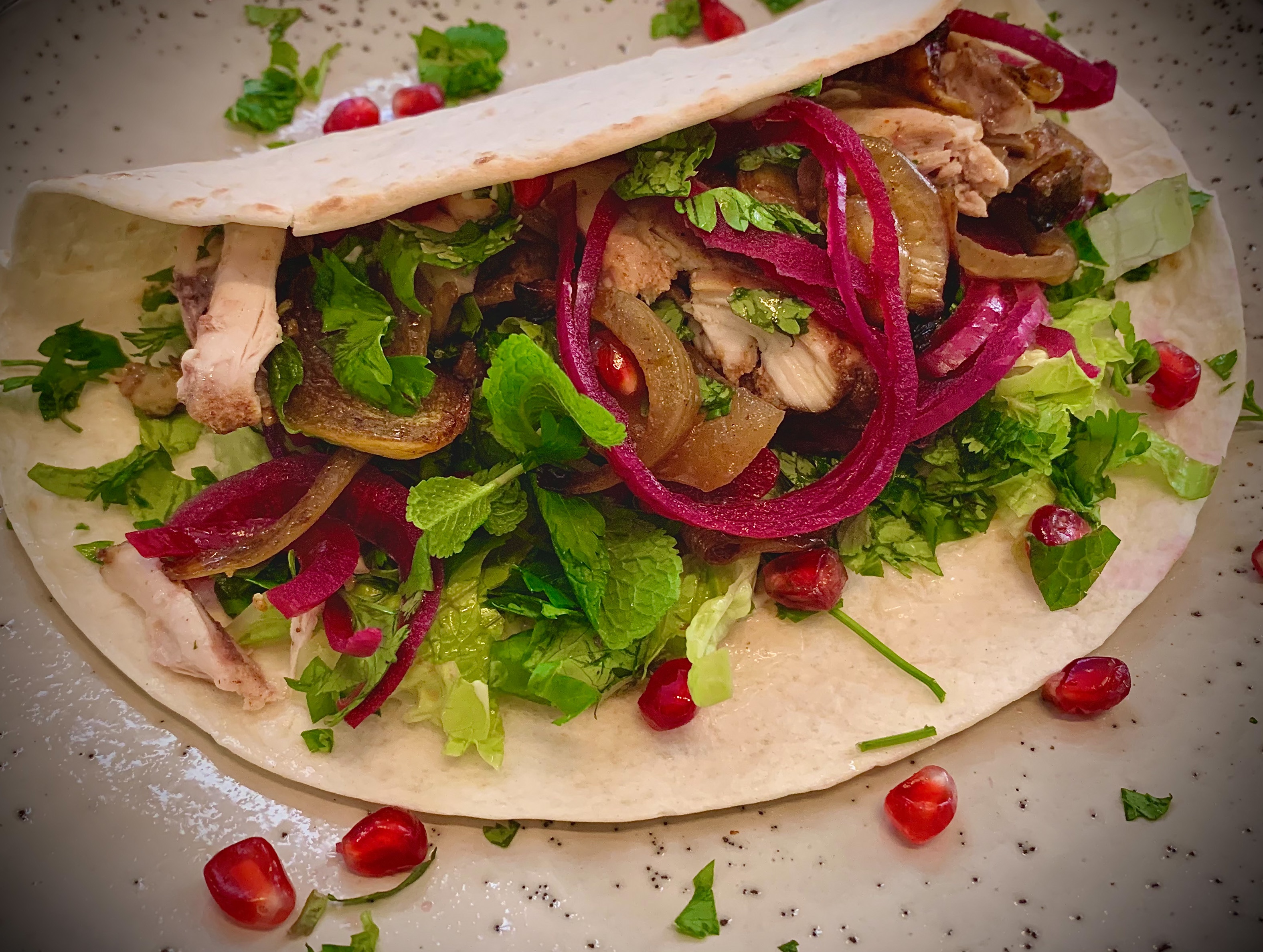

This is an easy recipe and will be familiar territory for you if you have, as most people have these days, cooked and / or eaten some kind of wrap. If not, it is still an easy recipe to follow and worth getting your hands on the two ingredients you may not have to hand – pomegranate molasses and moosir (Persian shallots).

Pomegranate molasses is a thick syrup with a dark grape colour made from reducing pomegranate juice. The juice is obtained from a tart variety of pomegranate. You can pick up pomegranate molasses (rob-e-anar) from most Middle-Eastern food shops, online or even at some local supermarkets.
It is deliciously tart but the addition of maple syrup and freshly squeezed orange juice balances the favours perfectly for this marinade and complements the chicken. As with all marinades, the longer you leave it the better. So if you have time to marinate your chicken overnight (thighs with skin on and bone in preferably) this will allow the chicken to absorb all the delicious flavours.

Moosir is a Persian shallot and has a flavour profile similar to garlic but slightly sweeter and less spicy. They grow wild in the foothills of the Zagros Mountains. They have to be found and dug out of the earth – a similar process to truffles. Commonly used in a yoghurt dip called Maast-o-Moosir, this ingredient adds an amazingly distinctive flavour to dishes. You can buy moosir from most Middle-Eastern food shops or online.
Moosir is bought in its dried form and will need to be rehydrated before use. Soak the moosir in water for 3 to 24 hours. Drain, then rinse in cold water and pat dry. Check the moosir and cut out any stems that remain hard after soaking. I have added the moosir to the mayonnaise for the chicken wraps. Once hydrated, chop the moosir finely and mix with mayonnaise. If you cannot get your hands on this Persian shallot, then you can use garlic. I would recommend steeping the cloves in boiled water before mincing and adding to the mayonnaise to temper the raw garlic.
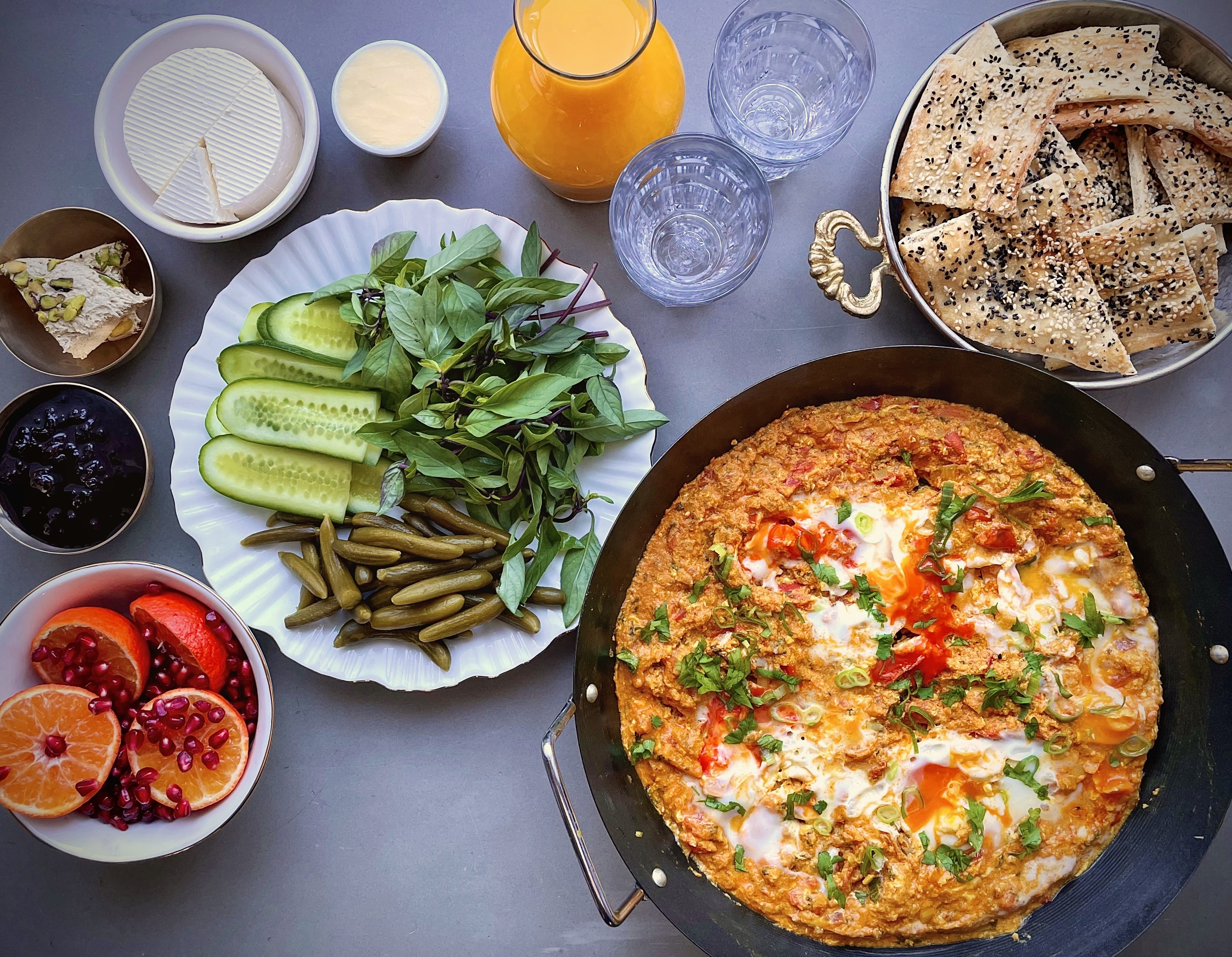

Omelette Gojeh Farangi is made by cooking eggs in a rich tomato sauce. The sauce is flavoured with aromatics and spices – garlic, cumin, turmeric and chilli. The tomato to egg ratio is quite high so the resulting texture is creamy.
It is usually eaten at breakfast or as a brunch option but can also be eaten as a lunch or dinner option.
Serve this dish with flatbread; feta; a sprinkle of fresh herbs, such as coriander or parsley; and Persian pickled cucumbers for an authentic Persian breakfast experience. You can also eat it with rice or chips when serving it at lunch or dinner.

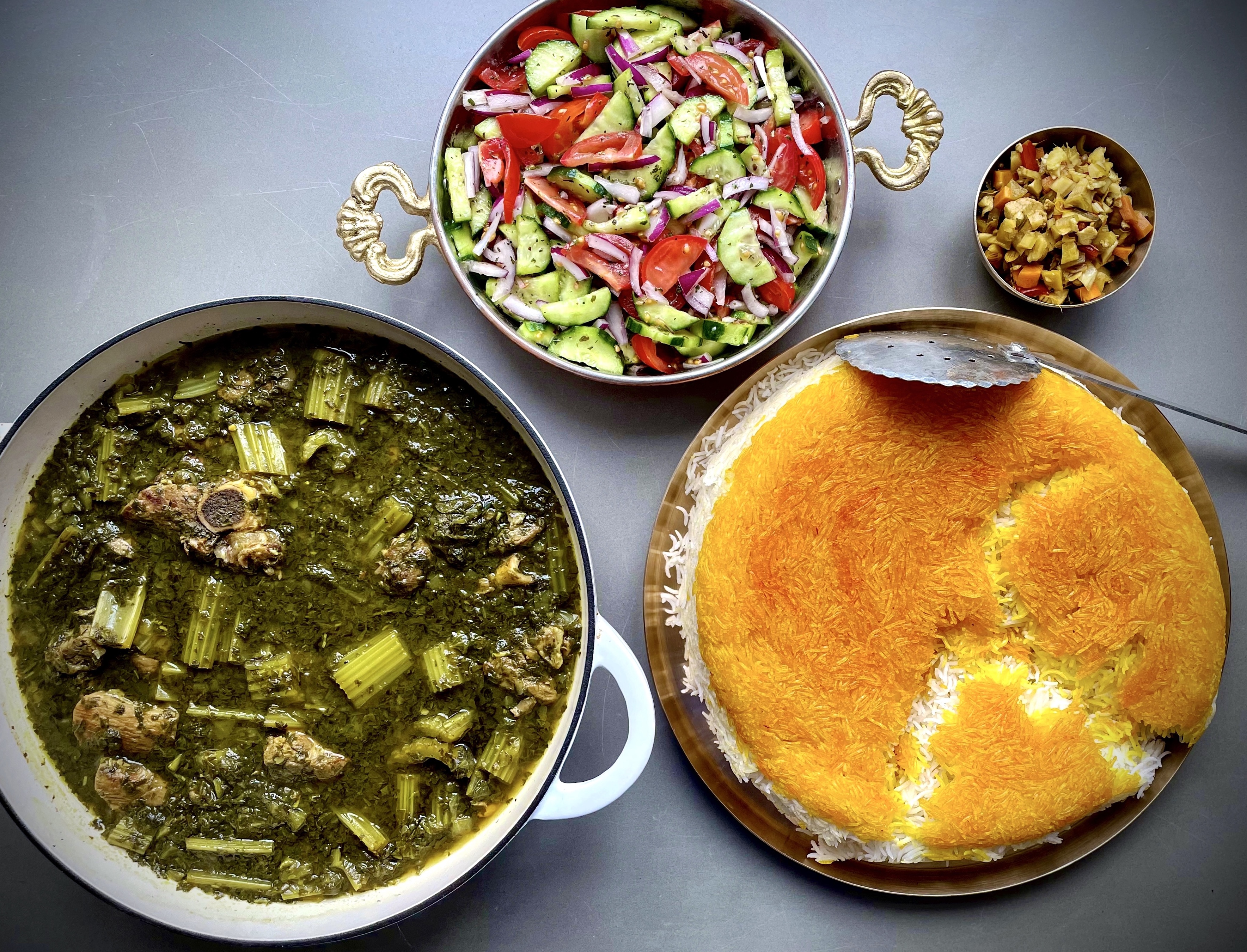

Winter is the season of stews and Khoresh Karafs is a lovely introduction if you are new to Persian cuisine. Persian stews are relatively low maintenance to cook. They just need time to cook and for the flavours to fall into place.
Khoresh Karafs is a Persian stew made with lamb, celery and fresh herbs (mint and parsley). ‘Karafs’ translated from Persian is ‘celery.’ And ‘Khoresh’ means ‘stew.’
We have two versions of Khoresh Karafs. The first one, the subject of this recipe and the better known version, is cooked with herbs. The second one is cooked with tomatoes and usually chicken. We refer to them by their colour: Khoresh Karafs-e-Sabz (‘sabz’ means green in Farsi); and Khoresh Karafs-e-Ghermez (‘ghermez’ means red in Farsi).
The ingredients for this khoresh (stew) are simple and easy to source with most items available at your local supermarket.
As with all Persian stews, the flavour continues to mature and intensify if you leave it for a day before you reheat and serve. This is, therefore, a dish you can make on a Sunday evening and tuck into later in the week reducing the time spent in the kitchen and washing up afterwards. Serve it with Persian rice – Chelow and a lime dressed chopped salad like Salad Shirazi.
Store in an airtight container in the fridge up to 3 days. Khoresh Karafs can also be frozen up to 4 months. Defrost thoroughly before reheating. Gently reheat khoresh in a saucepan or in a microwave.


If you have eaten at a Persian restaurant, then you will be familiar with Kabab Koobideh. The long metal skewers of minced lamb cooked to juicy perfection over a charcoal flame. Kabab Tabei is the easy version, cooked in a pan with no skewers required, and accompanied with a side of roasted tomatoes.
With the exception of saffron, the ingredients should be easy to source from your local supermarket.
Saffron can be found in most supermarkets nowadays. Remember to always grind the saffron strands to a fine powder after purchase because it makes the saffron go further. Bloom the amount of ground saffron directed in this recipe in water before adding to the Kabab Tabei mixture.
Serve with Kateh or Chelo (Persian rice) and Salad Shirazi as pictured. They can also be eaten with flatbreads, salad, chilli and garlic sauce with a side of chips as part of a fake-away style meal!
https://www.instagram.com/reel/Chh2YZgIPR0/?utm_source=ig_web_copy_link


I love a classic roast. Being born and raised in the UK, the Sunday roast is of course a recognised and loved tradition in my household. However, I don’t always love the amount of work and washing up involved. So this is my alternative to the traditional Sunday Roast resulting in less chaos in the kitchen!
There are two elements to this recipe: (1) the slow roast chicken; and (2) the vegetable stew topped with herb and cheese dumplings.
A whole chicken is placed in a roasting pan with lemons and herbs such as thyme, rosemary and sage. The chicken is rubbed with garlic butter and drizzled with olive oil. It is then slow roasted to juicy perfection for 3 hrs in the oven.

Vegetables (potatoes, carrots, parsnips, leeks, mushrooms and broccoli) are cooked in one pot. The cooking liquid is a white wine and herb infused gravy. Fluffy dumplings made with parmesan and parsley are made and popped on the top to cook.

For presentation purposes, serve in the dishes you have cooked the chicken, stew and dumplings in with a side of cranberry sauce.
For serving individual portions, ladle some of the stew and dumplings onto each person’s dish. Carve the chicken and add. Serve with a dollop of cranberry sauce on the side.
This recipe is comfort food at its best!
Once fully cooled, store leftovers in an airtight container in the fridge up to 3 days. Reheat in a medium heated oven or in a microwave.
Check out some of my other comforting recipes to serve as Sunday lunch.